


Graphene Concrete vs. Nevada’s 115°F Desert Heat: A Performance Guide
How Graphene Concrete Survives Nevada’s Extreme Desert Heat (115°F+ Performance Guide)
You know that shimmer you see rising off the asphalt on a Nevada highway in July? That’s not just a mirage. That’s heat doing real, measurable damage to the road surface underneath it.
Nevada is one of the most brutal environments on earth for infrastructure materials. Las Vegas regularly hits 115°F. The Mojave regions push even further. And it’s not just the peak temperature — it’s the daily thermal swing. Nights in the desert can drop 40-50 degrees from the afternoon high. Every single day, the pavement expands in the heat and contracts in the cool. Do that thousands of times over a road’s service life, and you’re not dealing with wear — you’re dealing with structural fatigue.
Conventional concrete handles this… okay. Not great. The expansion-contraction cycle opens microcracks. Those cracks become entry points for dust, water during flash floods, and the UV radiation that degrades binding materials over time. The result is the familiar Nevada highway experience: rough seams, patched surfaces, sections that look like they aged 20 years in 10.
There’s a better option — and if you’re curious what graphene concrete actually does in Nevada’s extreme desert heat conditions, this guide walks through the real performance picture. No hype. Just what the material science says about how graphene-enhanced concrete behaves when the temperature gauge reads 115 and climbing.
What You Need to Understand Before We Get Into It
A quick orientation, because context matters here.
Nevada isn’t one climate. Las Vegas and Henderson are extreme desert. Reno and the Carson City area have high desert conditions — still hot, but with more elevation and slightly different thermal profiles. The I-15 corridor from the California border through Las Vegas is probably the most demanding sustained heat environment for highway pavement in the continental US. These aren’t the same challenge, but graphene concrete addresses both.
Concrete fails in heat differently than it fails in cold. In Ohio or Minnesota, freeze-thaw cycling is the main villain — water infiltrates, freezes, expands, fractures. In Nevada, the primary stressors are thermal expansion and contraction, alkali-silica reactivity (a chemical degradation process that’s accelerated by heat), UV degradation of surface binders, and the flash-flood moisture cycles that periodically dump water on already-stressed pavement. Understanding how the failure happens is how you understand why graphene concrete helps.
Graphene concrete isn’t magic. I want to be clear about that going in. It’s a material improvement — a significant one — but it doesn’t make pavement immortal. What it does is extend service life meaningfully by addressing several failure mechanisms that conventional concrete can’t handle as well. In Nevada’s environment, that improvement is particularly valuable because the failure rate of conventional concrete is particularly high.
[IMAGE: Temperature gradient diagram showing a Nevada highway cross-section in July — surface temperature at 155°F+ (black asphalt absorbs more; concrete runs about 140-150°F), air temperature at 115°F, and subsurface temperature gradient showing how heat penetrates the slab]
Step 1: Understand What Desert Heat Actually Does to Concrete
Here’s the thing about extreme heat and pavement — the damage isn’t just from the temperature itself. It’s from everything the temperature enables and accelerates.
Thermal expansion and contraction fatigue. Concrete expands when hot and contracts when cool. Standard concrete has a coefficient of thermal expansion — basically, how much it moves per degree — that’s well understood. But in Nevada’s daily 40-50°F swing, that expansion and contraction is extreme by comparison to most climates. Over time, the repeated movement fatigues the material. Joints open. Microcracks form. The surface begins to show the stress.
Alkali-silica reaction (ASR). This is a chemical process that happens inside concrete — alkalis in the cement paste react with certain silica minerals in the aggregate. The reaction produces a gel that absorbs water and expands, causing internal pressure that cracks the concrete from within. Heat accelerates ASR significantly. Nevada’s aggregate sources often contain reactive silica minerals, making ASR a legitimate concern that’s often underappreciated.
Flash flood moisture cycles. Nevada’s desert gets less total precipitation than most places, but when it rains, it often comes hard and fast. Water hitting already-hot pavement creates rapid thermal shock. It also exploits whatever cracks and joints have opened from thermal cycling, infiltrating the slab and leaving mineral deposits as it evaporates. Over time, this cycle compounds the damage from other mechanisms.
UV radiation. At Nevada’s elevation and latitude, UV exposure is intense. Surface binders and sealants degrade under sustained UV. The top layer of pavement gradually loses its cohesion, making the surface more porous and more vulnerable to the other damage mechanisms.
The compounding effect of all four is why Nevada highways look the way they do. Graphene concrete for Nevada’s desert highway environment addresses each of these differently — and that’s what makes it worth understanding.
Step 2: See How Graphene Concrete’s Properties Map to Nevada’s Challenges
This is where the material science connects to the real-world problem. Let’s go through it directly.
On thermal fatigue: Graphene concrete’s improved tensile strength — how well it resists being pulled or stretched — directly improves its ability to handle the daily expansion-contraction cycle without developing fatigue cracks. The graphene fibers within the cement matrix distribute thermal stress more evenly, so instead of concentrating at weak points (which is where cracks start), the stress spreads across a larger area. The result is a material that tolerates the thermal cycling better and maintains its integrity through more cycles before showing distress.
On ASR: Graphene concrete’s denser microstructure reduces the moisture availability within the slab that ASR requires to progress. The gel that ASR produces needs water to expand — reducing the internal moisture environment slows the reaction even when reactive aggregates are present. It’s not a complete prevention, but meaningful mitigation.
On flash flood infiltration: Graphene concrete’s reduced water absorption — typically 40-50% lower than conventional mixes — means that when the monsoon rain hits hot pavement, less water finds its way into the slab. Less infiltration means less mineral deposition, less joint saturation, and less of the freeze-thaw-adjacent damage that can occur even in desert climates when moisture and temperature swings combine.
On UV exposure: Graphene’s effect here is indirect. A denser, harder surface is more resistant to the surface erosion that makes conventional concrete progressively more porous under UV exposure. It’s not that graphene is UV-resistant in the way a coating might be — it’s that the surface maintains its integrity longer, keeping the protective top layer intact.
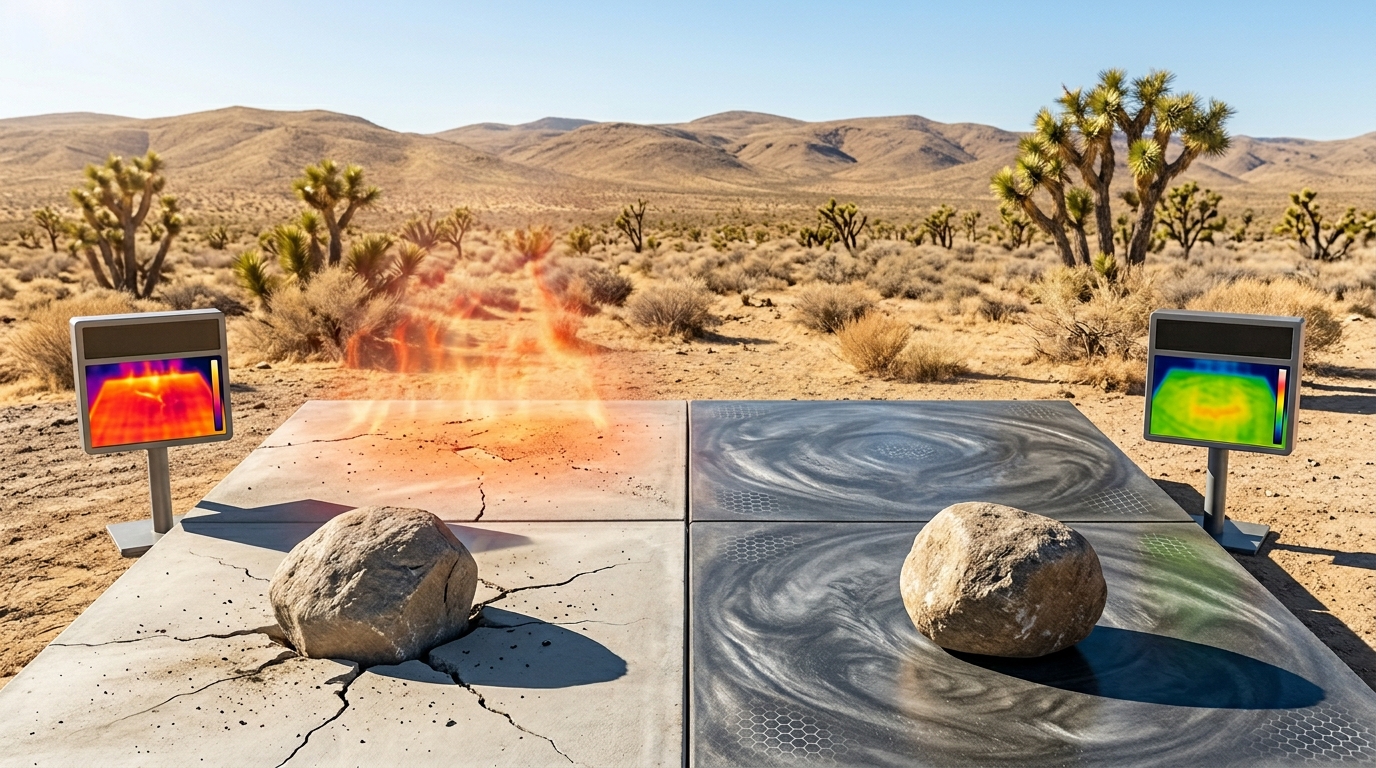
[IMAGE: Side-by-side road surface comparison — conventional concrete showing thermal cracking, joint deterioration, and surface erosion after 10 years of Nevada desert exposure vs. graphene concrete cross-section showing maintained density and surface integrity under same conditions]
Step 3: Understand the Construction Realities in Extreme Heat
This one matters practically, and it doesn’t get talked about enough.
Pouring concrete in Nevada summer heat is genuinely difficult with conventional materials. Fresh concrete needs to cure — a chemical process that requires the right moisture and temperature conditions. In 115°F ambient temperatures, concrete can lose moisture too fast during curing, which weakens the final product. The concrete industry has developed protocols for hot-weather concreting: ice in the mix water, chilled aggregates, placement timing in cooler hours, curing blankets, accelerated finishing. All of this adds cost and complexity.
Graphene concrete works with the same hot-weather concreting protocols. It doesn’t require new equipment or radically different methods. But here’s something worth knowing: the denser microstructure of graphene concrete means that once it’s properly placed and cured, the resulting material is less sensitive to minor variations in curing quality. Conventional concrete that’s slightly under-cured in extreme heat might end up with a surface that’s weaker than spec. Graphene concrete, with its superior molecular structure, has more margin for the real-world conditions of desert construction.
Practical tip for understanding project specifications: If you’re evaluating a graphene concrete project in Nevada, ask about the mix design’s water-to-cement ratio and how the graphene dispersion is verified. These two factors — along with hot-weather curing procedures — are where the quality of the final product is actually determined. A well-designed graphene mix improperly placed in extreme heat isn’t going to deliver the full performance benefit.
Step 4: Look at a Real Nevada Corridor Scenario
Let’s make this tangible. Take I-15 between the California border and Las Vegas.
This stretch carries some of the highest truck traffic in the Southwest. It’s exposed to peak desert temperatures for months at a stretch. It’s been resurfaced and patched repeatedly. And it’s critical infrastructure — this is the primary supply corridor for Las Vegas, which means any extended closure or capacity reduction has immediate economic consequences for hotels, casinos, distribution centers, and millions of visitors.
Under conventional concrete specifications, major rehabilitation on a high-traffic segment like this might be required every 12-15 years, with significant patching and joint maintenance in between. That means lane closures, traffic management, construction zone hazards, and logistics disruption — regularly.
With graphene concrete deployed on Nevada’s I-15 corridor, the expected service life extends to 25-30+ years. The same improved-material arguments that apply elsewhere — fewer rehabilitation cycles, lower total lifecycle cost — apply here, but with the additional benefit that every avoided construction project on I-15 also avoids disrupting one of the most economically sensitive road corridors in the region.
The math isn’t complicated. One fewer major rehabilitation over a 30-year period, on a corridor this busy, represents enormous savings in both direct cost and economic disruption.
[IMAGE: Illustration of the I-15 Nevada corridor from Baker, CA to Las Vegas, showing peak temperature zones, freight traffic volume indicators, and the economic destinations — resorts, distribution centers, airport — that depend on corridor reliability]
Troubleshooting: Honest Answers to Real Questions
“Isn’t graphene expensive? How does this pencil out?”
Yes, graphene concrete carries a higher upfront cost per cubic yard — that’s just true. But the lifecycle calculation is what matters for infrastructure. If a conventional concrete section costs $X to build and requires two major rehabilitations over 30 years, while graphene concrete costs $1.2X to build and needs one, you need to do the full math including construction, traffic management, and economic disruption costs. In Nevada’s high-traffic, high-economic-sensitivity environment, the lifecycle math increasingly favors graphene. Costs are also falling as graphene production scales — this is a moving target.
“Does graphene concrete actually hold up to 115°F+ surface temperatures?”
The surface temperature of concrete in direct Nevada sun can reach 150°F or above — significantly hotter than air temperature. Graphene concrete’s performance in these conditions is supported by the material science (improved thermal stress distribution, reduced porosity, better fatigue resistance) and by real-world testing data from high-temperature environments. The performance claims aren’t theoretical — they reflect what the material actually does under thermal stress.
“What about the aggregate compatibility question?”
This is a smart question. Graphene concrete’s performance partly depends on how well the graphene disperses within the specific mix design, which includes the local aggregate. Nevada’s regional aggregate sources have their own mineral profiles. Quality mix design in Nevada needs to account for local aggregate characteristics — including ASR potential — when specifying a graphene-enhanced mix. Working with suppliers who understand regional materials is important.
“Can existing Nevada DOT contractors use this material?”
Yes. Graphene concrete uses the same placement and finishing equipment as conventional concrete. The main process adjustment is verifying graphene dispersion in the batch, which is quality control, not a new construction method. Nevada-licensed concrete contractors familiar with hot-weather concreting protocols are positioned to work with graphene concrete without significant retraining.
Expert Tips: What the Pros Pay Attention To
Mix design is everything. Graphene concrete in Nevada isn’t one product — it’s a range of formulations. The graphene concentration, the cement type, the water-to-cement ratio, and the admixture package all interact to determine real-world performance. An experienced materials engineer specifying for Nevada conditions will look at all of these together, not just graphene content in isolation.
Time your pours. Hot-weather concreting in Nevada means night pours or early morning placements for large sections. This isn’t new — experienced Nevada contractors already do this with conventional concrete. But the curing quality matters even more with graphene concrete, since a properly cured graphene mix significantly outperforms a poorly cured one. Don’t let schedule pressure compromise the curing conditions.
Track surface temperature, not just air temperature. On a black or dark concrete surface in July Nevada sun, the surface temperature can run 30-40°F above air temperature. When evaluating performance specs or troubleshooting distress, the actual surface temperature exposure matters more than the weather station reading. Design and monitoring should use surface temperature data where available.
Pilot projects are your real data. Lab performance data is essential for specification confidence. But the performance data that really moves procurement decisions is real-world pilot project results on comparable corridors in comparable climates. Arizona, Southern California, and Texas have heat-environment pilot data worth referencing. Nevada-specific pilot data would be the most compelling — and the sooner it exists, the faster broader adoption can happen.
Summary: What This Means for Nevada Roads
Nevada’s extreme desert heat — the 115°F days, the 50°F daily swings, the UV intensity, the flash-flood moisture cycles — creates a pavement environment that pushes conventional concrete past its comfortable performance range. Repeatedly. Year after year.
Graphene-enhanced concrete addresses Nevada’s specific failure mechanisms directly: improved tensile strength for thermal fatigue resistance, reduced porosity for moisture infiltration and ASR mitigation, and a denser surface that maintains integrity under sustained UV exposure. The construction compatibility is real — existing equipment, familiar methods, Nevada-licensed contractors.
The lifecycle economics are compelling in Nevada’s high-traffic, high-economic-sensitivity corridors. Every avoided rehabilitation on I-15 or US-95 is not just a cost saving — it’s avoided disruption to the logistics and tourism economy that defines the state.
The practical next steps:
- Follow Nevada DOT materials updates for any graphene concrete pilot project announcements on high-traffic corridors
- Understand the lifecycle cost argument — it’s the most durable case for graphene concrete adoption in budget discussions
- Look at neighboring state data — Arizona and California heat-environment pilot projects provide the closest available real-world comparison data while Nevada develops its own
If you want to go deeper on what graphene concrete means specifically for Nevada’s highway construction environment, that’s exactly where to start. The desert isn’t going to get less extreme. The question is whether the roads we’re building are designed to handle what’s actually coming at them.
The full picture of graphene concrete’s application to Nevada’s road network — including specific corridor opportunities and technical specifications — is worth exploring in detail. The material is ready for the heat.