

Graphene Concrete: Built for Wyoming’s 200,000 lb Wind Turbine Loads
Graphene Concrete: Built for Wyoming’s 200,000 lb Wind Turbine Loads
Here’s something most people don’t think about when they see a wind turbine: getting that massive machine there in the first place.
Those blades alone can stretch 200 feet. The nacelle — that housing at the top — can weigh 300,000 lbs. And to install any of it, you need roads. Not regular roads. Roads that can handle haul trucks and transport vehicles pushing 200,000 lbs or more, across terrain that Wyoming is very good at throwing its worst at — freeze-thaw cycles, subzero temps, wind erosion, and spring mud season that turns access routes into soup.
Standard concrete? It doesn’t always make it. That’s where graphene concrete is changing the whole conversation.
If you’re a homeowner in Wyoming, this might feel like big-picture infrastructure news. But stay with me — because what’s being figured out on these wind farm access roads has real implications for driveways, foundations, and any concrete work on your property. The technology trickling down from these projects is worth understanding.
What You’re Actually Dealing With Here
Before we get into the how-to side of things, let’s just be honest about the scale of the problem.
A typical residential concrete driveway is engineered for maybe 8,000–10,000 lbs. A semi-truck with a full load pushes 80,000 lbs. Wind turbine transport rigs? They can hit two, three times that — with axle loads distributed across specialized multi-axle trailers, but still putting enormous, repeated stress on road surfaces mile after mile.
Wyoming’s climate doesn’t help. Temperatures can swing 80 degrees in a single day during shoulder seasons. Water gets into micro-cracks in traditional concrete, freezes, expands, and those cracks become failures. Add repeated heavy loads on top of that freeze-thaw cycle and you’re looking at road surfaces that deteriorate fast — which means expensive maintenance, project delays, and sometimes complete rebuilds.
The old answer was: use more concrete, make it thicker, add more rebar. That works, kind of. But it’s expensive, time-consuming, and still doesn’t fully solve the cracking problem.
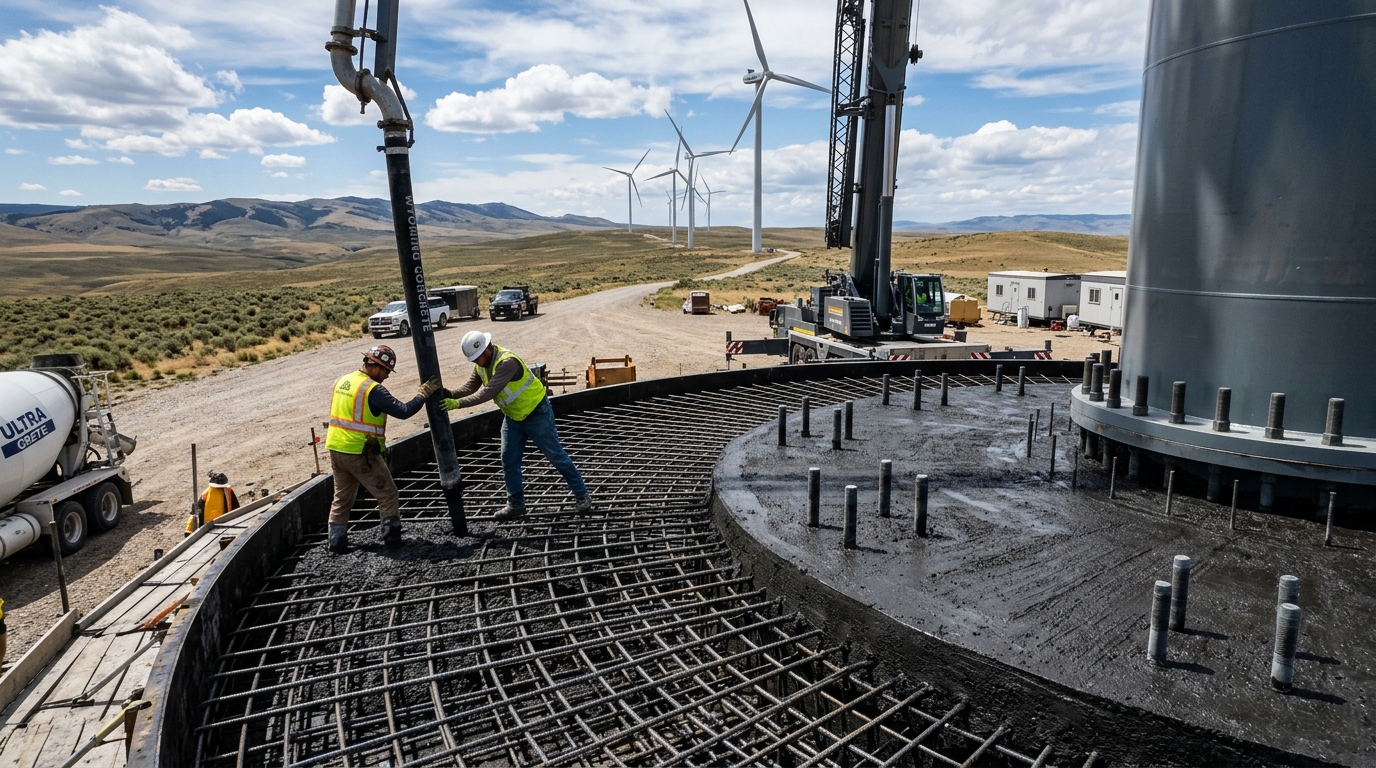
[IMAGE: Wide-angle shot of a Wyoming wind farm access road under construction, showing the scale of the terrain and the road width required for oversized turbine transport loads]
What Makes Graphene Concrete Different
Graphene is a single layer of carbon atoms arranged in a hexagonal lattice. It’s the strongest material ever tested — about 200 times stronger than steel, at a fraction of the weight. When it’s mixed into concrete at the right concentration (we’re talking tiny amounts — a fraction of a percent by weight), something remarkable happens.
The graphene flakes distribute through the concrete matrix and essentially act as a reinforcement web at the microscopic level. Cracks that would normally propagate through standard concrete hit these graphene barriers and… stop, or reroute, or slow dramatically.
The practical results are significant:
- Compressive strength increases of 25–30% compared to standard mixes
- Flexural strength (resistance to bending and cracking under load) can improve by 30–40%
- Reduced permeability, meaning less water infiltration — which is huge for freeze-thaw performance in Wyoming winters
- Potential to achieve equivalent strength with less material, reducing overall concrete volume needed
For wind farm access roads handling 200,000 lb loads, that’s not just an incremental improvement. That’s the difference between a road that lasts 20 years and one that needs major rehabilitation every 5–7 years.
You can dig deeper into how graphene concrete is reshaping roadway and highway construction in Wyoming — there’s a lot more going on than just the wind energy sector.
Step 1: Assess the Load Requirements and Site Conditions
Before any concrete gets poured on a wind farm access road, there’s a real engineering assessment that happens. Here’s what that looks like — and why it matters even at smaller scales.
What’s being evaluated:
The project team maps out the actual transport route and calculates the maximum axle loads and total gross vehicle weights for the specific turbine components being delivered. Different turbine models have different specs. A 3 MW turbine has a very different transport load profile than a 5 MW or 8 MW unit.
Then the site conditions: soil bearing capacity, drainage patterns, typical frost depth (in Wyoming, that can be 3–4 feet in some areas), and historical weather data.
Why this step matters for homeowners: If you’re having a driveway or foundation poured, the same principle applies — knowing what you’re actually asking the concrete to do. A decorative walkway and a pad for heavy equipment are not the same project, even if they look similar.
Pro tip: If you’re in a rural Wyoming area near wind energy development, your property may actually experience some of the same access route traffic. Worth knowing what was — or wasn’t — done to roads near your property.
Step 2: Choose the Right Graphene Concrete Mix Design
This is where the engineering gets specific. Not all graphene concrete is the same — the mix design has to match the application.
For heavy-load access roads in Wyoming, the mix typically targets:
Base concrete strength: Usually a starting point of 4,000–5,000 psi compressive strength (standard road concrete is often 3,000–4,000 psi)
Graphene addition: The concentration matters a lot. Too little and you’re not getting meaningful reinforcement. Too much and you can run into dispersion problems where the graphene clumps rather than distributes evenly. Current best practice is working with suppliers who have proven dispersion technologies — getting graphene uniformly distributed in a wet concrete mix is harder than it sounds.
Air entrainment: This is critical for Wyoming specifically. Entrained air bubbles give the concrete room to accommodate freeze-thaw expansion without cracking. Graphene concrete needs this too — the two technologies work together, not in opposition.
Fiber reinforcement: Some projects combine graphene with macro or micro synthetic fibers for additional crack resistance. Think of it as layered defense.
[IMAGE: Close-up of graphene-enhanced concrete mix showing the texture and consistency, alongside a comparison sample of standard concrete]
Step 3: Prepare the Subgrade Properly
Here’s a thing contractors sometimes rush: subgrade prep. And with graphene concrete — or any high-performance concrete — it matters even more, not less.
If the base under the road isn’t stable, even the strongest concrete on earth will crack and fail. Physics doesn’t care about your material specs if the ground underneath is moving.
For wind farm access roads, this means:
- Geotextile fabric installation to separate subgrade soil from aggregate base
- Proper aggregate base depth (often 12–18 inches for heavy-haul routes)
- Compaction testing — not just assuming, actually measuring
- Drainage provisions so water doesn’t pool under the slab
Wyoming’s clay-heavy soils in many areas are particularly prone to heaving and settlement. Getting this step right isn’t optional.
Step 4: Pour, Finish, and Cure — With Wyoming’s Climate in Mind
Pouring concrete in Wyoming is… an adventure. Hot, dry summers mean concrete can lose moisture too fast and cure unevenly. Shoulder seasons bring temperature swings that can freeze fresh concrete before it reaches adequate strength.
For graphene concrete on wind farm roads:
Timing: Avoid pouring when temperatures will drop below 40°F within the first 24–48 hours without cold-weather protection measures. Seriously.
Curing: Graphene concrete benefits from extended moist curing — minimum 7 days, ideally 14. This means curing compounds, wet burlap, or poly sheeting. The graphene reinforcement network achieves more of its potential when the hydration process completes properly.
Joints: Control joints need to be planned and cut correctly. Even the best concrete needs somewhere to accommodate dimensional changes. Joints don’t weaken the road — improperly placed joints (or none at all) do.
[IMAGE: Wind farm access road showing properly formed concrete panels with visible control joints, in a Wyoming landscape with turbines visible in the background]
Common Problems (And What Actually Causes Them)
“The concrete cracked anyway” — Almost always a curing issue, subgrade problem, or insufficient joint spacing. Graphene improves crack resistance; it doesn’t eliminate the need for proper technique.
“The road is pumping under load” — That’s a subgrade failure, not a concrete failure. No surface material fixes a bad base.
“Surface scaling in winter” — Often caused by deicing salts combined with inadequate air entrainment. In Wyoming, if you’re using any deicing chemicals, the concrete mix needs to account for that from day one.
“The graphene concrete cost more and I’m not sure it was worth it” — This is a lifecycle cost question, not a first-cost question. The upfront premium on graphene concrete is real. The math works out when you factor in reduced maintenance, extended service life, and avoided project delays from road failures.
Expert Tips Worth Knowing
Start with a proven supplier. The graphene dispersion technology in concrete is not yet standardized across the industry. Work with contractors and suppliers who have documented, tested results — not just theoretical claims.
Don’t skip the trial batch. On major projects, a trial pour before the main construction verifies the mix performs as expected under real site conditions. Worth it.
Document everything. Mix designs, batch tickets, compaction test results, curing logs. If there’s ever a performance question later, that documentation is invaluable.
Think system, not surface. Graphene concrete is one component in a system that includes subgrade, drainage, joints, and maintenance. It makes the system better — it doesn’t replace the system.
For more on how this technology is being applied across Wyoming’s infrastructure, check out the broader story of graphene concrete in highway and roadway construction — the wind farm applications are part of a bigger shift happening in how the state thinks about durable infrastructure.
What This Means for You as a Wyoming Homeowner
Okay, so you’re not building a wind farm access road. Fair enough.
But here’s the thing: the same concrete challenges Wyoming throws at heavy industrial roads — freeze-thaw cycling, heavy vehicle traffic, soil movement — are the same challenges your driveway, garage slab, or foundation faces. Just at a different scale.
Graphene concrete is becoming more accessible for residential applications. The price premium is narrowing as production scales up. And for concrete work that matters — a driveway you want to last 30 years instead of 15, a garage pad that won’t crack under your truck, a foundation in expansive clay soil — the technology is worth asking about.
When you talk to a contractor, ask specifically about: graphene or fiber reinforcement options, air entrainment in the mix (non-negotiable for Wyoming winters), subgrade preparation approach, and curing plan. Those four questions will tell you a lot about whether you’re getting a contractor who understands Wyoming concrete or one who’s just pouring generic slabs.
Summary: The Road From Here
Wind farm access roads handling 200,000 lb turbine loads are genuinely one of the most demanding concrete applications out there. Graphene concrete is proving itself in that environment because it delivers real, measurable performance improvements — better crack resistance, better freeze-thaw durability, longer service life.
The steps that make it work aren’t complicated, but they’re not optional either: proper load assessment, a well-designed mix, solid subgrade prep, careful pouring and curing, and realistic expectations about what the material can and can’t do.
Wyoming’s energy future — and its infrastructure future — is being built with this stuff. And honestly, that’s a story worth following.
If you want to go deeper on graphene concrete’s role in Wyoming’s roadway and highway construction, that’s a great next read. And if you’re thinking about a concrete project on your property and want to understand your options, now’s a pretty good time to start asking better questions.