


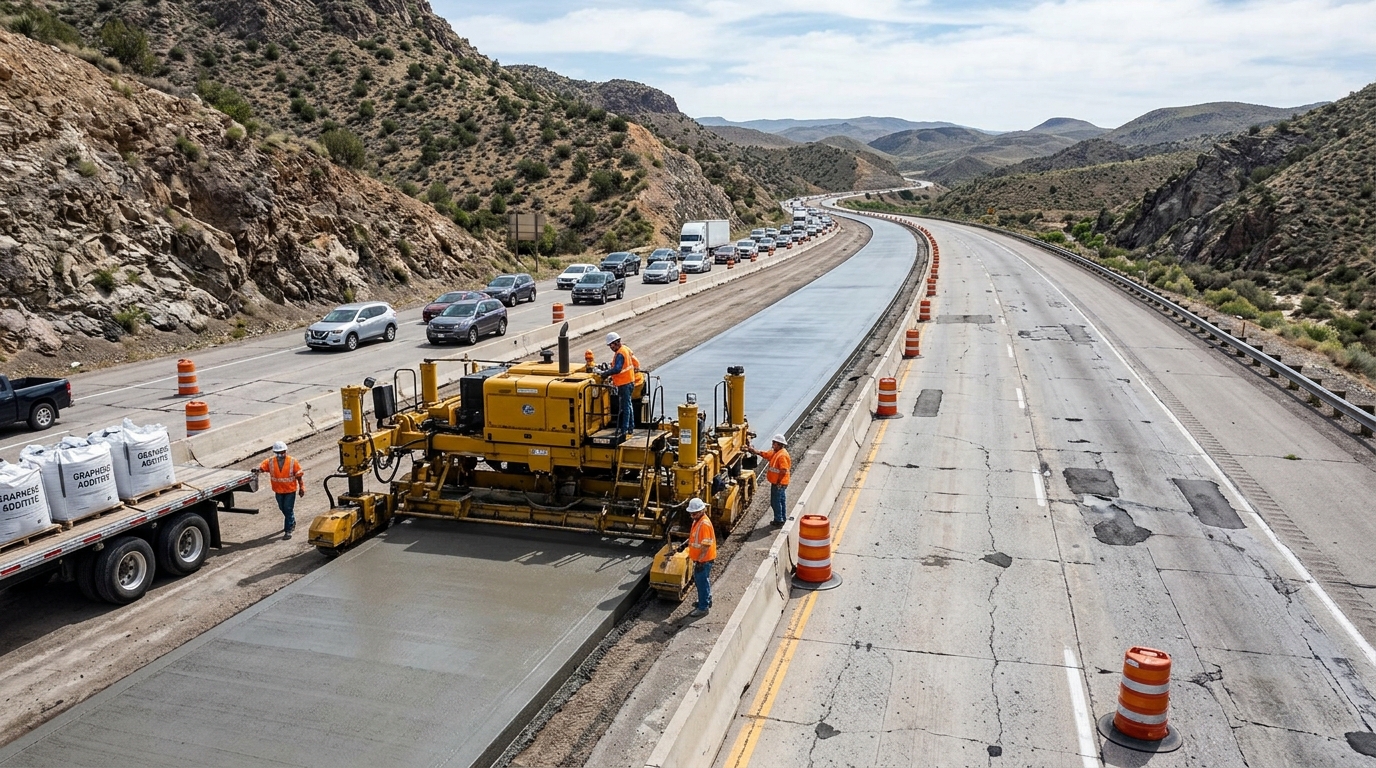
Why Graphene Concrete Could Finally Fix America’s Toughest Highway
I-80 Wyoming: Why Graphene Concrete Could Finally Fix America’s Toughest Highway
Picture this. You’re driving west across Wyoming on I-80 in January. The sky turns white before you even see the storm. Wind hits the truck so hard you feel it in your chest. Then the highway patrol closes the road — again — and you’re sitting at a rest stop outside Rawlins wondering if you’re spending the night.
If you’ve driven I-80 through Wyoming, you know exactly what I’m talking about. And if you haven’t… honestly, it’s a different experience than any highway in America.
Here’s what got me thinking about all this: the road itself. Because beyond the brutal weather, the infrastructure on that stretch takes an absolute beating every single year. And most of us — myself included — never really stop to think about what it takes to keep a highway alive when the conditions are actively trying to destroy it.
The Road That Shouldn’t Exist (But Does)
I-80 through Wyoming runs across the Continental Divide at over 8,600 feet. It crosses some of the most exposed, wind-blasted terrain on the continent. The stretch between Cheyenne and Laramie alone sees wind gusts regularly exceeding 60 mph. In winter, it can hit 100.
The highway closes more than almost any other interstate in the country. Not because of bad management — because the conditions are genuinely extreme.
And every freeze-thaw cycle, every salt application, every snowplow blade that drags across the surface is doing something to that pavement. Cracking it. Weakening it. Slowly pulling it apart.
Traditional concrete — the stuff roads have been built from for over a century — isn’t really designed for this. It’s strong, sure. But it’s brittle. Water gets in, freezes, expands, and the cycle begins. Maintenance crews patch it. The patches fail. More patches. More failures. It’s expensive, it’s endless, and it’s not really solving anything.
So when I started reading about graphene concrete and what it could mean for roads like I-80, I got genuinely curious.
What Even Is Graphene Concrete?
Okay, let’s slow down for a second, because “graphene” sounds like sci-fi and I want to make sure this actually lands.
Graphene is essentially a single layer of carbon atoms arranged in a honeycomb lattice. It’s incredibly thin — one atom thick — but it’s also one of the strongest materials ever discovered. Stronger than steel, actually, by a significant margin. And it conducts heat and electricity really well.
When you add even tiny amounts of graphene to concrete — we’re talking fractions of a percent — it changes how the concrete performs at a molecular level. The graphene strengthens the bonds between cement particles, fills microscopic gaps, and makes the whole structure dramatically more resistant to cracking and water infiltration.
You can read more about the specific mechanics of graphene concrete for roadways and highway construction if you want to go deeper — it’s genuinely fascinating stuff.
But here’s the short version: the same concrete slab, enhanced with graphene, lasts longer, handles stress better, and resists the freeze-thaw cycles that tear apart traditional pavement.
For a road like I-80 Wyoming? That’s not a small thing. That’s potentially transformative.
Why Wyoming Specifically Needs This
Most roads in America deal with weather. But I-80 in Wyoming is a different category.
The elevation means temperature swings are extreme and rapid. A road surface can go from well below freezing to above 50°F in the same day, sometimes multiple times in a week. Every one of those cycles is stress on the pavement.
The wind blows so hard it actually erodes road surfaces over time — mechanical wear, basically, from airborne particles traveling at speed.
And the salt. Wyoming uses serious quantities of de-icing chemicals because they have to. Salt saves lives on that highway. But it also accelerates concrete degradation significantly. It speeds up corrosion of the steel reinforcement inside the road and makes cracking worse over time.
Traditional concrete maintenance on I-80 is basically a treadmill. You can’t ever get ahead of it.
Graphene-enhanced concrete changes the calculus. Higher compressive strength means less cracking under traffic load and freeze-thaw stress. Better water resistance means less salt infiltration. Longer service life means less frequent replacement.
The implications for Wyoming highway infrastructure aren’t hypothetical — the math on lifecycle costs and reduced maintenance burden is genuinely compelling.
“But Isn’t This Expensive?”
Yeah, I hear this question a lot when new materials come up. And it’s fair.
Graphene-enhanced concrete costs more upfront than conventional concrete. There’s no getting around that. Adding graphene to the mix adds to the material cost.
But here’s the thing — and this is where the conversation usually goes wrong — we keep comparing upfront costs instead of total lifecycle costs.
Think about it this way. If traditional concrete on I-80 needs major resurfacing every 10-15 years and graphene concrete extends that to 25-30 years, you’re not paying twice as much. You’re potentially paying less over the full lifespan of the road, especially when you factor in the labor, closures, and economic disruption every major maintenance cycle causes.
And on a corridor like I-80 — which is a critical freight artery for the country — every closure has real economic ripple effects. Every lane restriction during repair season costs money. Those aren’t abstractions.
The case for graphene concrete on Wyoming roadways gets stronger the more you look at the full picture rather than just the material costs.
What the People Who Build Roads Are Saying
Here’s an honest observation: infrastructure innovation moves slowly. Really slowly.
There are good reasons for that — roads are public safety infrastructure, not consumer products. You don’t want to be experimental with highway design. The bar for “proven technology” is rightly high.
But there’s also a lot of inertia. Procurement systems are built around familiar materials. Engineers design around what they know. Contractors bid on what they’ve always used.
Graphene concrete has been tested extensively in the UK, Scandinavia, and increasingly in North America. The research is solid. The performance data in cold-climate, high-stress applications is encouraging.
The question isn’t really “does it work?” anymore. It’s closer to “how do we build the infrastructure (people, processes, supply chains) to actually deploy it at scale?”
That’s a different kind of problem. And it’s actually one that’s starting to get answered, which is genuinely exciting if you care about this stuff.
What This Means for You (Even If You Don’t Drive I-80)
I know what you might be thinking: “This is interesting, but I’m a homeowner. Why does Wyoming highway tech matter to me?”
Fair question.
Here’s my honest answer: the materials science happening in highway construction is a preview of what’s coming to everything built from concrete — bridges, foundations, driveways, retaining walls, parking structures. The same properties that make graphene concrete valuable in extreme conditions make it valuable in residential applications too.
Better crack resistance. Better water infiltration resistance. Longer lifespan.
Your driveway, if it’s concrete, goes through its own freeze-thaw stress every winter. Your foundation is subject to the same water and salt dynamics, just at a smaller scale. The innovation cycle in infrastructure materials tends to flow from large-scale applications (highways, bridges) down to residential over time, as costs decrease and adoption widens.
So even if you’re not a civil engineer, keeping an eye on what’s happening in graphene concrete highway applications gives you a window into where building materials are heading more broadly.
Frequently Asked Questions
Is graphene concrete actually being used on real roads right now? Yes — there are active deployments in the UK and pilot projects in North America. It’s not theoretical. The scale is still limited compared to conventional concrete, but real-world performance data is accumulating.
How much stronger is graphene concrete than regular concrete? Studies have shown compressive strength improvements in the range of 25-30% with relatively small graphene additions. That’s significant. It also shows improved tensile strength, which is what helps resist cracking.
Would graphene concrete actually survive Wyoming winters? That’s the right question to ask. Cold-climate performance is one of the areas where graphene concrete has shown particular promise — the reduced porosity and better bonding directly address the freeze-thaw failure modes that are so destructive in places like Wyoming.
How long until this is mainstream for highway construction? Honest answer: unclear. Infrastructure procurement moves slowly. But the trajectory is positive. Pilot projects are expanding, costs are coming down as production scales, and the performance evidence is building. If I had to guess, 10-15 years before it’s a standard option in major highway specs.
What’s the environmental angle? Worth mentioning — graphene concrete can achieve the same strength with less cement, and cement production is a significant carbon emitter. If you can use less cement to get more performance, that has environmental benefits beyond just road longevity.
Where This Goes From Here
I started thinking about I-80 Wyoming because it’s a vivid, concrete (pun maybe intended) example of what extreme infrastructure stress looks like. But the story is really bigger than one highway.
America has an infrastructure problem. The roads and bridges built during the mid-20th century are aging out. Rebuilding them with the same materials, the same way, means we’ll be back in the same situation in another 50 years.
Graphene concrete isn’t a magic fix. But it’s a real, tested improvement that changes the performance envelope for what concrete infrastructure can do. On a highway like I-80 — where the conditions are as demanding as anywhere in the country — that difference matters enormously.
If you want to go deeper on the science and the specific applications being developed for Wyoming’s highway system, The Graphene Solution has detailed information on graphene concrete for roadways that’s worth your time.
We’re at an interesting moment in infrastructure materials. The technology is ahead of the policy and procurement systems, but that gap is closing. And when it does, roads like I-80 might finally get the kind of surface they — and the people who drive them — actually deserve.