

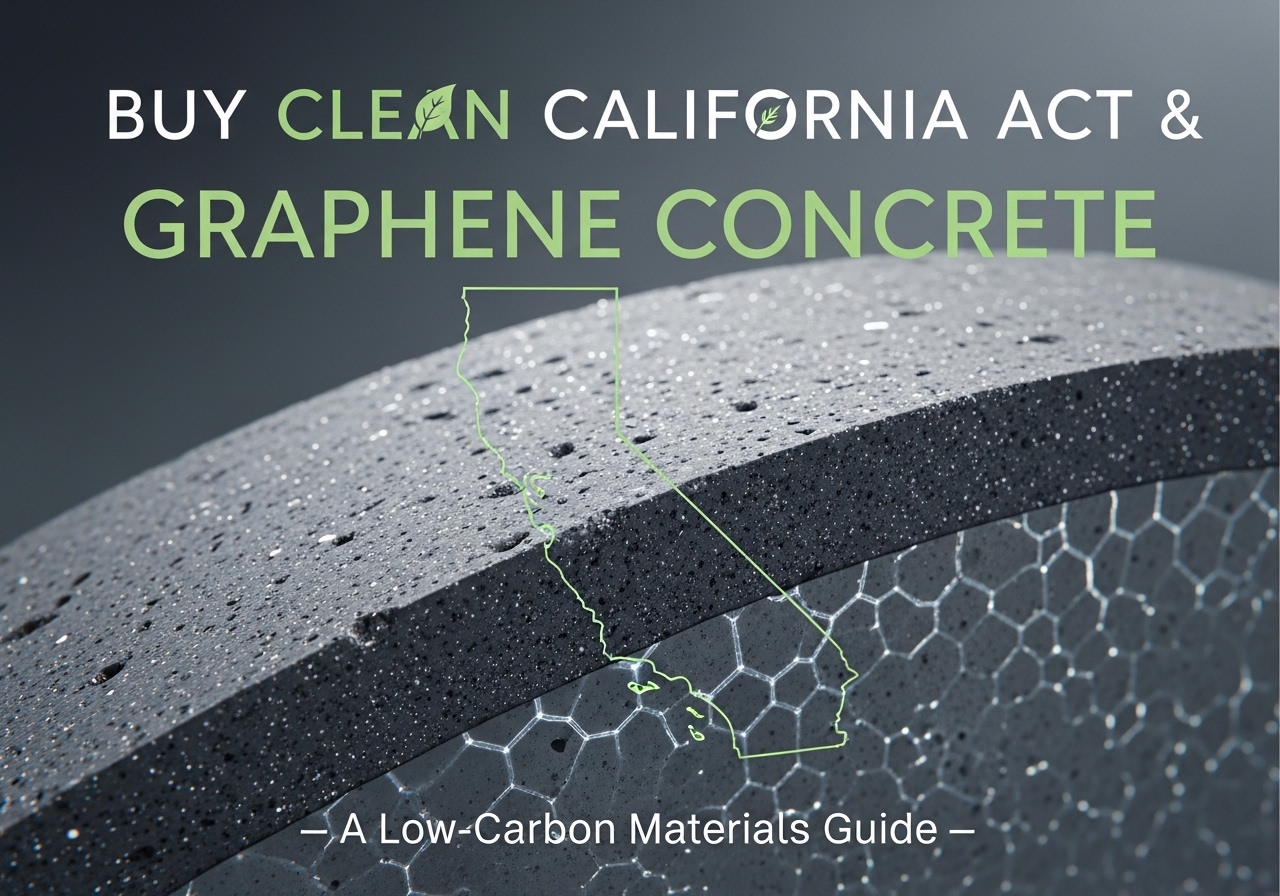
Buy Clean California Act & Graphene Concrete — A Low-Carbon Materials Guide
California has long been a national leader in environmental policy, and its approach to the construction industry is no exception. The Buy Clean California Act (BCCA) represents one of the most ambitious pieces of procurement legislation in the country — a law that fundamentally changes how the state buys materials for its public infrastructure projects. At the same time, a revolutionary building material is emerging that aligns perfectly with the spirit and letter of this law: graphene-enhanced concrete. This guide walks you through what the Buy Clean California Act actually requires, why it matters for contractors and project owners, and how graphene concrete positions California as a global model for sustainable construction.
What Is the Buy Clean California Act?
Signed into law in 2017 and progressively strengthened since, the Buy Clean California Act requires state agencies to consider the environmental impact of the structural materials they purchase for public works projects. Specifically, the law targets the embodied carbon — the greenhouse gas emissions generated during the extraction, manufacturing, and transportation of building materials — rather than just the operational carbon produced when buildings are in use.
The BCCA applies to a defined list of structural materials including steel, flat glass, mineral wool board insulation, and most critically for the construction industry, concrete and cement products. Under the law, material manufacturers must submit Environmental Product Declarations (EPDs) — third-party verified documents that quantify the Global Warming Potential (GWP) of their products per unit of measure. State agencies are then required to evaluate these EPDs and, progressively, to enforce maximum acceptable GWP thresholds during the procurement process.
This is not a voluntary program. It is a binding legal requirement that affects every contractor bidding on California state-funded infrastructure. The practical implication is clear: if you want to win public contracts in California, your concrete must meet increasingly strict carbon benchmarks, and that benchmark gets tighter every few years.
Why Embodied Carbon Matters More Than You Think
For decades, the conversation around green buildings focused almost exclusively on operational energy — the electricity and gas used to heat, cool, and power a structure over its lifetime. But researchers and policymakers have increasingly recognized that this misses roughly half the picture. Embodied carbon — the emissions locked into a building before anyone ever flips a light switch — can account for anywhere from 20% to 80% of a building’s total lifetime carbon footprint depending on its energy efficiency and location.
Concrete is the single largest contributor to embodied carbon in construction. The production of ordinary Portland cement, the binding agent in traditional concrete, releases enormous quantities of CO₂ through a chemical process called calcination, where limestone is heated to extreme temperatures. Globally, cement production is responsible for approximately 8% of all carbon dioxide emissions. In a state like California — which has mandated net-zero emissions by 2045 — continuing to build with conventional concrete is fundamentally incompatible with its climate goals.
This is precisely where the Buy Clean California Act creates both a mandate and an opportunity. By compelling contractors and material suppliers to reduce the embodied carbon of their materials, the state is effectively driving innovation in the construction materials market. And graphene concrete is one of the most promising innovations to emerge in response.
Understanding Graphene Concrete
Graphene is a single layer of carbon atoms arranged in a two-dimensional hexagonal lattice. It is the thinnest material ever discovered, yet it is stronger than steel, an excellent conductor of heat and electricity, and remarkably resistant to chemical and physical degradation. When graphene or graphene oxide is introduced into a concrete mix — even in trace quantities — it fundamentally transforms the performance characteristics of the resulting material.
Graphene concrete construction and materials solutions in California represent a breakthrough that addresses the central tension in sustainable construction: the trade-off between environmental performance and structural integrity. Traditional low-carbon concrete alternatives often sacrifice strength or durability. Graphene concrete eliminates that compromise.
When graphene nano-platelets are dispersed throughout a concrete mix, they act as reinforcement at the molecular level. The graphene bonds with the cement hydration products, creating a denser, more cohesive microstructure. This densification dramatically reduces the porosity of the concrete — meaning fewer pathways for water, chloride ions, sulfates, and other corrosive agents to penetrate the material. The result is a concrete that is significantly stronger in both compression and tension, more crack-resistant, and far more durable over its service life.
The Carbon Math: How Graphene Reduces Embodied Emissions
The connection between graphene concrete and lower embodied carbon operates through several mechanisms, and understanding each one is critical for contractors trying to comply with the Buy Clean California Act.
Cement Reduction: The most direct pathway is simple substitution. Because graphene dramatically improves the mechanical performance of a concrete mix, engineers can reduce the amount of Portland cement — the high-carbon component — required to achieve a target strength class. Studies have shown that graphene additions can reduce cement content by 30% or more while maintaining or exceeding the structural performance of the original mix. Since cement production is the primary driver of concrete’s carbon footprint, less cement means a meaningfully lower Global Warming Potential on the EPD that the BCCA requires you to submit.
Extended Service Life: The BCCA evaluates embodied carbon on a cradle-to-gate basis, but lifecycle thinking extends further. A concrete structure that lasts twice as long requires far less carbon-intensive repair, patching, and replacement over time. The enhanced durability of graphene concrete — its resistance to cracking, carbonation, chloride ingress, and freeze-thaw cycles — translates into extended service intervals and a dramatically lower total lifecycle carbon burden. For California’s aging infrastructure, this is not a minor benefit; it is transformational.
Reduced Concrete Volume: Because graphene concrete achieves higher strength with less material, structural engineers can design thinner slabs, narrower columns, and lighter foundations. This reduction in overall concrete volume directly reduces total embodied carbon, as well as the transportation emissions associated with delivering heavy materials to a job site.
California-Specific Applications Under the Buy Clean Mandate
California’s infrastructure needs are enormous and span a remarkable diversity of project types. The graphene concrete roadways and highway construction solutions for California are among the highest-value opportunities for low-carbon material adoption, given the scale of the state’s transportation network and the BCCA’s direct applicability to Caltrans procurement.
Highway and road construction represents one of the most carbon-intensive categories of public spending in California. Traditional concrete pavement mixes require high cement content to achieve the flexural strength needed to withstand heavy traffic loads and the state’s varied climate conditions — from the frost-prone Sierra Nevada to the salt-air coastal environments. Graphene concrete delivers the mechanical performance that highway engineers demand while slashing the cement content and thus the embodied carbon that Buy Clean auditors will scrutinize.
Bridge and overpass infrastructure presents similar opportunities. The graphene concrete for bridge and overpass infrastructure addresses one of the most pressing challenges in California’s public works portfolio: the state has hundreds of aging bridges that require either significant repair or full replacement, and every one of these projects must now navigate the BCCA’s EPD submission requirements. Specifying graphene concrete on these projects provides a clear pathway to compliance while delivering a structure with superior chloride resistance — critical for coastal and salt-exposed spans.
For California’s high-rise construction market, particularly in dense urban corridors like Los Angeles, San Francisco, and San Diego, graphene concrete for high-rise building construction enables developers to meet the state’s increasingly aggressive Title 24 energy and embodied carbon requirements. High-rise structures consume enormous volumes of concrete in their cores, slabs, and foundations. Even modest reductions in the GWP per cubic meter of concrete — the kind achievable through graphene enhancement — translate into substantial absolute carbon savings at the scale of a 30-story tower.
Navigating EPD Requirements With Graphene Concrete
One of the most practical challenges contractors face under the Buy Clean California Act is the EPD documentation requirement. An Environmental Product Declaration is a standardized document, verified by an independent third party, that reports a product’s environmental impact across a defined set of categories, with GWP being the most scrutinized for BCCA compliance purposes.
For contractors specifying graphene concrete, the path to EPD compliance follows the same framework as conventional concrete, but with a systematically lower GWP figure attributable to the cement reduction enabled by graphene. The key steps are straightforward: work with your concrete supplier to develop a mix design that incorporates graphene at the appropriate dosage rate, have the mix independently tested to verify its mechanical properties and GWP, and commission a product-specific EPD that documents those figures.
The important distinction is that graphene concrete EPDs will typically show lower GWP values than conventional mixes at equivalent strength classes. This means that specifying graphene concrete is not just a sustainability gesture — it is a concrete compliance strategy that gives you documented evidence of meeting or exceeding the BCCA’s maximum GWP thresholds.
The Bigger Picture: California Leading a National Shift
The Buy Clean California Act is not operating in isolation. Several other states have introduced or are actively considering similar buy-clean procurement legislation. Washington State, New York, and Colorado have all moved toward embodied carbon disclosure requirements for public procurement. Federal agencies have increasingly signaled interest in embodied carbon standards for federally funded infrastructure under various spending programs.
This means that the infrastructure California is building today — the roads, bridges, buildings, and public facilities that must comply with the BCCA — is effectively a proving ground for a national shift in how America procures construction materials. Contractors, engineers, and material suppliers who develop expertise in low-carbon concrete specification today, including the use of graphene-enhanced mixes, are positioning themselves at the leading edge of what will become standard practice across the country.
To explore more about how graphene is being applied across different infrastructure types and understand the full scope of available solutions, the learn about graphene resource provides a detailed foundation for contractors, engineers, and project owners who want to move beyond surface-level understanding.
Practical Steps for Contractors and Project Owners
If you are working on California public infrastructure projects subject to the BCCA, here is how to begin integrating graphene concrete into your procurement and specification process.
First, engage early with your concrete supplier about graphene-enhanced mix options. The earlier graphene is incorporated into the mix design phase, the more opportunity there is to optimize cement reduction, mechanical performance, and EPD outcomes simultaneously. Waiting until the procurement phase to address embodied carbon is a recipe for compliance stress and missed optimization opportunities.
Second, involve your structural engineer in the mix design conversation. Graphene concrete’s superior compressive and tensile strength means that existing structural specifications — written for conventional concrete — may be overly conservative when applied to graphene mixes. An updated structural analysis may reveal opportunities to further reduce concrete volume and embodied carbon.
Third, document everything. The BCCA is an evidence-based compliance framework. You need verified EPDs, not just supplier claims. Ensure that any graphene concrete product you specify comes backed by independent third-party testing and a properly formatted EPD that meets California’s program operator requirements.
Finally, think beyond the immediate project. The contractors who will thrive in California’s evolving low-carbon construction market are those who build institutional knowledge about sustainable materials now — before the BCCA’s GWP thresholds tighten further in upcoming compliance cycles.
Conclusion
The Buy Clean California Act is reshaping the economics and ethics of public construction in the nation’s largest state. By mandating embodied carbon disclosure and setting progressively tighter Global Warming Potential thresholds for structural materials, the law creates a powerful incentive for innovation — and graphene concrete is uniquely positioned to answer that call.
With its ability to reduce cement content significantly, dramatically extend service life, and deliver superior structural performance across a wide range of applications — from highways and bridges to high-rise towers — graphene concrete is not just a compliance tool. It is a generational upgrade to one of humanity’s oldest and most essential building materials. For California contractors, engineers, and project owners, the convergence of the BCCA mandate and graphene concrete technology represents an unprecedented opportunity to build smarter, cleaner, and more durably than ever before.