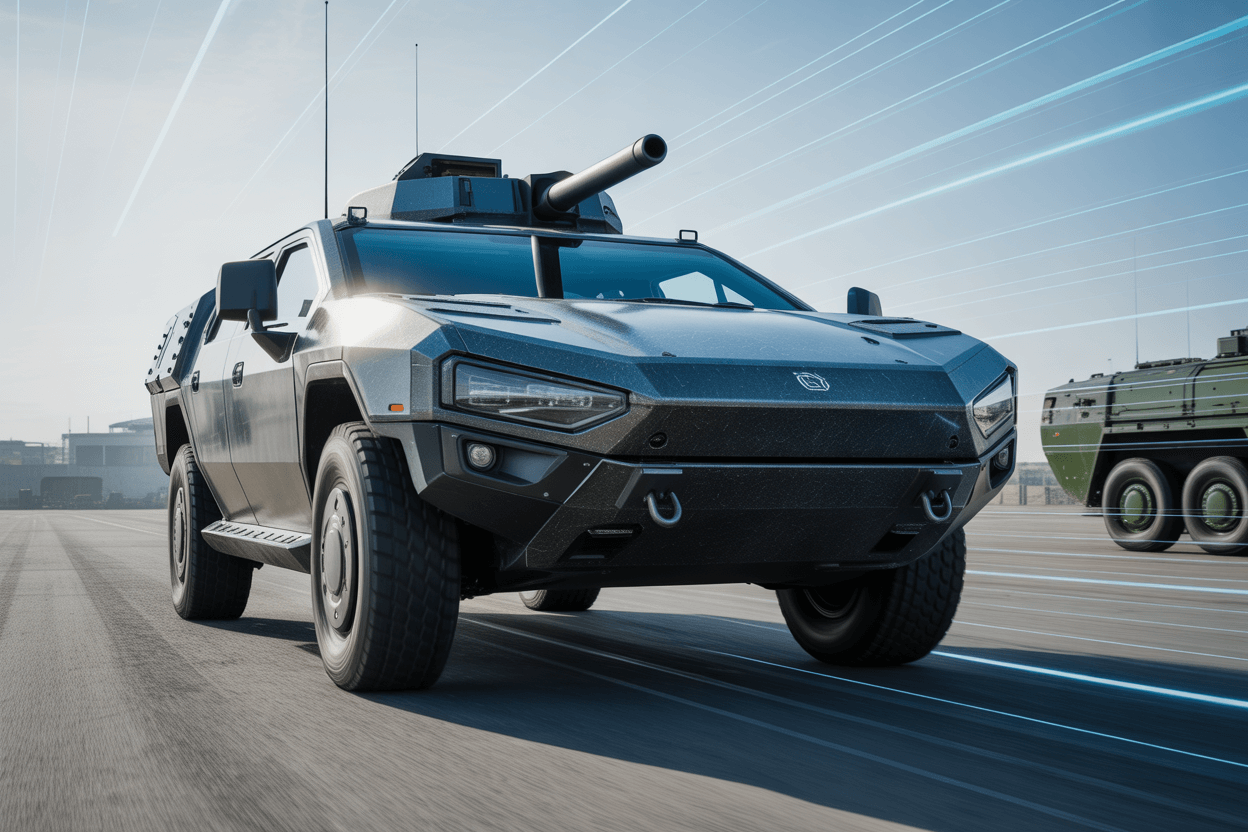
Let’s look at the current standard. Most military vehicles use CARC (Chemical Agent Resistant Coating). It’s good stuff. It resists chemical warfare agents, it’s matte to reduce visual signature, and it’s tough.
But it’s brittle.
When a rock hits standard paint at 60mph, or when a vehicle scrapes against a wall, the coating chips. That chip is a breach in the wire. Once moisture gets under that layer, the oxidation spreads underneath the paint like a cancer. You don’t see it until the paint bubbles up, and by then, the structural integrity of the metal is already compromised.
This isn’t just about looking pretty for parade. This is about operational availability.
Think about the supply chain. Every time a part rusts out, you need a replacement. That’s a part that has to be manufactured, shipped, tracked, and installed. It’s a massive logistical tail that slows down the entire force.
And then there’s the weight issue. To get better protection, we tend to layer things on thicker. But every pound of paint is a pound of payload you can’t carry. We are constantly fighting to shave weight off these platforms to improve fuel efficiency and range.
We need a coating that is thinner, lighter, but exponentially stronger. It sounds like a paradox, but with nanotechnology, it’s just physics.
The Solution: Armor at the Molecular Level
This is where we step into a new world of military defense.
Graphene is a 2D material. It’s a single layer of carbon atoms arranged in a hexagonal honeycomb lattice. It is the strongest material ever tested—about 200 times stronger than steel by weight. But for coatings, its strength isn’t even its best feature.
Its best feature is impermeability.
Graphene is so dense at an atomic level that not even helium atoms can pass through it. When we disperse graphene nanoplatelets into a coating matrix (like an epoxy or polyurethane), it creates a “tortuous path.”
Think of it like a maze.
In a standard coating, water and oxygen molecules can shoot straight through the microscopic pores to hit the metal. In a graphene-enhanced coating, those molecules hit a wall of graphene. They have to navigate around thousands of layers of these platelets. Most of them never make it.
This effectively shuts down the corrosion process before it can start.
Our Application Process: Science Meets Service
We don’t just sell a bucket of magic paint. Applying graphene coatings requires precision. It’s not difficult, but it has to be done right to get the benefits.
Here is how we handle a fleet upgrade:
Surface Prep: This is 90% of the battle. We blast the surface to near-white metal. If you don’t have a clean anchor profile, the best coating in the world won’t stick.
The Mix: Graphene tends to clump if you just stir it with a stick. We use specialized shear-mixing techniques to ensure the nanomaterials are evenly dispersed throughout the resin.
Application: We can spray, roll, or dip depending on the part. Because graphene coatings have excellent flow (rheology), they lay down smooth and fill in microscopic imperfections in the metal.
Curing: Graphene transfers heat incredibly well, which actually helps the coating cure more evenly, creating a tighter bond with the substrate.
The Strategic Benefits: What You Get in the Field
So, you apply this high-tech coating. What changes on the ground?
Plenty.
1. Extreme Corrosion Resistance
This is the big one. We are talking about extending the maintenance cycle from every 3-5 years to potentially every 10-15 years. If you operate in marine environments or salted roads, graphene coatings for military vehicles act as a near-perfect barrier against salt fog.
2. Abrasion and Impact Resistance
Graphene is hard. Really hard. When mixed into a coating, it creates a surface that is incredibly resistant to scratching and chipping. Brush, sand, and debris that would normally strip paint down to the bare metal will just glance off. This keeps the camouflage pattern intact and the metal protected.
3. Thermal Regulation
Graphene is highly thermally conductive. It helps dissipate heat from engine compartments or weapon systems. Instead of heat building up in one spot and causing thermal stress cracks, the coating spreads it out across the surface, helping the vehicle run cooler.
4. Reduced Weight
Because the material is so strong, we can often achieve better protection with a thinner layer of coating. On a single jeep, that might be negligible. On a C-130 or a naval vessel, that weight savings translates to significant fuel savings or extra ammunition capacity.
5. Stealth and Signature Management
Here’s something a lot of people don’t think about. Because we can engineer the electrical conductivity of the coating, graphene has potential applications in reducing radar cross-sections and managing electromagnetic interference (EMI). It can help shield sensitive electronics inside the vehicle from external static or jamming.




 Smart Applications of Graphene Concrete