


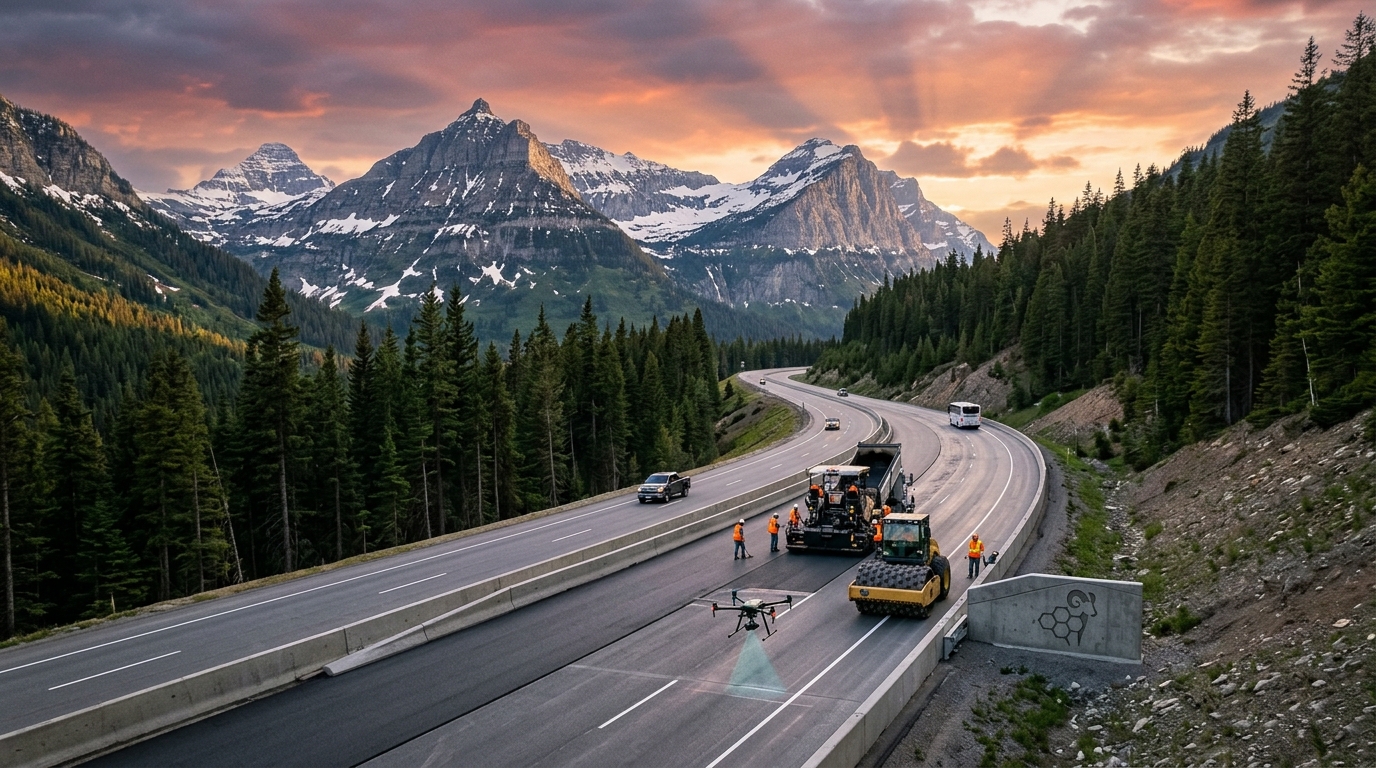
Graphene Concrete: Protecting Montana’s Gateway Roads
Graphene Concrete: Protecting Montana’s Gateway Roads
Picture the Going-to-the-Sun Road in early June.
Snow has just receded enough to open the pass. The first wave of tourists is rolling in — millions of them over the coming months — and underneath those tires is a road that spent the last six months frozen solid, then thawing, then freezing again. Repeat that cycle a few hundred times and you start to understand why maintaining infrastructure near Glacier and Yellowstone is basically a full-time act of defiance against nature.
Montana’s gateway roads are some of the most stressed pieces of pavement in the country. And honestly? The standard approach to fixing them — patch, repave, repeat — isn’t keeping up anymore.
That’s what makes graphene concrete worth talking about. Not because it’s a magic fix, but because it’s genuinely the most promising development in concrete durability that I’ve seen in a long time. And if you own property anywhere near Montana’s mountain corridors, this matters more than you might think.
The Problem Nobody Talks About Enough
Here’s the thing about Montana’s gateway infrastructure: the damage isn’t just from traffic. It’s from the environment doing exactly what Montana environments do.
Freeze-thaw cycling is brutal on concrete. Water gets into tiny pores and micro-cracks, freezes, expands by about 9%, and pushes those cracks wider. Come spring, it thaws, contracts, and the cycle starts over. Do that 50, 100, 150 times in a Montana winter and spring — especially at elevation near Glacier — and even well-built concrete starts to fail.
Then add the traffic. Not just tourists in minivans, but the supply trucks, construction equipment, and commercial vehicles that keep gateway communities running year-round. The roads to West Glacier, St. Mary, Gardiner, and Cooke City take a pounding that flatland infrastructure engineers sometimes struggle to fully account for.
The traditional fix has been Portland cement concrete or asphalt, with aggressive maintenance schedules and periodic full reconstruction. It works… sort of. But the maintenance costs are staggering, closures are disruptive, and the environmental footprint of constantly rebuilding roads near national parks is a real concern.
There’s a better conversation happening now, and it starts with a single layer of carbon atoms.
So What Is Graphene Concrete, Exactly?
Okay, quick science detour — I’ll keep it brief, I promise.
Graphene is a material made of carbon atoms arranged in a hexagonal lattice, one atom thick. It’s technically the thinnest material ever created, and also one of the strongest things on Earth — about 200 times stronger than steel by weight. It conducts heat and electricity remarkably well, and it’s incredibly resistant to chemical degradation.
When you add graphene to concrete — and we’re talking tiny amounts, fractions of a percent by weight — it distributes through the cement matrix at the microscopic level. Think of it like reinforcing the concrete from the inside out, at a scale that traditional rebar or fiber reinforcement simply can’t reach.
The results in testing and real-world applications have been genuinely impressive:
- Compressive strength increases of 25–30% over standard mixes
- Flexural strength (resistance to bending and cracking) up 30–40%
- Significantly reduced water permeability — which is the key factor in freeze-thaw damage
- Potential for thinner slabs that achieve the same or better performance
For a road near Glacier that needs to survive 150 freeze-thaw cycles a year, that permeability reduction alone is a game-changer. Less water getting in means less freeze-thaw damage, means longer road life, means fewer closures and lower maintenance costs.
[IMAGE: Microscopic visualization of graphene flakes distributed through a concrete matrix, showing the reinforcement network at the molecular level]
You can get a deeper look at how graphene concrete is being applied to Montana’s roadway and highway infrastructure — it’s a genuinely interesting story about where this technology is headed in the state.
Why Montana’s Gateway Corridors Are the Perfect Test Case
I want to be honest here: graphene concrete isn’t being used everywhere yet. It’s still scaling up. The price premium over standard concrete is real, and not every application justifies it.
But gateway infrastructure near Glacier and Yellowstone? This is exactly the kind of high-value, high-stress application where the economics actually work out.
Think about what a road closure near West Glacier costs. Not just in repair dollars — though those are significant — but in economic impact to the entire region. Hotels, restaurants, outfitters, gas stations, the whole ecosystem of businesses that depend on tourist traffic flowing freely. A single major infrastructure failure during peak season can hit a gateway community hard.
When you run the lifecycle math — upfront cost plus maintenance plus replacement over 30 years — graphene concrete starts looking very attractive, even at a premium price point. You’re not just buying a stronger road. You’re buying fewer closures, lower maintenance frequency, and extended intervals before full reconstruction.
And there’s an environmental angle too, which matters a lot when you’re talking about infrastructure near two of the most iconic national parks in the world. Producing less concrete overall (thinner slabs that perform equally), shipping fewer maintenance materials into sensitive areas, and reducing construction-related disruptions in wildlife corridors — it adds up.
What the Experts Are Actually Saying
Engineers who specialize in cold-climate concrete infrastructure have been watching graphene applications closely. The consistent theme I hear is that graphene concrete’s real advantage in places like Montana isn’t just strength — it’s durability under repeated stress cycles.
Standard high-strength concrete can be brittle. It resists compression well, but under repeated flexural stress — the kind roads experience every time a heavy vehicle passes — micro-cracks eventually accumulate. Graphene’s reinforcement effect is particularly valuable here because it interrupts that crack propagation at the microscopic level, before cracks become visible problems.
There’s also interesting work being done on graphene concrete’s performance in combination with traditional reinforcement — rebar, synthetic fibers, post-tensioning. The early indication is that these technologies complement each other rather than compete. A road that uses graphene concrete plus proper reinforcement design doesn’t just perform better — it maintains that performance over a much longer service life.
For Montana’s gateway infrastructure specifically, there’s growing interest in pilot applications — sections of road or bridge deck where graphene concrete can be evaluated under real conditions, with real traffic, in real Montana winters. Those real-world data points will drive wider adoption faster than any lab result.
You can read more about the ongoing developments in graphene concrete for Montana roadways — the technology is moving quickly.
What This Means If You Own Property Near Montana’s Gateway Communities
Here’s the practical question for homeowners: why does any of this matter to you?
A few reasons, actually.
First, what happens on public infrastructure eventually trickles into residential applications. The concrete mix designs, dispersion technologies, and installation best practices being refined on Montana’s gateway roads will become available — and affordable — for driveways, foundations, and slabs in the surrounding communities. That timeline is compressing as graphene production scales up.
Second, if you’re planning any concrete work in the near term, it’s worth asking contractors whether they’re aware of graphene-enhanced options. Not every project justifies the premium. A decorative patio? Probably not necessary. A driveway in Whitefish or Bozeman that you want to last 30 years without cracking through Montana winters? Worth the conversation.
Third, property values near gateway communities are tied to infrastructure quality. Better-maintained, longer-lasting public roads mean less disruption, more reliable access, and more stable property values. You benefit indirectly even if you never pour a yard of graphene concrete yourself.
[IMAGE: Montana mountain road in early spring showing typical freeze-thaw damage patterns compared to a newer section with enhanced concrete, gateway community visible in the background]
Common Questions Worth Answering
Is graphene concrete actually available in Montana right now?
For major infrastructure projects, yes — through specialized suppliers and contractors who work with graphene admixtures. For residential applications, availability is growing but not universal. Ask your contractor; if they haven’t heard of it, that’s useful information too.
Is it safe? Any concerns about graphene in the environment?
This comes up a lot. Current research suggests that graphene embedded in a cured concrete matrix is stable and poses no known environmental risk. It’s not like free-floating graphene nanoparticles — it’s locked into the concrete structure. That said, it’s a newer material and monitoring continues. No red flags so far.
What does it actually cost compared to standard concrete?
The premium varies by supplier and mix design, but roughly 10–20% more than standard concrete for the material. For residential projects, that might mean a few hundred dollars on a driveway. For large infrastructure projects, the lifecycle savings typically more than offset the upfront cost.
Does graphene concrete still need proper curing and subgrade prep?
Absolutely yes. Graphene enhances the concrete’s performance — it doesn’t compensate for bad technique. Proper subgrade prep, air entrainment for freeze-thaw resistance, and adequate curing time are still non-negotiable, especially in Montana’s climate.
Can it really survive Montana winters near Glacier?
The freeze-thaw data is genuinely encouraging. Reduced permeability means less water infiltration, which is the primary driver of freeze-thaw damage. Real-world performance in similar cold-climate environments has been strong. Montana’s gateway corridors would be a rigorous test, and that’s kind of the point — if it holds up here, it holds up anywhere.
Here’s Where Things Stand
Montana’s gateway infrastructure faces a challenge that’s only growing: more visitors, more traffic, more climate volatility, and an aging road network that was never designed for what it’s handling today.
Graphene concrete isn’t a silver bullet. But it’s a meaningful advance — one that addresses the specific failure modes that have plagued cold-climate, high-traffic infrastructure for decades. Better freeze-thaw resistance. Less crack propagation. Longer service life. Lower lifetime maintenance costs.
For the roads leading to Glacier and Yellowstone, those aren’t abstract benefits. They’re the difference between a road that stays open and one that doesn’t.
If you want to dig deeper into how graphene concrete is reshaping infrastructure planning across Montana, there’s a lot more to explore. And if you’re thinking about a concrete project on your own property — especially if you’re dealing with Montana’s freeze-thaw reality every winter — this is exactly the kind of technology worth asking about before your next pour.
The concrete industry moves slowly. But this particular change? It’s worth paying attention to.