

Graphene Concrete for PennDOT Projects — What Pennsylvania Contractors Need to Know (2026)
Pennsylvania’s infrastructure network is one of the most heavily used in the entire United States. With more than 40,000 miles of highway, tens of thousands of bridges, and a state transportation department — PennDOT — that consistently pushes for higher performance standards in every bid cycle, contractors across the Commonwealth are constantly searching for materials that deliver a genuine competitive edge. In 2026, one material has moved from scientific curiosity to a real-world solution that forward-thinking Pennsylvania contractors are actively adopting: graphene-enhanced concrete.
If you are a contractor operating in Pennsylvania — whether you are bidding on state highway projects, municipal infrastructure jobs, or bridge rehabilitation work — this guide breaks down exactly what graphene concrete is, why it matters for PennDOT compliance and performance, and how it fits into the broader landscape of construction materials being used across the state right now.
What Is Graphene Concrete and Why Does It Matter in 2026?
Graphene is a single layer of carbon atoms arranged in a hexagonal lattice. It is one of the strongest materials ever tested, with extraordinary thermal conductivity, electrical conductivity, and flexibility. When graphene is introduced into a concrete mix — typically in the form of a graphene oxide or few-layer graphene additive — it transforms the microstructure of the concrete at a molecular level.
The result is a concrete that performs measurably better across virtually every metric that matters to infrastructure engineers and contractors: compressive strength, tensile strength, resistance to freeze-thaw cycling, permeability, and long-term durability. For Pennsylvania contractors bidding on PennDOT projects, these are not abstract laboratory statistics — they are the exact performance benchmarks that determine whether a project passes inspection, holds up through the brutal Pennsylvania winters, and avoids costly callbacks and warranty claims years down the road.
Pennsylvania sits in a climate zone that is particularly punishing on concrete infrastructure. The state experiences hundreds of freeze-thaw cycles every winter, heavy road salt application, and significant temperature swings between seasons. Standard Portland cement concrete, even when properly mixed and placed, can begin showing signs of microcracking, scaling, and spalling within a decade under these conditions. Graphene concrete addresses this vulnerability directly by strengthening the internal bond structure of the cement paste, reducing porosity, and creating a denser matrix that is far less susceptible to water infiltration and salt penetration.
For a comprehensive overview of how these advanced materials are being applied specifically within the state, contractors should review the full resource on construction and concrete materials with graphene in Pennsylvania. This page outlines how Pennsylvania’s unique regulatory and climate environment shapes the best use cases for graphene-enhanced mixes.
PennDOT’s Push for Higher-Performance Infrastructure Materials
PennDOT has been progressively updating its specifications and material standards over the past several years. The agency’s long-range transportation plan has consistently emphasized lifecycle performance over initial placement, meaning that bid evaluations increasingly weigh projected service life alongside upfront considerations. This is a significant shift for contractors who have historically focused solely on meeting minimum spec thresholds.
Graphene concrete is particularly well-positioned in this evaluation environment. Because graphene enhances the durability and structural performance of concrete beyond standard mixes, structures built with it carry longer projected service lives and reduced maintenance requirements — both factors that PennDOT’s value engineering processes reward. Contractors who can demonstrate these long-term performance advantages in their bids are standing out in competitive procurement situations.
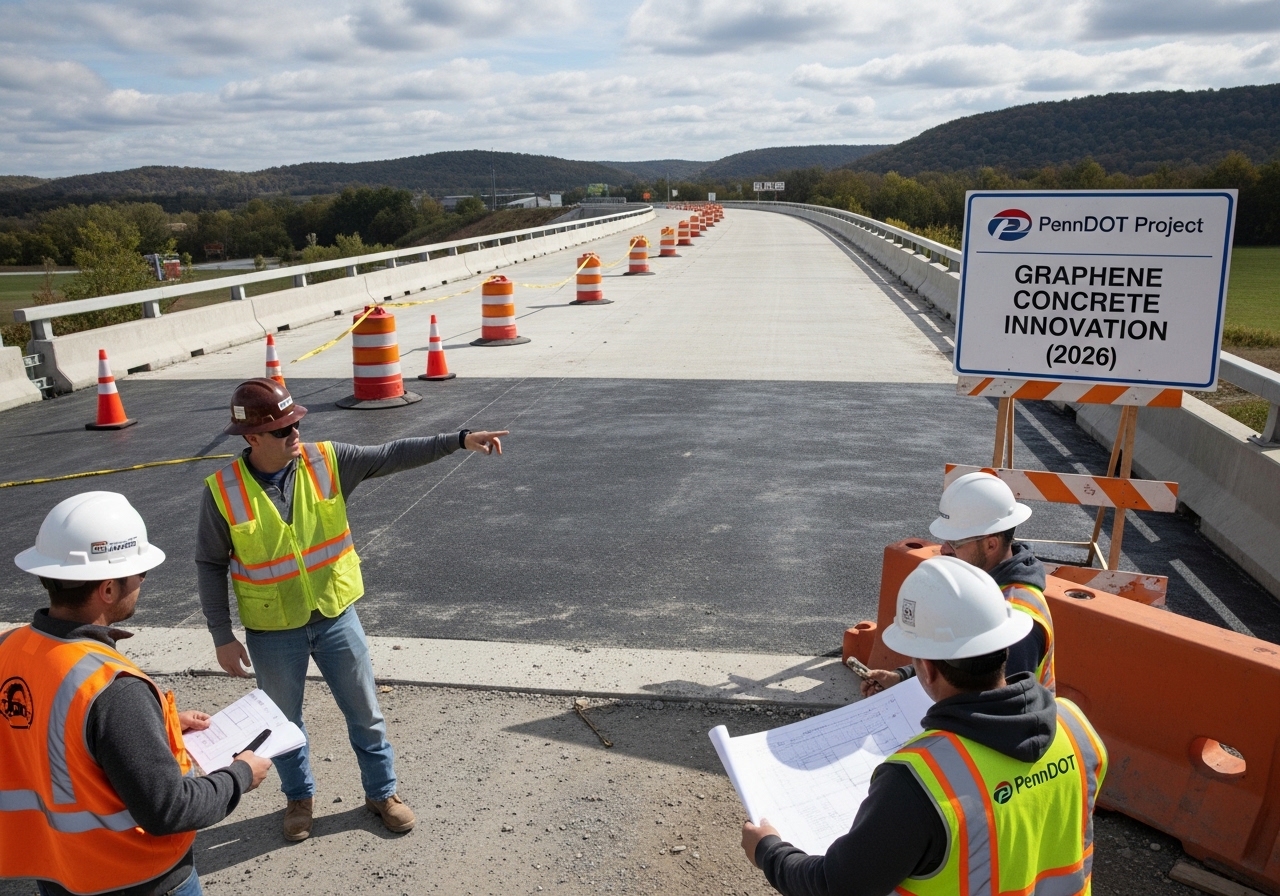
PennDOT’s bridge program alone manages thousands of structures across the state, and a significant portion of Pennsylvania’s bridge inventory is aging infrastructure in need of rehabilitation or full replacement. Graphene concrete has demonstrated particular promise in bridge deck applications, where the combination of high strength and low permeability directly addresses the chloride-induced corrosion of reinforcing steel that is the leading cause of bridge deterioration in cold-weather states. Pennsylvania contractors working in this segment should understand that adopting graphene-enhanced mixes is not just about performance — it is increasingly becoming a differentiator in a competitive bidding environment.
Key Performance Advantages for Pennsylvania Road and Highway Projects
Pennsylvania’s road network is managed under PennDOT’s oversight, and the demands placed on highway concrete in this state are extreme. Interstate routes like I-76, I-78, I-80, and I-95 carry some of the heaviest freight loads in the Northeast corridor, while secondary roads in rural areas of the state must survive with limited maintenance budgets.
Graphene concrete delivers several specific advantages that are highly relevant to Pennsylvania roadway construction:
Compressive Strength Enhancement: Research across multiple studies has demonstrated that graphene additives can increase the compressive strength of concrete by 30% or more compared to control mixes. For pavement applications, this translates directly into the ability to withstand heavier axle loads and maintain structural integrity over longer periods without rutting or cracking.
Freeze-Thaw Resistance: This is arguably the most critical performance factor for Pennsylvania infrastructure. Graphene’s ability to reduce the porosity of the cement paste means that less water enters the concrete matrix in the first place. Less absorbed water means dramatically reduced damage from ice expansion during freeze-thaw cycles — a mechanism responsible for an enormous proportion of pavement deterioration across the state each year.
Reduced Permeability: Pennsylvania’s heavy use of road salt during winter maintenance operations creates a chemical attack environment that degrades standard concrete relatively quickly. Graphene-enhanced mixes exhibit significantly lower water and chloride ion permeability, making them far more resistant to salt-induced deterioration and the corrosion of embedded steel reinforcement.
Crack Resistance: Graphene’s nanoscale reinforcement mechanism arrests microcrack propagation at its earliest stages, before cracks can grow and interconnect into the larger failure patterns visible on deteriorating road surfaces.
Contractors looking at the broader national picture of how graphene is reshaping highway construction can also explore the dedicated resource on graphene concrete roadway and highway construction benefits to understand how these performance gains translate across different project types and geographies.
Bridge and Overpass Applications: A Critical Pennsylvania Use Case
No state in the union has a more complex bridge management challenge than Pennsylvania. The state has consistently ranked among the highest in the nation for the proportion of structurally deficient bridges, and PennDOT’s bridge improvement programs represent a significant share of the state’s annual transportation budget.
For bridge contractors in Pennsylvania, graphene concrete represents a genuine paradigm shift in what is achievable with a concrete deck or substructure application. The combination of enhanced compressive strength, dramatically reduced permeability, and superior resistance to chemical attack makes graphene-enhanced mixes ideally suited for bridge deck overlays, full deck replacements, pier repairs, and abutment work.
Bridge decks in Pennsylvania face a particularly hostile environment. They are exposed to direct application of deicing chemicals, temperature extremes, heavy dynamic loading from truck traffic, and the freeze-thaw cycling that initiates surface scaling and cracking. Conventional high-performance concrete mixes have improved outcomes over standard mixes, but graphene concrete takes performance to another level by addressing durability at the microstructural level rather than simply adjusting water-cement ratios or adding supplementary cementitious materials.
Pennsylvania contractors actively bidding bridge rehabilitation and replacement work through PennDOT’s capital programs should read the dedicated analysis of graphene concrete for bridge and overpass infrastructure to understand the full technical case for adoption on these project types and how to present this advantage to bridge engineers during the design and approval process.
What Contractors Need to Know About Specification and Mix Design
Introducing graphene into a concrete mix is not as complicated as many contractors initially assume. Graphene additives are typically supplied in the form of water-based dispersions or dry powders that can be introduced during standard mixing operations. The key is working with a supplier who can provide proper dosing guidance and technical support to ensure that the graphene is properly dispersed throughout the mix — because graphene’s performance benefits depend entirely on achieving uniform distribution at the nanoscale level.
From a specification standpoint, Pennsylvania contractors working on PennDOT projects will typically need to work through the Materials Management process to introduce a graphene-enhanced concrete mix as an approved material. This involves submitting mix design data, independent test results, and often trial batch results to demonstrate that the mix meets or exceeds the relevant PennDOT standard specifications for the application in question. Contractors who approach this process with thorough documentation — including third-party laboratory testing data showing strength, permeability, and durability characteristics — are far more likely to achieve approval efficiently.
It is also worth noting that graphene does not require dramatic changes to concrete placement or finishing operations. Properly designed graphene concrete mixes behave similarly to conventional mixes in terms of workability, set time, and finishing characteristics when the mix design has been correctly developed. Experienced field crews should not encounter significant learning curve challenges in transitioning to graphene-enhanced concrete.
Graphene Concrete for Pennsylvania Infrastructure Beyond Roads and Bridges
While PennDOT road and bridge projects represent the most obvious application category for graphene concrete in Pennsylvania, contractors operating in other infrastructure segments should also be paying attention to this material.
Pennsylvania has significant tunnel infrastructure, particularly in the Pittsburgh area and along major mountain crossings. Tunnel linings and underground structures benefit from the same impermeability and crack resistance characteristics that make graphene concrete so effective for surface infrastructure. Contractors working in subsurface construction can explore the detailed breakdown of graphene concrete tunnel construction for underground infrastructure to understand how these properties apply in below-grade environments.
Pennsylvania also has active industrial construction markets around its energy sector, manufacturing base, and logistics infrastructure. The durability advantages of graphene concrete translate directly into reduced maintenance requirements and longer service life for industrial floors, loading docks, warehouse structures, and heavy industrial facilities — all applications where concrete performance directly impacts operational uptime and facility maintenance budgets.
Beyond construction applications, contractors who want to build their foundational understanding of graphene as a material can access the educational resource at Learn About Graphene — a solid starting point for anyone who is new to the science behind this additive and wants to understand why its properties translate into the construction performance gains that are being reported from real-world projects.
Competitive Positioning for Pennsylvania Contractors in 2026
The construction market in Pennsylvania is competitive. PennDOT’s procurement processes are rigorous, and contractors who win work consistently are those who find ways to differentiate their technical capabilities, reduce lifecycle risk for project owners, and demonstrate that they are working at the leading edge of the industry.
Graphene concrete is one of the most significant material innovations available to contractors right now, and early adopters in the Pennsylvania market are building a genuine competitive advantage. By developing expertise in graphene concrete mix design, establishing supplier relationships, navigating the PennDOT materials approval process, and building a track record of successful placements, forward-thinking contractors can position themselves as the preferred choice for high-performance infrastructure projects across the state.
The window for being an early adopter in this space is still open — but it is closing. As more contractors in Pennsylvania begin adopting graphene-enhanced mixes and accumulating approved product listings with PennDOT, the baseline expectations for high-performance projects will shift upward. Contractors who move now will have the advantage of established approvals, proven field experience, and supplier relationships when the broader market begins mandating higher performance standards as the norm rather than the exception.
Getting Started: Next Steps for Pennsylvania Contractors
If you are a Pennsylvania contractor evaluating graphene concrete for your next PennDOT project or state infrastructure bid, the practical starting point is building your understanding of the material’s performance characteristics, identifying a reputable graphene concrete supplier with the technical support capability to assist with mix design and specification documentation, and beginning the PennDOT materials approval process.
The approval process requires time and preparation, so contractors who begin this work now — before a specific bid opportunity arrives — will be in a far stronger position than those who attempt to introduce a new material in the middle of a competitive bid cycle.
Pennsylvania’s roads, bridges, tunnels, and infrastructure need materials that can perform for decades under some of the most demanding conditions in the country. Graphene concrete delivers exactly that — and in 2026, Pennsylvania contractors who understand this material and know how to deploy it are the ones who will be winning the most demanding PennDOT projects.