


Graphene Concrete vs. North Dakota’s Brutal Bakken Winter Roads
Graphene Concrete vs. North Dakota’s Brutal Bakken Winter Roads
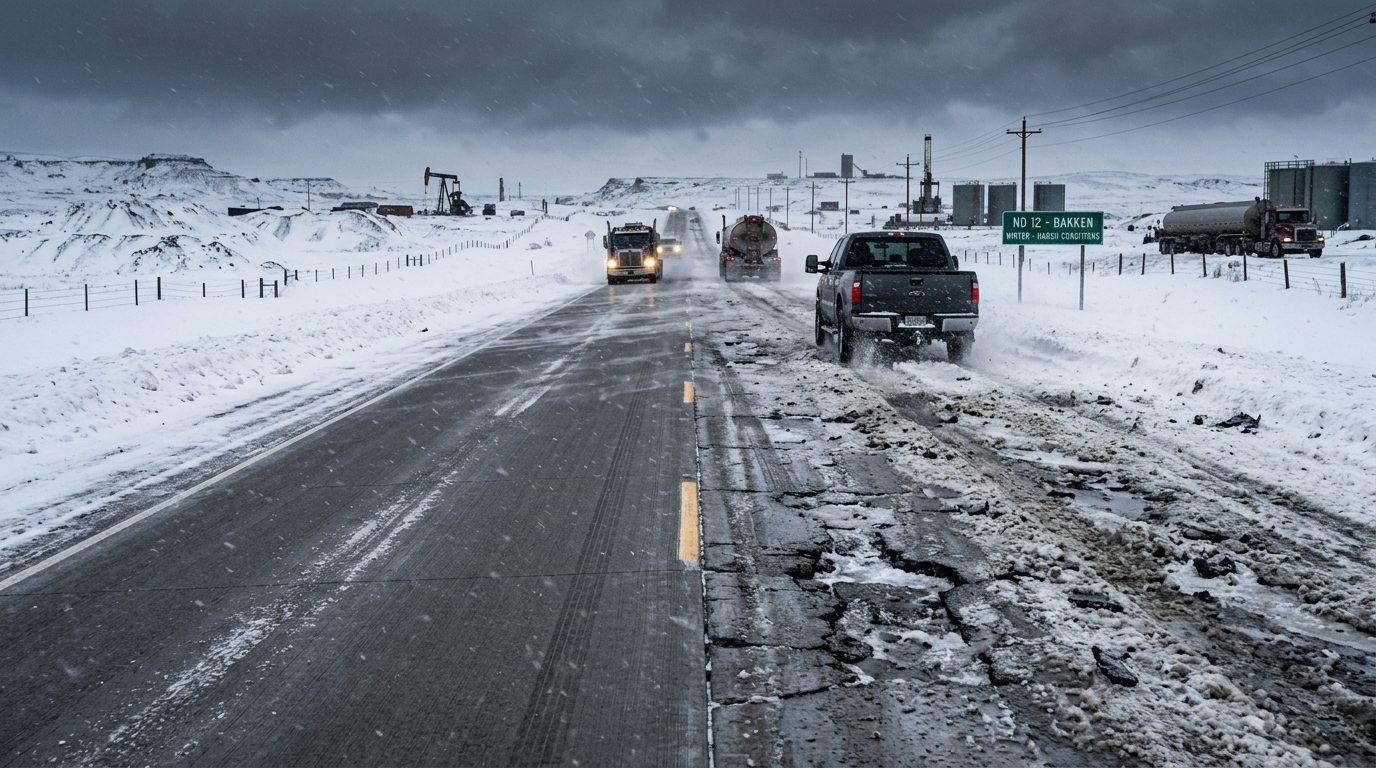
If you’ve never driven a county road in the Bakken oil patch in January, let me paint the picture for you.
It’s dark by 4:30 in the afternoon. The temperature is hovering somewhere between -10 and -30°F. And rolling past you in both directions — before sunrise and well after dark — are heavy trucks. Oil tankers, water haulers, sand trucks for fracking operations, equipment trailers. Big, loaded, relentless.
The roads underneath all of that? They were not built for this. Most of North Dakota’s rural infrastructure was designed for farm equipment and the occasional pickup. The Bakken oil boom changed the math completely — and the roads have been paying for it ever since.
Here’s where it gets interesting, though: there’s a material that actually performs in these conditions. Not just tolerates them. Performs. And if you follow infrastructure news at all, or you work in or near the oil patch, graphene concrete is a name worth knowing.
Why Bakken Roads Are Such a Uniquely Hard Problem
Before we get into what graphene concrete does, it’s worth understanding why standard concrete keeps failing out there. Because it’s not one thing. It’s several brutal things happening at once.
The freeze-thaw cycle is relentless. North Dakota sees temperatures swing from -40°F in winter to 100°F in summer. Every time water gets into a small crack in concrete, freezes, expands, thaws, and contracts — that crack gets a little bigger. Do that a few thousand times over a few years and you’ve got serious structural deterioration.
The loads are extreme and concentrated. A fully loaded oil tanker or water truck can weigh 80,000 pounds or more. When those trucks run the same routes day after day, the stress accumulates in predictable spots. Roads that were rated for light agricultural traffic get absolutely hammered.
The ground itself moves. Much of the Bakken sits on clay-heavy soils that shift with moisture and frost. That sub-base movement creates differential settling — some sections of road sink, others heave — and the surface above it cracks.
Conventional concrete just wasn’t built for all three of those things hitting simultaneously. Which is why North Dakota’s approach to road and highway construction has had to evolve.
What Graphene Actually Does to Concrete
Okay, quick version — I promise I’ll keep it human.
Graphene is a single-atom-thick layer of carbon. It’s extraordinarily strong relative to its weight. When you incorporate graphene nanoplatelets into a concrete mix, they essentially fill in the microscopic gaps in the cement matrix, reinforcing the material at a scale you can’t see but absolutely feel in performance.
The result is concrete that:
- Resists cracking under freeze-thaw cycles significantly better
- Handles tensile stress (the pulling-apart force that causes surface fractures) more effectively
- Achieves higher compressive strength — often with less material
- Has lower permeability, meaning less water infiltrates in the first place
That last one matters enormously in the Bakken. Water infiltration is the beginning of nearly every failure mode in cold-climate concrete. Cut off the water’s path in, and you’ve broken the cycle.
Think of it like this: regular concrete is like a sponge — porous, absorbent, vulnerable. Graphene concrete is closer to dense hardwood. Same basic function, completely different resilience.
7 Reasons Graphene Concrete Makes Sense for Bakken Oil Field Roads
1. It Actually Survives the Freeze-Thaw Gauntlet
This is the big one. Freeze-thaw cycling is the primary destruction mechanism for Bakken road surfaces, and graphene concrete addresses it directly.
The tighter microstructure means there are simply fewer pathways for water to enter the material. Less infiltration means less expansion pressure when that water freezes. Over hundreds of cycles across a North Dakota winter, that difference compounds into a dramatically longer service life.
Early research and pilot applications in cold-climate regions consistently show graphene-enhanced concrete outperforming standard mixes in freeze-thaw resistance — some studies showing the equivalent of 40-50% fewer surface defects after comparable cycling exposure.
The honest caveat: mix design matters a lot. Graphene concrete isn’t magic — a poorly proportioned mix with graphene still underperforms a well-designed standard mix. The material improves what’s already there; it doesn’t compensate for bad engineering.
2. It Handles Heavy Load Repetition Better
Here’s something that doesn’t get talked about enough in road construction: it’s not just the weight of a load that damages infrastructure. It’s the repetition. A road that handles 10,000 heavy truck passes will fail differently than one that handles 10. And Bakken haul roads handle vastly more than 10.
Graphene concrete’s improved tensile strength means it resists the micro-fracturing that accumulates under repeated loading. Think of it like metal fatigue — a steel beam bent once is fine. Bent a million times at the same spot and it eventually fails. Concrete behaves similarly, and graphene pushes that failure threshold significantly further out.
For oil field access roads, haul routes, and lease roads near active well pads, that extended fatigue life translates directly into fewer road closures and lower annual maintenance costs.
3. Less Road Failure Means Fewer Disruptions to Operations
This one’s practical and maybe a little obvious, but it’s worth saying: when an oil field access road deteriorates to the point of needing repair, operations don’t just slow down — they often stop.
Equipment can’t get in. Trucks can’t get out. If the road closures hit during a critical operational window, the costs compound fast. Road repairs in remote Bakken locations aren’t cheap either — mobilizing crews and equipment to western North Dakota in January is a significant undertaking.
Graphene concrete for North Dakota highway and road construction is increasingly attractive precisely because it shifts the maintenance calculus — fewer emergency repairs, more predictable infrastructure lifespans.
4. Reduced Permeability Protects the Sub-Base Too
Here’s something most people don’t think about: road failure often starts below the surface. When water infiltrates through a road surface, it doesn’t just damage the concrete — it saturates the sub-base, weakens it, and sets up the differential settling that causes surface cracking and heaving.
Graphene concrete’s lower permeability protects the entire system, not just the top layer. Less water gets through, the sub-base stays more stable, and the whole structure holds its shape longer.
In North Dakota’s clay-heavy soils, where moisture-driven movement is a constant challenge, this sub-base protection effect is genuinely significant. It’s not just a surface improvement — it’s a system improvement.
5. It Works With — Not Against — Extreme Temperature Swings
Some construction materials that perform well in the cold do so by being rigid and brittle. That’s… not ideal when you need something to survive both -30°F January nights and 95°F July afternoons in the same year.
Graphene concrete maintains better structural integrity across that temperature range. The reinforced microstructure doesn’t just resist freeze-thaw expansion — it also handles the thermal expansion and contraction from seasonal extremes without developing the surface crazing and edge cracking that plague conventional Bakken road surfaces by their second or third winter.
Pro tip: The thermal performance advantage is especially relevant for bridge approach slabs and culvert headwalls in the Bakken, where freeze-thaw and thermal movement happen at joints and transitions — historically some of the most failure-prone locations on any rural road network.
6. Lower Long-Term Costs Even With Higher Upfront Investment
This is where the math gets interesting, and honestly, it’s where most conversations about graphene concrete eventually land.
Yes, graphene-enhanced concrete typically costs more per yard than a standard mix. The nanomaterial addition isn’t free. But when you factor in extended service life — and in harsh environments like the Bakken, that extension can be substantial — the total cost of ownership often favors graphene concrete even at a higher initial price.
A road surface that lasts 35 years instead of 20 isn’t just 75% more durable. It also means 75% fewer mobilizations, 75% fewer traffic management headaches, 75% fewer disruptions to operations. That math adds up fast when you’re talking about critical oil field infrastructure.
7. Environmental Load Reduction Matters Out There Too
This one surprises people, but it’s real. Graphene concrete typically achieves target strength with less material than conventional concrete — sometimes meaningfully less. Producing less concrete means less cement, and cement manufacturing is carbon-intensive.
For oil field roads specifically — where environmental permitting and land use concerns are already part of every infrastructure decision — a material that performs better with a smaller footprint has genuine appeal beyond just the economics.
It’s not the primary reason anyone chooses graphene concrete, but it’s a legitimate secondary benefit in an industry that increasingly has to account for its environmental impact.
How the Performance Stacks Up
| Challenge | Conventional Concrete | Graphene Concrete |
|---|---|---|
| Freeze-thaw resistance | Moderate; degrades over cycles | Significantly improved |
| Heavy load fatigue | Susceptible to micro-fracturing | Higher fatigue threshold |
| Water infiltration | Porous; allows water in | Lower permeability |
| Sub-base protection | Indirect; surface only | Improves system stability |
| Temperature range performance | Can craze/crack at extremes | Better across full range |
| Service life (harsh cold climate) | 15-25 years typical | Extended; 30-40+ years possible |
| Maintenance frequency | Regular; every few years | Reduced |
Again — these aren’t guarantees. They’re directional. Actual performance depends on mix design, application, traffic loads, and site conditions. But the direction is consistent and it’s significant.
Key Takeaways
- Bakken oil field roads face a combination of extreme cold, freeze-thaw cycling, heavy truck loads, and unstable sub-bases that destroys conventional concrete faster than almost any other environment
- Graphene concrete addresses the primary failure mechanisms directly — especially water infiltration and freeze-thaw expansion — through a reinforced microstructure at the molecular level
- The benefits aren’t just surface-level: reduced permeability protects the sub-base and the whole road system
- Higher upfront cost is real, but total cost of ownership over an extended service life often favors graphene concrete in harsh environments
- North Dakota’s road infrastructure challenges are specific enough that generic solutions keep failing — which is why material innovation matters here more than in milder climates
- For haul roads, lease roads, and access routes near active well pads, reduced maintenance downtime has direct operational value that compounds over time
Where Do We Go From Here?
Look, if you’re a homeowner in North Dakota — especially in the Williston Basin or surrounding Bakken communities — you’ve probably watched the roads in your county deteriorate in real time over the past decade. The truck traffic from oil operations hit infrastructure that was never designed for it, and the repair cycles have been endless.
Graphene concrete isn’t a silver bullet. Nothing is. But it’s a genuine, practical improvement over what’s been used — and it’s becoming more accessible as more contractors get familiar with the mix design and application.
If you’re curious how this technology applies to broader road and highway infrastructure in your state, the full breakdown on graphene concrete for North Dakota roads and highways is worth a read. It goes deeper into the technical side while staying practical.
The Bakken is one of the most demanding infrastructure environments in North America. It deserves materials that are actually up to the challenge. And honestly? It looks like we’re finally getting there.