

Graphene Concrete & California Seismic Zone 4 — What Engineers Need to Know
California sits on one of the most seismically active land masses on Earth. With major fault lines cutting through virtually every region of the state — the San Andreas, Hayward, Cascadia Subduction Zone, and dozens of secondary faults — structural engineers practicing in California aren’t just designing buildings. They are designing for survival. In Seismic Zone 4, the highest designation under legacy California building codes and one directly reflected in modern CBC and ASCE 7 requirements, the margin for material failure is essentially zero.
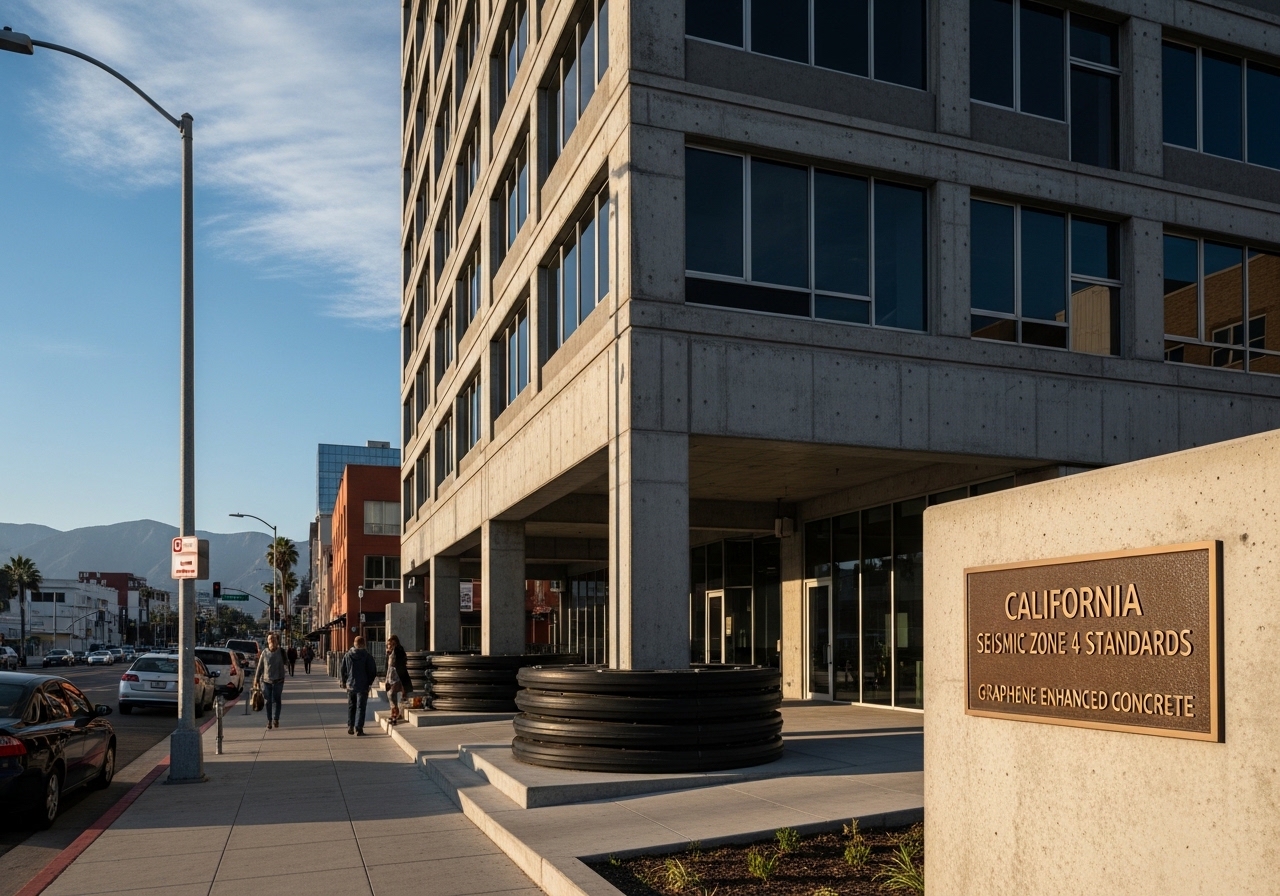
For decades, engineers have worked within the constraints of conventional concrete — a material that is excellent in compression but notoriously brittle in tension, and one that develops micro-cracks under cyclic seismic loading long before visible structural failure becomes apparent. Now, a new material science development is forcing engineers to reconsider everything: graphene-enhanced concrete. This guide breaks down what graphene concrete is, why it matters specifically for California’s seismic environment, and what engineers need to understand before specifying it on their next project.
Understanding California Seismic Zone 4 and Its Demands on Concrete
Seismic Zone 4 covers most of the San Francisco Bay Area, greater Los Angeles, San Diego, and large portions of the Central Valley and coastal regions. Under the older Uniform Building Code (UBC) classification system — still referenced for legacy structures — Zone 4 represents the areas of highest expected ground motion. Under the current California Building Code (CBC), this translates into the highest Seismic Design Categories (SDC D, E, and F), demanding Special Moment-Resisting Frames, special shear walls, and tight reinforcement detailing requirements.
What this means for concrete specifically is demanding. Concrete in Zone 4 structures must endure not just static dead and live loads, but repeated, high-intensity dynamic loading cycles. Cyclic shear forces, ground acceleration forces measured in fractions of g, and moment reversals all conspire to initiate crack propagation in conventional concrete mixes. Once cracking begins, rebar corrosion accelerates, structural stiffness degrades, and buildings can experience what engineers call “soft story” failure — a phenomenon tragically documented in earthquakes from Northridge (1994) to Loma Prieta (1989).
The engineering community has responded over the decades with improvements to mix design, higher-strength cements, fiber-reinforced concrete, and ever-tighter reinforcement ratios. But these solutions add weight, complexity, and do not fundamentally address the brittle nature of the cement matrix itself. This is precisely where graphene enters the conversation.
What Is Graphene Concrete and How Does It Work?
Graphene is a single layer of carbon atoms arranged in a two-dimensional hexagonal lattice. At one atom thick, it is simultaneously the thinnest and one of the strongest materials ever tested, with a tensile strength approximately 200 times greater than structural steel by weight. When graphene or graphene oxide is introduced into a concrete mix — typically as a precisely dosed additive or pre-dispersed solution — it integrates at the nanoscale level throughout the cement matrix.
The result is a profoundly different microstructure. In conventional concrete, the calcium silicate hydrate (C-S-H) gel that forms during hydration creates a porous, irregularly bonded matrix with inherent weak zones between aggregates. Graphene particles, dispersed at the nanoscale, act as nucleation sites for C-S-H formation, producing a denser, more uniformly bonded matrix with significantly fewer micro-voids.
For engineers, this translates into measurable performance gains across multiple parameters. Compressive strength improvements of 20% to 30% have been documented in peer-reviewed studies. More critically for seismic applications, flexural strength and tensile splitting strength — the properties most relevant to crack resistance — can increase by 30% to 40% compared to control mixes using identical cement content, water-cement ratio, and aggregate gradation. If you want to understand the full material science behind these gains, learn about graphene and its properties before specifying it on structural projects.
Seismic Performance: Why Graphene Concrete Excels in Zone 4 Conditions
The specific failure mechanisms that occur during a major seismic event are directly addressed by graphene’s material characteristics.
Crack Arrest and Propagation Resistance. In conventional concrete, a crack that initiates at a micro-void will propagate through the cement matrix along the path of least resistance, often along aggregate-paste interfaces. Graphene sheets distributed through the matrix create physical barriers to crack propagation. When a crack tip encounters a graphene platelet, the energy required to continue propagation increases dramatically — a phenomenon known as crack bridging. This converts what would be brittle, sudden fracture into a more ductile, energy-absorbing failure mode.
Flexural Ductility Under Cyclic Loading. Seismic loading is not a single impact — it is a series of displacement reversals that accumulate damage with each cycle. Conventional concrete degrades rapidly under cyclic flexural loading, losing stiffness and bond strength with reinforcing steel. Graphene-enhanced concrete, with its improved bond matrix density, maintains its structural integrity through more loading cycles before reaching critical degradation thresholds. For engineers designing to ASCE 7 ductility demand requirements, this is not a marginal improvement — it is a fundamental shift in how the concrete behaves as a structural material.
Shear Resistance. Shear failure in reinforced concrete during seismic events is often catastrophic and without warning. Graphene’s integration into the cement paste improves the aggregate interlock mechanism and the paste-aggregate bond, increasing diagonal tension resistance. This matters enormously for shear walls in Zone 4 buildings, where demand-capacity ratios are already pushing the limits of conventional concrete shear strength.
Reduced Permeability and Long-Term Durability. Seismic resistance is not just about surviving the event — it is about maintaining structural integrity in the years and decades between events. The denser microstructure of graphene concrete dramatically reduces water and chloride ion permeability, slowing rebar corrosion. In coastal California environments — where marine chloride exposure compounds standard corrosion — this durability advantage is particularly significant for long-term seismic performance.
Graphene Concrete in California’s Infrastructure Context
California engineers are not just working on buildings. The state’s vast infrastructure — highway overpasses, bridges, tunnels, dams, and water infrastructure — all faces the same seismic reality. Many of these structures were built to older standards and require both retrofitting and new construction that exceeds minimum code compliance.
Engineers involved in graphene concrete for bridge and overpass infrastructure projects understand that seismic performance for transportation infrastructure is not just a safety issue — it is an economic continuity issue. Bridge collapses during the Northridge earthquake severed critical arterial routes for weeks, causing economic losses that dwarfed the direct structural repair costs. A material that improves flexural ductility and shear resistance in bridge columns and deck elements directly addresses the most common seismic failure modes seen in California’s bridge inventory.
Similarly, graphene concrete for high-rise building construction has become increasingly relevant as California’s cities continue to densify. High-rise concrete frames in Zone 4 must meet Special Moment Frame requirements with extremely demanding reinforcement detailing. A higher-performance concrete matrix that improves bond between rebar and concrete reduces the risk of splice zone failures during seismic events — one of the most critical concerns in tall building seismic design.
Code Compliance Considerations for California Engineers
One of the first questions engineers ask about any new material is: will it pass plan check? Graphene concrete is not a replacement for conventional concrete — it is an enhanced version of it, and it can be designed to meet or exceed the same ACI 318 and California Building Code requirements that govern conventional concrete design.
The key compliance pathway is through the standard concrete mix design approval process. Graphene concrete mixes must be accompanied by batch plant mix design data, third-party compressive strength testing per ASTM C39, and in many cases, additional testing for flexural strength (ASTM C78) and splitting tensile strength (ASTM C496). The performance data must demonstrate that specified design strengths are achieved with adequate statistical confidence.
For projects requiring special inspection under CBC Chapter 17, graphene concrete does not require different special inspection protocols than conventional concrete — the same batch monitoring, slump testing, air content verification, and cylinder sampling apply. Engineers should ensure that the graphene admixture is properly documented in the project specifications with clear QC requirements for dosage verification at the batch plant level.
For engineers working on California’s graphene concrete roadway and highway construction projects, Caltrans project requirements introduce additional testing and specification layers — particularly around shrinkage, workability, and long-term durability benchmarks. Graphene’s demonstrated improvement in durability metrics positions it well for meeting these enhanced public infrastructure specifications.
Mix Design Guidance for Zone 4 Applications
Structural engineers specifying graphene concrete for Zone 4 applications should work closely with the concrete supplier to optimize the mix design for both seismic performance and constructability. A few key design considerations deserve attention.
Graphene dosage is typically expressed as a percentage of cement weight, with effective ranges generally falling between 0.01% and 0.05% by mass. Higher dosages do not necessarily produce proportionally higher performance — proper dispersion is as important as dosage. Engineers should require documentation of the dispersion method from the supplier, as agglomerated graphene particles reduce rather than enhance performance.
Water-cement ratio remains as critical in graphene concrete as in conventional mixes. The microstructural benefits of graphene are most pronounced in mixes with lower w/c ratios — typically 0.40 or below for Zone 4 structural applications. High-range water reducers (superplasticizers) should be evaluated for compatibility with the specific graphene product being used, as some combinations have shown interaction effects that require adjustment.
Fresh concrete workability should be verified through trial batches, particularly for slip-formed or pumped applications common in California high-rise construction. Graphene-enhanced mixes have generally demonstrated comparable or improved workability to control mixes at equivalent w/c ratios, but this should be confirmed for each specific mix design before production batching begins.
Real-World Applications: Where California Engineers Are Specifying Graphene Concrete
The application landscape for graphene concrete in California spans both new construction and retrofit/upgrade projects across multiple structure types. Industrial facilities and warehouses — particularly tilt-up construction in the Inland Empire and Central Valley — represent a major application area. Tilt-up panels in Zone 4 must handle both seismic in-plane shear and out-of-plane bending simultaneously. Graphene’s improvement in flexural and tensile performance directly addresses the most common tilt-up seismic vulnerabilities.
For engineers involved in graphene concrete industrial facilities and warehouse construction in California, the combination of improved seismic performance and reduced permeability makes graphene concrete particularly attractive for facilities that house equipment sensitive to humidity and temperature cycling — common in food processing, pharmaceutical, and semiconductor manufacturing facilities concentrated in California’s industrial corridors.
Water infrastructure — dams, reservoirs, and water treatment facilities — represents another priority application area. California’s water infrastructure was largely built in the mid-20th century to standards that predate modern seismic understanding. Graphene concrete’s combination of seismic performance improvement and dramatically reduced water permeability makes it ideal for dam face panels, outlet works, and water treatment basin construction across the state’s vast water management network.
Sustainability Alignment with California Environmental Requirements
California’s environmental regulations — particularly Title 24 energy standards and the state’s ambitious carbon reduction goals — create additional specification pressure for engineers. Conventional Portland cement concrete is one of the most carbon-intensive construction materials in common use, with cement production accounting for approximately 8% of global CO₂ emissions.
Graphene concrete’s higher performance per unit of cement creates a legitimate pathway to reducing cement content per cubic yard while maintaining or exceeding design strength requirements. A mix design that achieves 6,000 psi with 15% less cement than a conventional 6,000 psi mix is simultaneously a seismic performance advantage and a sustainability gain — both valued in California’s regulatory and procurement environment.
Engineers specifying materials for California public projects — which increasingly require Environmental Product Declarations (EPDs) and Global Warming Potential (GWP) documentation — should require EPD data from graphene concrete suppliers to support project LEED and CALGreen documentation requirements.
Practical Next Steps for Engineers
For structural engineers in California considering graphene concrete for Zone 4 projects, a structured evaluation process is advisable. Start by engaging with graphene concrete suppliers during the design development phase — not during construction documents — so that mix design optimization can inform structural design assumptions. Request performance test data covering the specific mix design you intend to specify, not generic product data sheets.
Engage your local building department early on projects where graphene concrete is being used as a primary structural material in critical elements. While the approval pathway through standard mix design testing is well-established, some jurisdictions appreciate a pre-submittal conversation about novel materials, particularly for essential facilities like hospitals and emergency response centers that face the most demanding seismic requirements.
Review the full scope of California’s graphene concrete applications and capabilities through the construction and concrete materials with graphene in California resource to understand how the technology is being deployed across the state’s diverse project types and regulatory environments.
Conclusion
California’s Seismic Zone 4 demands the highest performance from every element of a structural system — and concrete is no exception. Graphene-enhanced concrete represents a genuine engineering advance, addressing the specific failure mechanisms that have caused concrete structures to underperform during major seismic events. Improved compressive and tensile strength, crack arrest behavior, cyclic loading ductility, shear resistance, and dramatically reduced permeability all contribute to a material profile that is exceptionally well-matched to California’s demanding seismic environment.
For engineers willing to move through the mix design qualification process and engage suppliers with documented performance data, graphene concrete offers a path to structures that don’t just meet Zone 4 code requirements — but exceed them with measurable margin. In a state where the next major earthquake is not a matter of if, but when, that margin matters.