


Why Lowcountry Bridges Are Crumbling (And What’s Finally Fixing Them)
Why Lowcountry Bridges Are Crumbling (And What’s Finally Fixing Them)
Picture this: you’re driving over the Chechessee River on a warm Tuesday morning, marsh grass swaying, egrets doing their thing on the mudflats. It’s beautiful. And somewhere beneath you, under the concrete you’re rolling over at 55 mph, salt is quietly doing what salt has always done along the South Carolina coast — eating things alive.
That’s the thing about the Lowcountry. It’s gorgeous. It’s also absolutely brutal on infrastructure.
If you own property along the coast — a home near Beaufort, a place on Hilton Head, a lot out on Edisto — you probably already know this feeling. You’ve watched wooden docks rot faster than expected. You’ve seen the rust streaks on anything metal. But it’s easy to forget that the roads and bridges connecting you to the mainland are fighting the same battle. And in a lot of cases, they’re losing.
The Salt Problem Nobody Talks About at the HOA Meeting
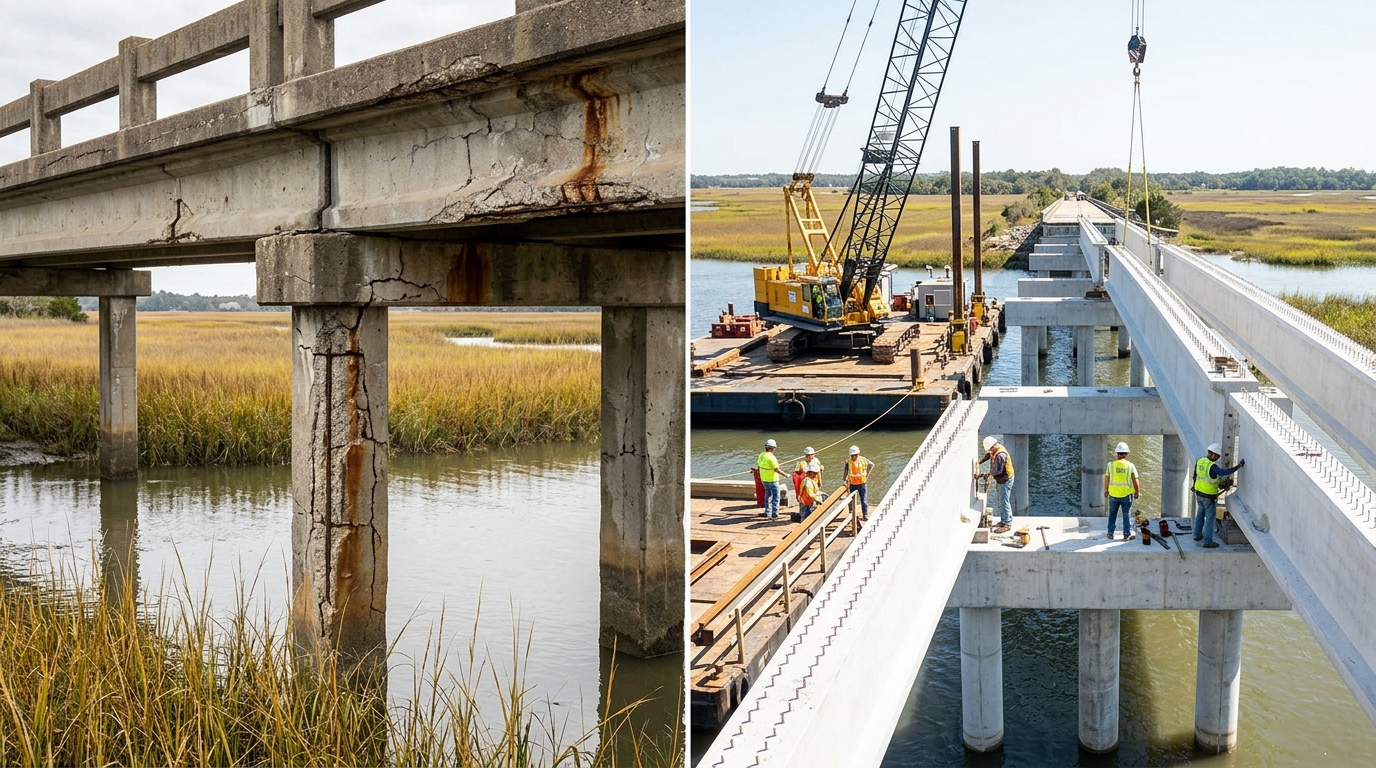
Here’s what’s actually happening under those bridges and along coastal roads: chloride ions from saltwater and salt air work their way into standard concrete over time. Once they hit the steel reinforcing bars inside — the rebar that gives concrete its strength — they trigger rust. And rust expands. It expands so much it cracks the concrete from the inside out, which lets in more salt, which causes more rust. It’s a brutal feedback loop.
Engineers call it chloride-induced corrosion. You can just call it expensive.
SCDOT (South Carolina Department of Transportation) has spent hundreds of millions of dollars over the decades patching, repairing, and replacing bridges and road sections that got chewed up by this exact process. Some of these structures were only a couple decades old when they needed major work. In a region where bridges are the literal lifeline connecting barrier islands and coastal communities to the rest of the state, that’s not just a budget problem — it’s a safety and access problem.
And honestly? Standard concrete was never really built for this environment. It was designed for places where the ground doesn’t taste like the ocean.
So What’s Corrosion-Resistant Concrete, Exactly?
Okay, let’s get into it — but I’ll keep this practical, not a chemistry lecture.
Corrosion-resistant concrete for coastal applications isn’t one single thing. It’s more like a category of upgraded concrete mixes and approaches specifically engineered to slow or stop that chloride corrosion cycle. A few of the most common approaches:
Supplementary cementitious materials (SCMs): Things like fly ash, silica fume, and slag get mixed into the concrete to make it denser and less permeable. Less permeable means it’s harder for salt to sneak in and reach that rebar.
Epoxy-coated or stainless rebar: Instead of standard steel, the reinforcing bars get a protective coating — or are replaced with materials that just don’t rust the same way. Corrosion-resistant concrete and corrosion-resistant rebar work together; you really want both.
Fiber-reinforced concrete: Adding fibers (steel, glass, synthetic) distributes stress and reduces micro-cracking, which is another entry point for saltwater.
Graphene-enhanced concrete: This is where things get genuinely interesting. Graphene — yes, the same material that won a Nobel Prize — added in small amounts to concrete mixes has shown dramatic improvements in strength and impermeability. If you haven’t read about graphene concrete’s potential for roadways and highway construction in South Carolina, it’s worth a look. The material is still scaling up, but the early results are hard to ignore.
The common thread across all these approaches: make it harder for salt to get in, and reduce or eliminate the vulnerable steel that reacts when it does.
Why This Matters More Than Most Homeowners Realize
You might be thinking — okay, but that’s a government infrastructure problem. What does this have to do with me?
More than you’d think.
When a bridge on a key coastal route goes down for emergency repairs, it doesn’t just inconvenience commuters. It affects property values. It affects emergency response times. It affects whether your contractor can get to your renovation job on time. In some Lowcountry communities, there’s literally one bridge in and one bridge out — and when that bridge needs serious work, everything gets complicated.
There’s also the less obvious issue of coastal road degradation. Salt air doesn’t just attack bridges; it attacks the roadbed, the drainage structures, the culverts under local roads. When roads start showing accelerated deterioration — pothole cycles that come back faster, surface cracking along coastal stretches — that’s often chloride corrosion at work underneath.
And here’s the thing: every dollar SCDOT doesn’t spend on premature repairs is a dollar available for new infrastructure. Corrosion-resistant concrete costs more upfront — sometimes 20-40% more depending on the mix and application. But the lifecycle math almost always favors it in coastal environments. A bridge that lasts 75 years instead of 35 years isn’t twice as good — it’s exponentially better when you factor in the disruption costs of closure and reconstruction.
What the Experts Are Actually Building With Now
If you talk to civil engineers working on coastal South Carolina projects, a few things come up consistently.
High-performance concrete (HPC) has become something close to standard on new bridge construction in coastal environments. The water-to-cement ratio matters enormously — lower ratios create denser concrete — and coastal specs now typically mandate mixes that would have been considered premium-grade a generation ago.
Impressed current cathodic protection (ICCP) sounds sci-fi but it’s real: small electrical currents run through the concrete to counteract the electrochemical reaction that causes rebar corrosion. It’s been used on some existing Lowcountry bridge structures as a retrofit when replacement isn’t in the budget.
Fiber-reinforced polymer (FRP) rebar is gaining traction for applications where long-term maintenance access is difficult — think submerged bridge pilings, coastal culverts, retaining walls near tidal zones. It doesn’t corrode at all, which is the whole point.
The honest truth is that the best projects are using multiple strategies at once. It’s not “pick one.” It’s picking the right combination for the specific exposure conditions of each structure.
The Lowcountry Is a Special Case — Even Among Coastal Environments
I want to make sure I’m not being generic here, because the Lowcountry genuinely is different from, say, the South Carolina Grand Strand or even the Virginia coast.
The tidal marsh environment means structures are often dealing with fluctuating water levels, not just constant submersion or just salt air. That tidal zone — where a bridge piling is sometimes wet, sometimes dry, sometimes in between — is actually the most corrosive zone. The repeated wetting and drying cycles drive chloride deeper into concrete with each cycle.
The soil chemistry here is also aggressive. Pluff mud, the dark, sulfur-smelling sediment that defines Lowcountry waterways, is mildly acidic and contains sulfates that attack concrete binders. Structures with foundations in pluff mud are dealing with a double threat.
And then there’s the hurricane factor. When Lowcountry bridges take storm surge hits, they’re getting a concentrated blast of highly saline water pushed at velocity into every crack and joint. A structure that was “fine” before a storm can be significantly compromised afterward — even without visible damage — because of the chloride loading that just happened.
All of which is to say: the Lowcountry doesn’t need “coastal concrete.” It needs the best coastal concrete available.
FAQ: What Homeowners Actually Ask
Does corrosion-resistant concrete matter for private driveways and walkways near the water?
Yes, actually. If you’re installing a concrete driveway, seawall cap, dock approach, or patio within a few hundred feet of tidal water, asking your contractor about silica fume or fly ash admixtures and epoxy-coated rebar is worth the conversation. The upcharge is much smaller at the residential scale than it sounds.
How can I tell if an existing bridge near me is deteriorating from corrosion?
Look for rust staining (brown streaks running down from cracks), spalling (chunks of concrete flaking off), exposed rebar, or visible cracking along the underside of bridge decks or on pilings. These are visual warning signs. If you see them on a public bridge, report it to SCDOT.
Is graphene concrete actually commercially available yet?
It’s getting there. Several manufacturers now offer graphene-enhanced concrete admixtures, and pilot projects are underway. It’s not yet the default choice for most projects — primarily a cost and supply chain issue — but it’s moving from research to real-world application faster than most new construction materials do. The potential for South Carolina’s highway infrastructure is significant.
Why does it seem like some newer bridges are already showing wear?
Sometimes specs that look good on paper get value-engineered during construction — cheaper concrete, standard rebar instead of epoxy-coated. Sometimes the damage is from storm events accelerating an otherwise normal aging process. And honestly, sometimes the design didn’t account adequately for the specific exposure of that site. There’s no single answer, but premature deterioration on newer structures is almost always a story about chloride getting somewhere it shouldn’t have.
Where This Is All Heading
The good news is that the engineering community genuinely understands the Lowcountry corrosion problem now in a way it didn’t 40 years ago. New projects are being spec’d with much more aggressive corrosion resistance as a baseline. Materials like graphene-enhanced concrete are moving from experimental to practical faster than skeptics expected.
The less good news is that there’s a significant backlog of aging infrastructure — bridges and coastal roads built in the 60s, 70s, and 80s with standard concrete that’s now at or past its design life. Working through that backlog is a long, expensive process.
For homeowners, the takeaway is this: the infrastructure connecting you to the coast is in a fight against the environment, and it’s a fight that never really ends. The best materials help. The right specs help. And staying informed — knowing what’s being built and how — matters more than most people realize.
If you’re curious about what next-generation corrosion-resistant concrete could mean for your area’s infrastructure, or if you’re a builder or developer working on a coastal project, understanding graphene concrete’s applications for coastal road construction is a good place to start the conversation.
The Lowcountry is worth protecting. The infrastructure that connects it is too.