

Alkali-Silica Reaction in Nevada Concrete: How Graphene Helps
Alkali-Silica Reaction in Nevada Concrete: How Graphene Helps
There’s a particular kind of frustration that comes with watching concrete you built — or concrete you’re responsible for — fall apart in ways that don’t make obvious sense.
No freeze-thaw. No salt spray. No heavy overloading. The slab just… starts cracking. And not the normal surface cracks you expect from shrinkage. These are deeper, more chaotic, almost like the concrete is cracking from the inside out. Because it is.
If you’re working with concrete in Nevada — and especially if you’re dealing with infrastructure along I-15, US-95, or anywhere in the Las Vegas or Reno metro areas — alkali-silica reaction is something you need to understand. It’s one of the most destructive and least visible concrete problems in the American Southwest, and Nevada’s specific geology makes the state particularly vulnerable.
The good news is that graphene-enhanced concrete is emerging as a genuinely promising tool in the fight against ASR. Not a silver bullet — nothing in concrete really is — but a meaningful improvement over what’s been available.
This article breaks down what ASR actually is, why Nevada is especially prone to it, the mechanisms that make it so damaging, and where graphene concrete fits into the picture. If any part of this connects with what you’ve been seeing on your projects, stick with me.
First: What Is Alkali-Silica Reaction, Really?
Before the list, a quick explanation — because ASR is genuinely misunderstood even by people who’ve been working in concrete for years.
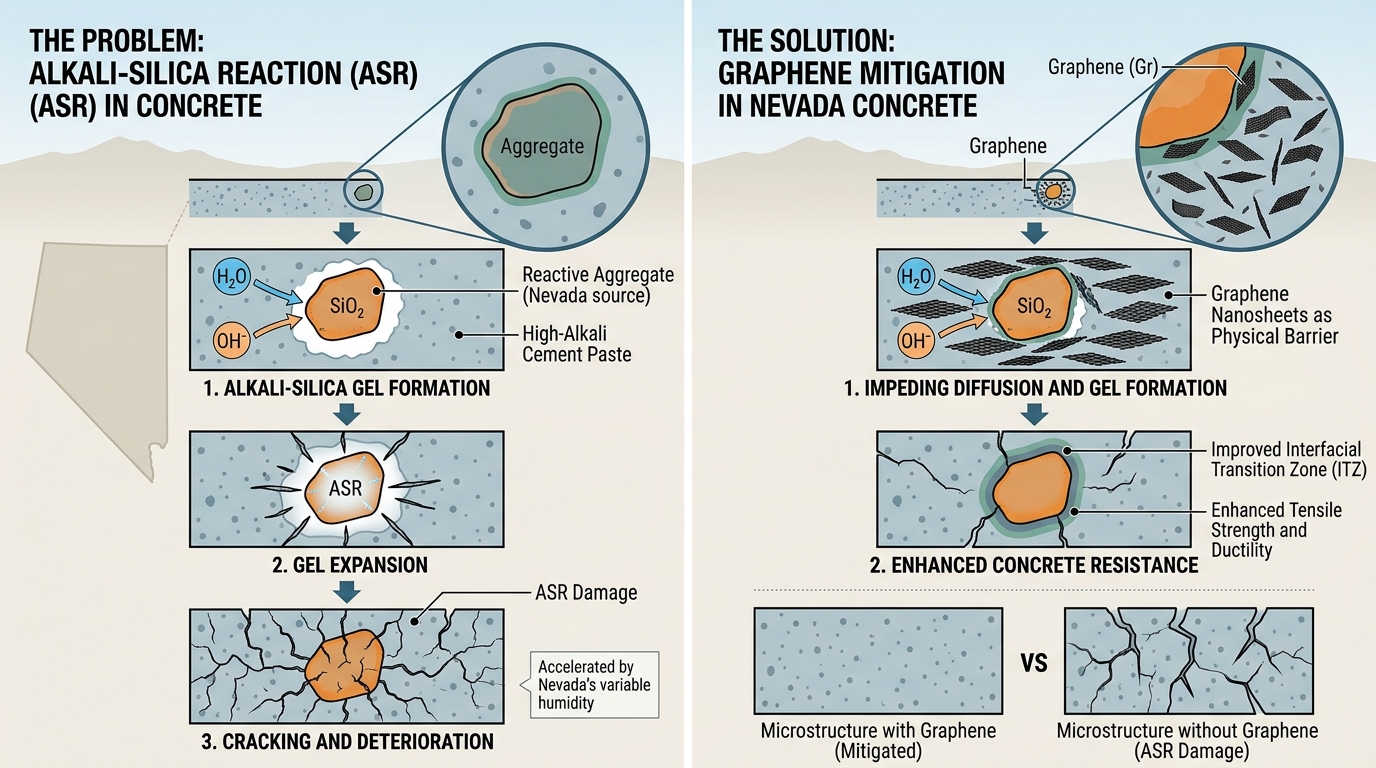
Alkali-silica reaction is a chemical reaction that happens inside hardened concrete between the alkali hydroxides in cement paste and certain forms of reactive silica found in aggregates. When those two things meet in the presence of moisture, they form a gel. That gel absorbs water and expands. And because it’s trapped inside a rigid concrete matrix, the expansion creates internal pressure that eventually cracks the concrete.
It’s slow. That’s part of what makes it so insidious. You can have a structure that looks fine for five years and then starts deteriorating noticeably in year eight. By the time the cracking is visible on the surface, the reaction has often been underway for a long time.
The cracking pattern it creates — called “map cracking” or “crazing” — looks different from other types of concrete distress. It’s a network of irregular cracks that spreads across the surface without following obvious stress lines. And sometimes you’ll see a whitish gel exuding from the cracks. That’s the ASR gel itself, pushed to the surface by internal pressure.
Now that you know what we’re dealing with, here’s why Nevada is a particularly tough place for it.
1. Nevada’s Aggregates Are Heavily Reactive
This is where the problem starts, and it’s geographical more than anything else.
Nevada’s geology is dominated by volcanic and metamorphic rock formations that contain reactive forms of silica — particularly opaline silica, chalcedony, and volcanic glass. These aren’t obscure minerals. They’re common in the aggregate sources that Nevada contractors have been pulling from for decades. The Las Vegas Valley, the Reno-Sparks corridor, and the rural stretches in between all draw from aggregate sources that have known or potential reactivity.
Here’s the thing: not all silica is reactive for ASR purposes. Crystalline quartz — the kind in granite — is largely non-reactive. But the amorphous or poorly crystallized silica forms that show up in volcanic and altered sedimentary rock? Those react readily with cement alkalis.
The practical implication is that Nevada contractors can’t assume their aggregate is safe. Testing is essential — specifically ASTM C1260 (mortar bar test) or ASTM C1293 (concrete prism test) for aggregate reactivity assessment. If you’re sourcing aggregate in Nevada and those tests haven’t been run recently, you’re building on assumptions.
The insight worth holding onto: Aggregate reactivity varies not just by source location but by quarry depth and geological zone within a single source. A batch that tested clean a few years ago may not represent what’s coming out of the same quarry today.
2. Nevada’s Heat Accelerates the Reaction
Temperature matters for ASR in a way that Nevada contractors need to understand clearly.
The ASR reaction rate is temperature-dependent. Warmer temperatures accelerate the reaction kinetics — which means the gel forms faster, the expansion happens sooner, and the visible deterioration arrives earlier than it would in a cooler climate. Nevada’s summer temperatures, particularly in the Las Vegas Valley where summer highs routinely exceed 110°F, create conditions that push ASR along faster than standard testing protocols sometimes anticipate.
This has real implications for how you interpret lab test results. Standard ASTM accelerated mortar bar tests run at 80°C. Real-world performance in Nevada’s summer heat doesn’t perfectly mirror those conditions. The reaction happens at different temperatures and moisture levels, which means test results are informative but not perfectly predictive for Nevada-specific applications.
What this means practically: structures in hotter Nevada locations may see ASR-related deterioration earlier in their service life than similar structures in cooler climates, even with the same aggregate and cement combination. Planning for this — in materials selection, in structural detailing, in inspection schedules — is part of building well in this environment.
The insight worth holding onto: Nevada’s heat doesn’t just stress concrete mechanically. It’s chemically significant. Material selection decisions that would be fine in a cooler climate may not hold up the same way in the Mojave.
3. The Moisture Paradox in the Desert
Here’s something that surprises people: Nevada is a desert, and ASR requires moisture. So why is ASR such a problem here?
The answer is that concrete doesn’t need to be submerged or even visibly wet for ASR to proceed. The reaction requires moisture at the microscopic level — within the capillary pores of the concrete matrix. And despite Nevada’s dry climate overall, concrete in infrastructure applications finds moisture in ways that aren’t always obvious.
Bridge decks receive moisture from traffic-splash and precipitation events. Pavement in contact with the ground can wick moisture from below. Structures in areas with even periodic rainfall — and Nevada does get rain, particularly in the monsoon season — cycle through wet-dry conditions that are actually good at pumping moisture into concrete pores over time. Nighttime dew and condensation contribute in ways that don’t register as “wet conditions” but matter at the microscopic level.
The paradox is that periodic wetting may actually be worse for ASR than continuous saturation in some ways. The wet-dry cycling keeps the reaction active rather than reaching equilibrium, sustaining gel formation over a longer period.
The insight worth holding onto: Don’t let Nevada’s dry reputation lead you to underestimate moisture availability for ASR. Infrastructure concrete is rarely as dry as the air around it.
4. Standard Mitigation Strategies and Their Limits
This is where we get into what’s currently being done — and where the gaps are.
The standard toolkit for ASR mitigation in Nevada concrete includes supplementary cementitious materials (SCMs) like fly ash, slag, and silica fume. These work by reducing the alkali content available in the pore solution (fly ash and slag) or by consuming reactive silica before it can form the expansive gel (silica fume). They’re effective. NDOT has used them on projects with reactive aggregates for years.
Low-alkali cements are another tool — using cement with reduced alkali content (Na₂O equivalent below 0.60%) limits the alkali supply for the reaction. Combined with SCMs, this can meaningfully reduce ASR risk.
Lithium-based admixtures represent another approach: lithium compounds alter the chemistry of the ASR gel, producing a non-expansive form that doesn’t generate the internal pressure that causes cracking. They’re effective but add cost and require careful dosage.
But here’s the honest limitation of all these approaches: they reduce ASR risk. They don’t eliminate the concrete’s permeability or improve its resistance to moisture ingress, which is the delivery mechanism for everything that makes ASR go. And they don’t provide the structural benefits — strength, durability — that you’d get from a fundamentally better concrete matrix.
The insight worth holding onto: Current ASR mitigation is mostly about chemistry management within the mix. Improving the concrete matrix itself — making it denser and less permeable — is a different and complementary approach.
5. How Graphene-Enhanced Concrete Changes the Equation
This is the part I find genuinely interesting, and it’s worth explaining carefully.
Graphene concrete for Nevada roadways and highway construction addresses the ASR problem partly through a different mechanism than traditional mitigation strategies. Here’s how.
Graphene nanoplatelets, when properly dispersed through a concrete mix, fill the microstructural voids in the cement paste matrix. The result is a denser concrete with significantly reduced permeability. And reduced permeability matters for ASR because it limits the moisture availability at the microscopic level — less moisture reaching the reactive silica-alkali interface means a slower, less aggressive reaction.
Beyond permeability, graphene-enhanced concrete is mechanically tougher. The flexural strength improvements — typically in the range of 20–30% over equivalent control mixes — mean the concrete matrix can better resist the internal expansion pressure generated by ASR gel. The cracks that ASR eventually causes in conventional concrete take longer to initiate and propagate in a graphene-enhanced matrix.
This doesn’t mean graphene concrete is ASR-immune. It isn’t. If you’ve got highly reactive aggregates and high-alkali cement, you still need the standard mitigation chemistry. But graphene concrete used in combination with standard SCM-based ASR mitigation creates a genuinely more durable result than either approach alone — better chemistry control plus a denser, tougher matrix.
The insight worth holding onto: Think of graphene concrete as a structural upgrade that complements chemical ASR mitigation, not a replacement for it. Together, they address the problem from multiple angles simultaneously.
6. Real-World Application: Where This Makes the Most Sense in Nevada
Not every Nevada concrete project needs to be an ASR mitigation exercise. But for applications where ASR risk is real and the cost of failure is high, here’s where the graphene concrete approach makes the strongest case.
Bridge decks and structures: ASR in bridge deck concrete is expensive to address — deck replacements on active highway bridges involve closure costs, detour costs, and agency downtime that make the initial material premium look modest by comparison. Higher-durability concrete that delays deterioration onset by years pays back multiple times over.
Pavement in volcanic aggregate zones: If you’re paving in areas where the aggregate source has documented reactivity, building ASR resistance into the pavement mix design is worth the investment. Pavement replacement on Nevada’s high-traffic corridors is enormously disruptive.
Infrastructure with long design service lives: Structures being built today that are expected to last 50–75 years are exactly the context where upfront material investment in durability makes sense. ASR operates on a timeline where the reaction initiated at year one might not cause visible problems until year fifteen — but it’s accumulating the whole time.
The insight worth holding onto: The projects where ASR mitigation pays back best aren’t always the ones with the most obvious immediate exposure. Think about what the repair cost and disruption looks like at year twenty, and work backward to what material choice makes sense today.
7. What NDOT’s Approach Looks Like — And Where Graphene Fits
Nevada Department of Transportation has well-developed protocols for ASR mitigation on state projects — they’ve been dealing with reactive Nevada aggregates for long enough that the standard practices are genuinely sophisticated.
NDOT typically requires petrographic examination and aggregate reactivity testing, specifies SCM replacement rates based on reactivity classification, and has requirements for low-alkali cement on projects with reactive aggregates. It’s a serious, data-driven approach.
Graphene concrete in Nevada highway construction isn’t yet a standard NDOT specification — it sits in the materials innovation category, requiring documented performance data and project-specific approval for state work. But that pathway exists, and the combination of ASR mitigation chemistry with graphene-enhanced matrix density is a compelling technical case to make to NDOT materials engineers, particularly on high-value, long-service-life structures.
For private and municipal work, the approval constraints are lighter, and there’s more room to move immediately.
Key Takeaways
If you want to pull the thread out of everything above, here it is:
Nevada’s geology, climate, and moisture dynamics combine to create real ASR risk for concrete infrastructure — more than the desert reputation suggests. Reactive aggregates are common in Nevada’s main aggregate-producing regions. Heat accelerates the reaction. And periodic moisture — even in a generally dry climate — is enough to keep ASR going.
Standard mitigation strategies (SCMs, low-alkali cement, lithium admixtures) are effective and should be used on reactive-aggregate projects. They work by managing the chemistry of the reaction.
Graphene-enhanced concrete adds a structural dimension to that mitigation: a denser, lower-permeability matrix that limits moisture availability and better resists the internal expansion forces that ASR generates. Used together, these approaches are meaningfully more effective than either alone.
The practical opportunity is clearest on high-value, long-service-life applications — bridge decks, major pavement projects, structures with significant rehabilitation costs — where the upfront investment in better materials pays back over time.
Where to Go From Here
ASR isn’t a problem you can ignore and hope doesn’t catch up with you. In Nevada’s geological environment, working with reactive aggregates without understanding your mitigation options is genuinely risky — not in a theoretical sense, but in the “you’ll be looking at map-cracked concrete in ten years wondering what happened” sense.
If you want to understand more about how graphene concrete is being applied to Nevada highway and roadway construction, that’s a solid place to dig deeper. And if you’re designing a project with known reactive aggregates and want to think through what a combined mitigation-plus-graphene approach might look like — reach out. The conversation is worth having before the concrete is poured, not after the cracks show up.
The problem is solvable. The tools are here. It’s just a matter of using them in the right combination.