

Graphene Concrete for NC’s Outer Banks & Coastal Infrastructure
Graphene Concrete for NC’s Outer Banks & Coastal Infrastructure
If you’ve ever driven US-158 across the Wright Memorial Bridge at dawn with the sound coming off Currituck Sound, you know there’s nowhere else quite like the Outer Banks.
And if you’ve ever had to build or maintain anything out there, you also know it’s one of the most unforgiving environments on the East Coast for concrete infrastructure.
The Outer Banks isn’t just coastal. It’s a narrow ribbon of barrier islands with Atlantic Ocean on one side and Pamlico Sound on the other, battered by nor’easters, hurricane remnants, and salt-laden wind that works its way into every pore of every surface you put down. The bridges — Oregon Inlet, Bonner, the Virginia Dare Memorial — are marvels of engineering, and they’re also constant reminders of how hard this environment is on concrete.
So when contractors and engineers working North Carolina’s coast ask about materials options, it’s not abstract curiosity. It’s a genuine search for something better, because the status quo keeps failing on a predictable schedule.
This article is a comparison — an honest look at how conventional concrete approaches stack up against graphene-enhanced concrete for the specific demands of the Outer Banks and North Carolina’s broader coastal infrastructure. Not hype. Just what the options are, what they’re each good at, and where graphene concrete genuinely changes the equation.
The Core Problem: Why the Outer Banks Eats Concrete
Before comparing any materials, it helps to understand exactly what we’re designing against out here.
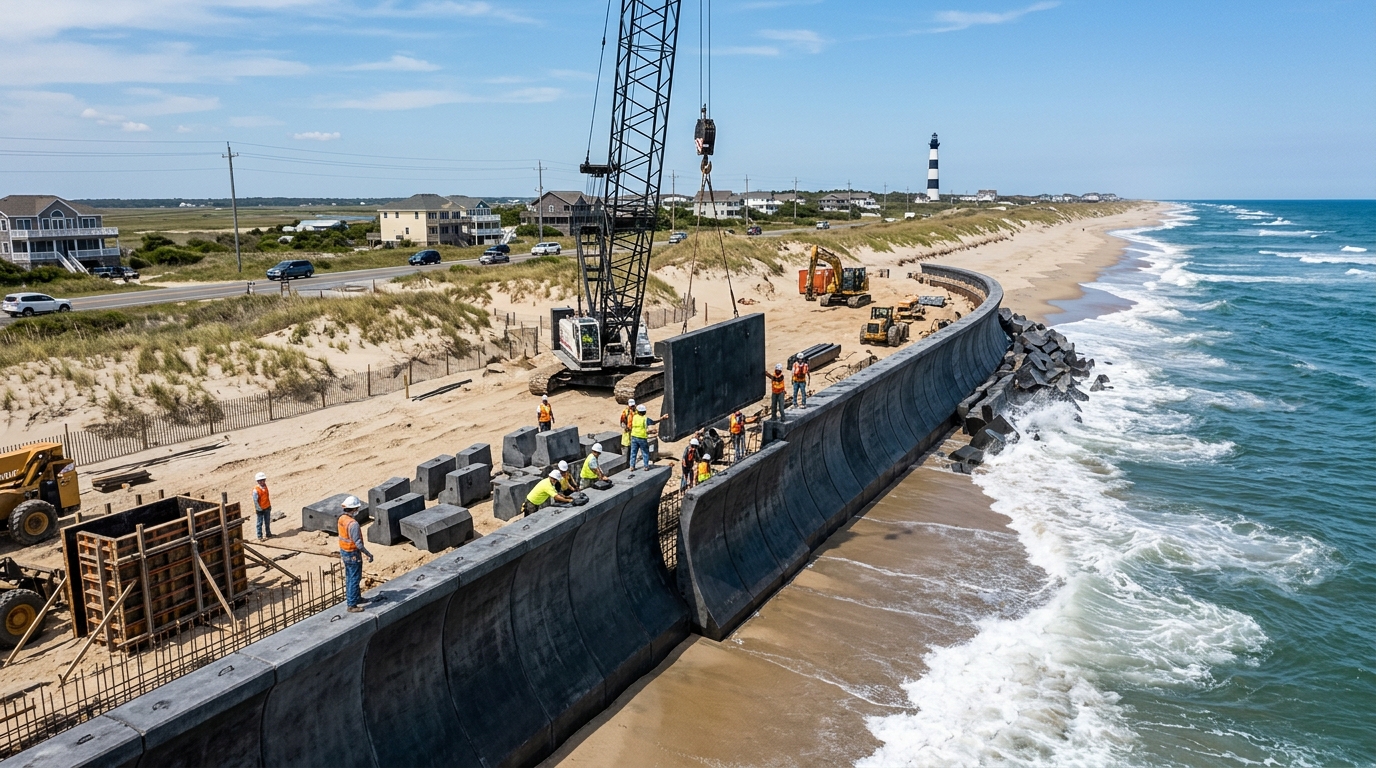
The Outer Banks environment creates a perfect storm for concrete deterioration. Salt spray and salt-laden air penetrate concrete surfaces and reach reinforcing steel, setting off the corrosion cycle that eventually cracks concrete from the inside out. Wind-driven sand acts as an abrasive, accelerating surface wear. Tidal exposure on bridge elements cycles concrete through wet-dry conditions that pump chlorides deeper into the matrix over time. And storm surge events can submerge infrastructure that wasn’t designed for full immersion.
Add to that the logistical reality of building on barrier islands — limited access, construction windows constrained by tourism season and storm season, materials that have to travel across bridges or by barge — and you’ve got a situation where every year of additional service life from better materials translates directly into real money saved and real disruption avoided.
That’s the context for everything that follows.
Option 1: Standard Portland Cement Concrete
This is the baseline. Standard PCC is what most NCDOT coastal projects have been built with historically, and it’s the reference point for every comparison.
What it is: Conventional concrete using Portland cement, aggregate, and water, meeting standard NCDOT mix design requirements.
Where it works: Inland projects, low-exposure applications, situations where cost and simplicity matter most. Standard PCC is battle-tested, widely available, and every contractor in North Carolina knows how to work with it.
Where it struggles: Coastal environments like the Outer Banks. The permeability of standard PCC is high enough that chloride penetration is essentially inevitable given enough time. On the coast, “enough time” is often measured in years, not decades.
The honest pros: Low cost, universal contractor familiarity, no approval complications, straightforward QC. If you’re building a parking structure in Raleigh, standard PCC is often the right call.
The honest cons: In marine environments, it deteriorates faster than anyone wants. The repair cycle is real, predictable, and expensive. NCDOT knows this. Every contractor who’s maintained coastal infrastructure knows this.
Cost: Lowest initial cost. Highest lifecycle cost in aggressive exposure environments.
Option 2: High-Performance Concrete (HPC)
NCDOT has specified high-performance concrete on major bridge projects for years, particularly in coastal applications where durability matters.
What it is: Concrete engineered for superior performance — typically lower water-cement ratios, supplementary cementitious materials (fly ash, silica fume, slag), and tighter QC requirements than standard mixes.
Where it works: Major coastal bridge structures, bridge decks, marine substructure elements. The Bonner Bridge replacement (now the Marc Basnight Bridge) used high-performance concrete elements specifically because of the exposure conditions at Oregon Inlet.
Where it struggles: HPC costs more and demands more from QC and placement crews. It doesn’t eliminate chloride penetration — it slows it. Over a long enough timeline in severe exposure, HPC still faces durability challenges.
The honest pros: Meaningful durability improvement over standard PCC. NCDOT-approved, spec’d on major projects, contractors with experience in NC coastal HPC aren’t hard to find. Well-documented performance data.
The honest cons: Premium cost over standard PCC. Requires more careful mix design and placement. Not a permanent solution to chloride-driven deterioration — a better one.
Cost: Moderate to significant premium over standard PCC, depending on mix design specifics.
Option 3: Supplementary Cementitious Materials (SCMs)
Fly ash, slag, and silica fume have been part of NCDOT’s toolkit for coastal concrete for a long time, either as standalone modifications or incorporated into HPC mixes.
What they are: Industrial byproduct materials that partially replace Portland cement in a mix, improving specific performance characteristics.
Where they work: Fly ash and slag improve long-term strength development and reduce permeability. Silica fume in particular is excellent at filling the microstructural voids that allow chloride penetration — it’s a common addition to coastal bridge deck mixes in NC.
Where they struggle: SCMs improve standard concrete but don’t fundamentally change the performance ceiling. They’re tools in a mix design kit, not a solution by themselves.
The honest pros: Well-established, NCDOT-approved, cost-effective improvements to base concrete performance. Easy to incorporate into existing mix designs.
The honest cons: The improvement is incremental, not transformational. Silica fume mixes require careful water management and finishing because of changed workability characteristics.
Cost: Modest premium, often offset partially by replacing some Portland cement content.
Option 4: Epoxy-Coated and Corrosion-Resistant Reinforcement
Worth including because it approaches the problem from a different angle — protecting the steel rather than making the concrete more impervious.
What it is: Epoxy-coated rebar, stainless steel rebar, or fiber-reinforced polymer (FRP) rebar as corrosion protection strategies.
Where it works: Bridge decks in splash zones, marine substructure elements, anywhere chloride-driven corrosion is the primary failure mode. NCDOT has used epoxy-coated rebar on coastal projects extensively.
Where it struggles: Epoxy-coated rebar has a known failure mode — coating damage during handling creates corrosion initiation points. Stainless and FRP rebar are expensive. And none of these approaches address the concrete matrix itself — they just protect what’s inside it.
The honest pros: Directly addresses the corrosion mechanism. Stainless and FRP eliminate the corrosion risk essentially entirely.
The honest cons: High cost for stainless/FRP. Epoxy coating performance is only as good as handling procedures. Doesn’t improve concrete durability — just buys time before the corrosion clock starts.
Cost: Epoxy: modest premium. Stainless: significant premium. FRP: very high premium, with some lifecycle cost justification on critical elements.
Option 5: Graphene-Enhanced Concrete
And here’s where the comparison gets genuinely interesting.
Graphene concrete for North Carolina roadways and highway construction is moving from research-phase technology to practical application — and the performance characteristics map almost specifically onto the Outer Banks’ problems.
What it is: Standard concrete mix incorporating graphene nanoplatelets at a fraction of a percent by weight. The graphene particles fill microstructural voids, reinforce the cement paste matrix, and fundamentally change the concrete’s permeability and mechanical properties.
Where it works: Coastal and marine environments where permeability is the key failure driver. Bridge decks, pavement in splash zones, substructure elements with tidal exposure. Anywhere you want concrete that chlorides have a genuinely hard time getting through.
Where it stands out: The permeability reduction is the headline. Properly formulated graphene concrete can achieve chloride permeability ratings (ASTM C1202) in the “very low” range — a meaningful step beyond what HPC typically achieves with SCMs alone. Combined with the 20–30% strength improvements that are consistently documented, you’re looking at concrete that is both stronger and more resistant to the primary failure mechanism in coastal environments.
The honest pros: Superior permeability reduction compared to standard HPC. Strength improvements that can allow for mix optimization. Longer service life potential — which in an environment like the Outer Banks, where every repair involves bridge closures, access challenges, and tourism-season timing constraints, has enormous practical value.
The honest cons: Not currently a standard NCDOT specification. Requires a mix design with proper dispersion — this isn’t a commodity additive situation. Costs more than standard PCC. The approval process for NCDOT projects requires documentation and, in some cases, formal materials review.
Cost: Premium over standard PCC. The lifecycle cost picture, particularly for coastal applications with high repair and access costs, is often favorable — but that calculation has to be done project-by-project.
Putting It Side by Side
Here’s a direct read on how these options compare across the factors that matter most for Outer Banks and NC coastal applications:
Chloride resistance: Graphene concrete leads, followed by silica-fume HPC, then standard HPC with SCMs, then standard PCC. Corrosion-resistant rebar addresses this indirectly.
Structural performance: Graphene concrete and HPC are comparable and both superior to standard PCC. SCMs add long-term strength. Rebar choices don’t affect the concrete’s structural properties.
NCDOT approval status: Standard PCC, HPC, and SCMs are fully established. Epoxy rebar is standard. Stainless/FRP have NCDOT precedent. Graphene concrete requires project-specific documentation and approval — possible, but not off-the-shelf.
Contractor familiarity in NC: Standard PCC is universal. HPC with SCMs is well-understood on coastal work. Graphene concrete requires a learning curve that’s short but real.
Lifecycle cost in coastal environment: Graphene concrete is potentially best. Standard PCC is worst. HPC with SCMs sits in the middle.
Logistical fit for Outer Banks conditions: All concrete options face similar supply and access challenges. Graphene additives need to come from a qualified supplier, which adds one supply chain variable to manage.
The Recommendation — And How to Think About Your Project
Here’s my honest read on which option fits which situation.
Standard PCC: Only on the Outer Banks if cost constraints are absolute and the exposure is genuinely low. For most coastal NC infrastructure, the lifecycle cost argument against standard PCC is too strong.
HPC with SCMs: The right choice for major NCDOT coastal structures right now, when you need a proven, approved material with documented coastal performance. This is what you use when you can’t afford the approval timeline for something newer.
Epoxy rebar with HPC: Strong combination for bridge decks and splash-zone elements. Addresses both the concrete matrix and the reinforcement in the same project.
Graphene-enhanced concrete: The right choice when you’re on a project where the approval pathway is workable, where lifecycle performance is weighted heavily in the evaluation, or where you’re in a design-build or VE scenario that gives you room to make the case. The performance data for graphene concrete in North Carolina highway applications supports a serious case — you need the right project context to make it.
The decision framework, simplified: Start with your project’s approval flexibility. If you’re locked into prescriptive NCDOT specs with no innovation pathway, HPC with SCMs is your best available option. If you have flexibility — performance specs, VE provisions, design-build delivery, or a pilot project designation — graphene concrete deserves a serious look.
FAQ: What People Actually Ask About This
Has graphene concrete been used on any NC coastal projects?
It’s an emerging technology in the state. Real-world applications are growing nationally, and the approval pathway exists through NCDOT’s materials review processes. But it hasn’t accumulated the same track record as HPC in North Carolina specifically — yet.
What’s the realistic service life improvement from graphene concrete in coastal NC?
Precise numbers are hard to give without knowing the specific project conditions, but the permeability data suggests meaningful service life extension versus standard HPC. Modeling from permeability test results is how engineers typically estimate this. A qualified graphene concrete supplier can help develop project-specific projections.
Can graphene concrete be combined with corrosion-resistant rebar?
Yes, and that combination is arguably the strongest approach for the most severe exposure conditions. Reducing concrete permeability with graphene while also eliminating the corrosion risk in the steel attacks the problem from both sides simultaneously.
How does graphene concrete handle the wind-driven abrasion on the Outer Banks?
The strength and surface hardness improvements from graphene-enhanced concrete do improve abrasion resistance. It’s not the primary selling point, but it’s a real secondary benefit in an environment where wind-driven sand is a constant surface stressor.
What should I bring to an NCDOT materials conversation about graphene concrete?
Third-party testing data addressing NCDOT’s standard performance metrics — compressive strength at 28 and 56 days, ASTM C1202 chloride permeability, durability indices. The more specifically the documentation addresses North Carolina’s coastal exposure conditions, the more useful the conversation will be.
The Bottom Line
The Outer Banks is beautiful. It’s also relentless on the infrastructure that serves it.
Every option covered here has a legitimate place depending on project type, approval context, and budget structure. But if you’re thinking seriously about the best available materials for North Carolina’s most demanding coastal applications, graphene-enhanced concrete is a conversation worth having — not because it’s new and exciting, but because the performance data for coastal durability is genuinely compelling.
If you want to go deeper on how graphene concrete is being approached in North Carolina highway and roadway construction, that’s a good next step. And if you’re working on a project where this might be the right fit — reach out to people who’ve already navigated the materials conversation. The coast doesn’t wait, and neither should you.