

Top 5 Advanced Concrete Products for Houston TX Construction Projects (2026)
Houston, Texas, is one of the most active construction markets in the entire United States. From sprawling commercial developments along the Energy Corridor to massive infrastructure expansions across Harris County, the demand for high-performance building materials has never been greater. Houston’s unique environment — defined by intense heat, humidity, heavy rainfall, flooding cycles, and expansive clay soils — places extraordinary stress on traditional building materials. Standard concrete, while still widely used, increasingly falls short of the demands placed on it by Houston’s climate and scale of development.
That is exactly why contractors, developers, and civil engineers across the Greater Houston area are turning to advanced concrete products in 2026. These next-generation materials are engineered to outperform conventional concrete in every measurable way — from compressive strength and crack resistance to waterproofing and long-term sustainability. Whether you are managing a high-rise residential project in Midtown, a commercial warehouse in Katy, or a highway expansion near Beltway 8, choosing the right advanced concrete product is one of the most important decisions you will make.
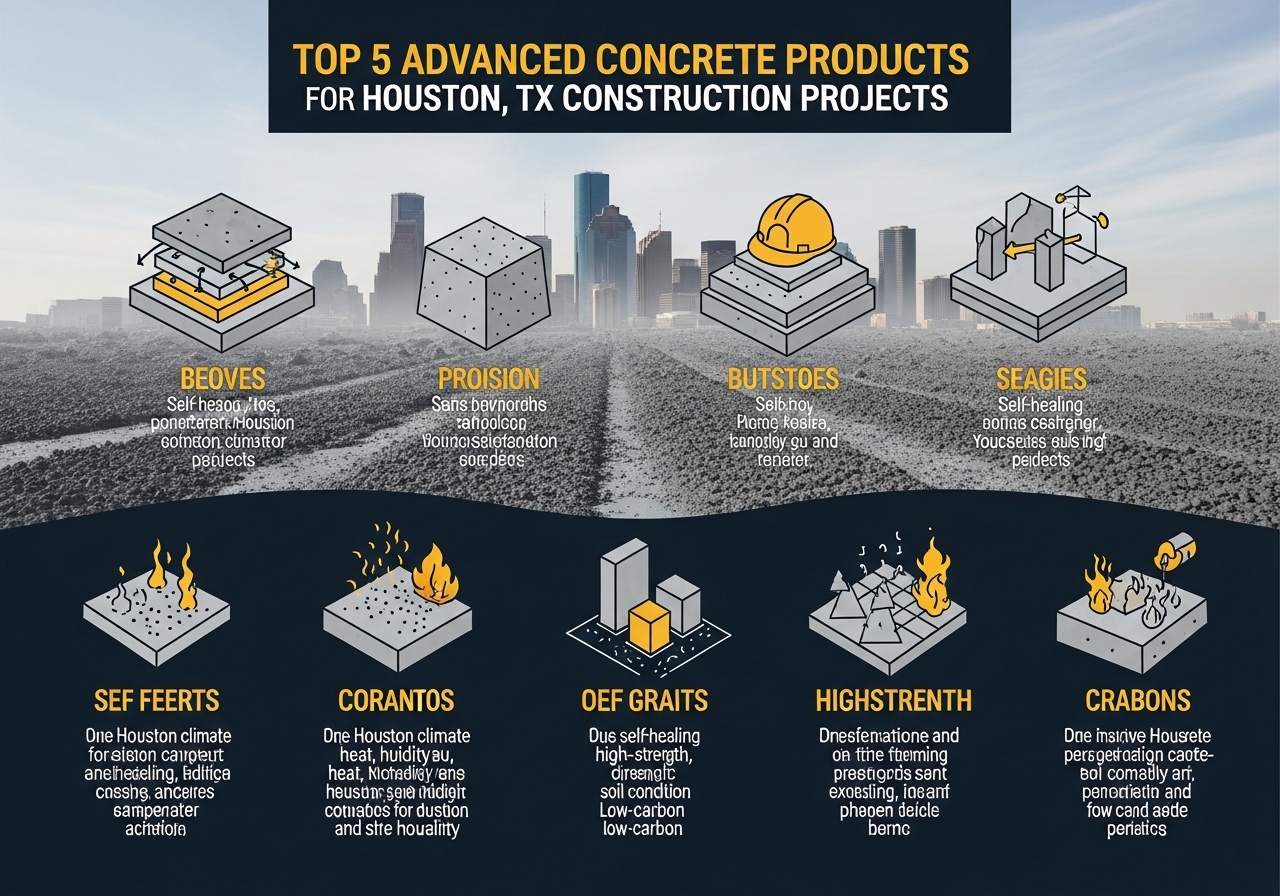
In this guide, we break down the top five advanced concrete products being used in Houston TX construction projects this year, and explain why each one deserves serious consideration for your next build.
1. Graphene-Enhanced Concrete: The Future of High-Performance Construction
Without question, the most transformative advancement in concrete technology to reach the Houston market is graphene-enhanced concrete. Graphene is a single layer of carbon atoms arranged in a hexagonal lattice, and it is considered one of the strongest materials ever discovered. When integrated into a concrete mix at even very small concentrations, graphene dramatically improves the mechanical and durability properties of the finished product.
For Houston contractors and project managers, the benefits of graphene concrete are particularly compelling. Houston’s extreme summer temperatures and frequent hurricane-season rainfall create a highly demanding environment for structural concrete. Graphene-enhanced mixes offer superior resistance to thermal cracking, moisture infiltration, and chemical attack — all of which are constant threats in the Houston climate.
Graphene concrete has been shown to increase compressive strength by up to 30% compared to standard mixes, while also improving tensile and flexural strength. This means structures can be built with less material without sacrificing structural integrity, which reduces both material waste and long-term maintenance expense. The improved density of graphene-infused concrete also makes it significantly more resistant to water penetration — a critical advantage in a flood-prone city like Houston.
If you are exploring options for your next Houston project, the advanced concrete products available through The Graphene Solution represent a cutting-edge approach that is already being adopted by forward-thinking builders across the region. From residential slabs to large-scale commercial foundations, graphene concrete is proving its value at every level of construction.
The applications in Houston are extensive. High-rise building foundations benefit from graphene’s added compressive strength. Industrial warehouse floors gain exceptional durability and resistance to heavy machinery loads. Road surfaces and highway infrastructure projects gain extended service life even under Houston’s punishing traffic volumes and weather cycles. To explore how graphene concrete is being applied to roadway and highway projects specifically in Texas, visit the dedicated page on graphene concrete roadways and highway construction in Texas.
2. Ultra-High-Performance Concrete (UHPC)
Ultra-High-Performance Concrete, commonly referred to as UHPC, is a specialized concrete formulation that achieves compressive strengths far beyond what conventional high-strength mixes can deliver. UHPC typically incorporates steel fibers, silica fume, quartz powder, and a very low water-to-binder ratio, resulting in a dense, nearly impermeable matrix.
In Houston’s construction landscape, UHPC is increasingly being specified for bridge decks, pedestrian overpasses, retaining walls, and other infrastructure elements where longevity and reduced maintenance are prioritized. The Texas Department of Transportation has shown growing interest in UHPC for bridge rehabilitation and new construction, particularly for structures spanning waterways and flood plains in the greater Houston area.
One of the standout properties of UHPC is its exceptional ductility despite its extreme hardness. Conventional high-strength concrete can be brittle, but the fiber reinforcement in UHPC allows it to deform slightly under load before cracking, giving engineers a much more predictable failure mode. This ductility also makes UHPC well-suited to seismic and impact loading scenarios.
For Houston’s port infrastructure, petrochemical facilities, and industrial complexes, UHPC offers a durable solution that can withstand aggressive chemical environments and heavy operational loads without significant degradation over time. Structures built with UHPC routinely achieve design lives exceeding 100 years with minimal maintenance intervention — a compelling advantage in a market where construction labor and material costs continue to rise.
When evaluating UHPC for bridge and overpass applications specifically, it is worth understanding how graphene technology is being incorporated into similar structural projects. The work outlined on graphene concrete for bridge and overpass infrastructure demonstrates how nanomaterial enhancement can complement or even outperform conventional UHPC formulations in certain applications.
3. Self-Compacting Concrete (SCC)
Self-Compacting Concrete is an advanced concrete formulation specifically engineered to flow and consolidate under its own weight without the need for mechanical vibration. SCC is designed with a carefully calibrated mix of superplasticizers, supplementary cementitious materials, and fine aggregates that give it a highly fluid yet stable consistency.
For Houston construction projects, SCC offers a number of practical advantages that go beyond simple convenience. In densely reinforced structural elements — such as the complex rebar cages used in high-rise columns, shear walls, and transfer beams — conventional concrete can struggle to fully consolidate around reinforcement. This leads to voids, honeycombing, and weak spots that compromise structural integrity. SCC eliminates this problem by flowing into every corner of a formwork system without any mechanical assistance.
Houston’s active high-rise construction sector has embraced SCC for exactly this reason. Projects in downtown Houston, Midtown, and the Medical Center district regularly specify SCC for critical structural pours where quality and consistency are non-negotiable. The reduced labor requirement for vibration also helps contractors control labor costs on large, multi-floor pours where time is at a premium.
Beyond high-rise construction, SCC is being used across Houston’s industrial construction market. Precast concrete manufacturers serving the Gulf Coast region use SCC extensively because it produces surfaces of exceptional quality with minimal finishing required. For tilt-up construction — a method extremely popular in Houston’s warehouse and logistics sector — SCC delivers a consistently smooth, dense surface that performs well in both structural and aesthetic applications.
SCC also pairs well with graphene enhancement. When graphene is incorporated into a self-compacting mix, the result is a concrete product that combines the workability advantages of SCC with the extraordinary mechanical properties that graphene delivers. This combination is particularly relevant for Houston’s industrial facilities and warehouse construction, a sector that demands durable, high-performance flooring solutions. More on this application can be found at graphene concrete for industrial facilities and warehouse construction.
4. Fiber-Reinforced Concrete (FRC)
Fiber-Reinforced Concrete incorporates discrete fibers — which may be steel, synthetic polypropylene, glass, or natural materials — distributed throughout the concrete matrix to enhance its post-crack performance, toughness, and durability. While fiber reinforcement has been used in concrete for several decades, the technology has advanced considerably, and 2026 sees a new generation of high-performance fiber blends reaching the Houston construction market.
In a city where thermal movement, ground settlement, and heavy traffic loads are everyday realities, the crack resistance offered by FRC is enormously valuable. Houston’s expansive clay soils are particularly notorious for causing differential settlement in slabs and foundations, which can initiate cracking in conventional concrete. Fiber-reinforced mixes distribute micro-stresses throughout the slab, dramatically reducing the formation and propagation of cracks.
For Houston’s retail and commercial flooring market, FRC has become a preferred specification for ground-bearing slabs. The improved toughness and impact resistance make it well-suited for environments with heavy foot traffic, forklift operations, and dynamic loading from retail racking systems. Warehouse facilities across the Beltway 8 corridor and the Northwest Houston logistics hub regularly specify fiber-reinforced slabs to extend the service life of their floors and reduce the frequency of costly repairs.
Steel fiber-reinforced concrete is also being adopted more widely in Houston’s tunnel and underground infrastructure projects. The combination of crack control and enhanced flexural strength makes it an excellent choice for tunnel linings and cut-and-cover structures where waterproofing and structural performance are equally critical. Contractors working on underground infrastructure in Houston will find useful context on how advanced concrete technology is applied to tunnel projects at graphene concrete for tunnel construction and underground infrastructure.
For exterior applications including parking structures, airport aprons, and marine terminals along the Houston Ship Channel, fiber-reinforced concrete with supplementary graphene enhancement delivers a particularly robust product that addresses both the structural and durability challenges of these demanding environments.
5. Geopolymer Concrete
Geopolymer concrete represents one of the most significant sustainability-focused advances in construction materials technology. Unlike ordinary Portland cement concrete, which is produced through a highly carbon-intensive manufacturing process, geopolymer concrete is made by activating industrial by-products — typically fly ash or ground granulated blast furnace slag — with an alkaline solution. The result is a binder that performs comparably to traditional cement while producing a fraction of the associated carbon emissions.
For Houston’s construction industry, geopolymer concrete holds strong appeal for several reasons beyond its environmental credentials. The material demonstrates excellent resistance to sulfate attack and acid exposure — both significant concerns in Houston’s industrial areas and along the Gulf Coast, where soils and groundwater can contain aggressive chemical compounds. It also shows superior performance in elevated temperature environments, making it an attractive option for industrial facility construction in the petrochemical and energy sectors that define so much of Houston’s economy.
Geopolymer concrete also has an inherently lower water absorption rate than conventional Portland cement concrete, which contributes to better durability in Houston’s wet climate. Structures built with geopolymer mixes tend to exhibit reduced carbonation depth over time, which translates to better long-term corrosion protection for embedded steel reinforcement.
As Houston developers and project owners face increasing pressure to meet green building standards and reduce the carbon footprint of their projects, geopolymer concrete provides a credible path to achieving sustainability targets without compromising structural performance. LEED-certified projects across Houston’s medical, educational, and commercial sectors are increasingly looking to geopolymer mixes as a key component of their low-carbon construction strategies.
It is worth noting that geopolymer concrete also serves as an excellent carrier matrix for graphene enhancement. Early research and field applications suggest that graphene-modified geopolymer concrete delivers even greater mechanical performance than either material achieves independently — a combination that could become a defining product category for Houston’s most demanding construction applications in the years ahead.
Why Houston Contractors Need to Think Differently About Concrete in 2026
The construction environment in Houston is changing rapidly. Regulatory requirements around resilience, sustainability, and longevity are tightening. Project owners are demanding longer maintenance cycles and lower lifecycle costs. Insurance underwriters are placing greater scrutiny on building materials and construction methods in flood-prone zones. And the labor market continues to incentivize construction methods that reduce on-site work and rework.
Against this backdrop, the advanced concrete products described above are not simply premium alternatives to standard mixes. They represent a necessary evolution in how Houston builds. Contractors who specify and master these materials today will be better positioned to win the large, complex, and high-value projects that will define Houston’s construction pipeline for the next decade.
For those looking to work with a team that understands both the material science and the practical Houston construction context, The Graphene Solution’s team of graphene concrete contractors in Houston offers expertise and supply chain access that can make the transition to advanced concrete products straightforward and efficient.
Choosing the Right Advanced Concrete Product for Your Houston Project
Selecting the right advanced concrete product requires a clear understanding of your project’s structural demands, environmental exposure conditions, timeline, and sustainability goals. There is no single product that is optimal for every application, which is why working with experienced materials specialists matters so much.
Graphene-enhanced concrete stands out as the most versatile option — applicable across residential, commercial, industrial, and infrastructure sectors, and compatible with many of the other advanced concrete technologies described in this article. Its combination of enhanced strength, reduced permeability, improved crack resistance, and long-term durability addresses virtually every challenge that Houston’s construction environment presents.
UHPC delivers unmatched performance for high-stress structural elements and long-span infrastructure. SCC maximizes quality and efficiency on complex structural pours. Fiber-reinforced concrete provides cost-effective crack control for slabs and ground-bearing elements. And geopolymer concrete charts the path toward a lower-carbon future for Houston’s rapidly growing built environment.
The bottom line is straightforward: Houston’s construction projects in 2026 demand materials that can match the ambition and scale of the city itself. Advanced concrete products — led by graphene-enhanced formulations — are ready to deliver.