

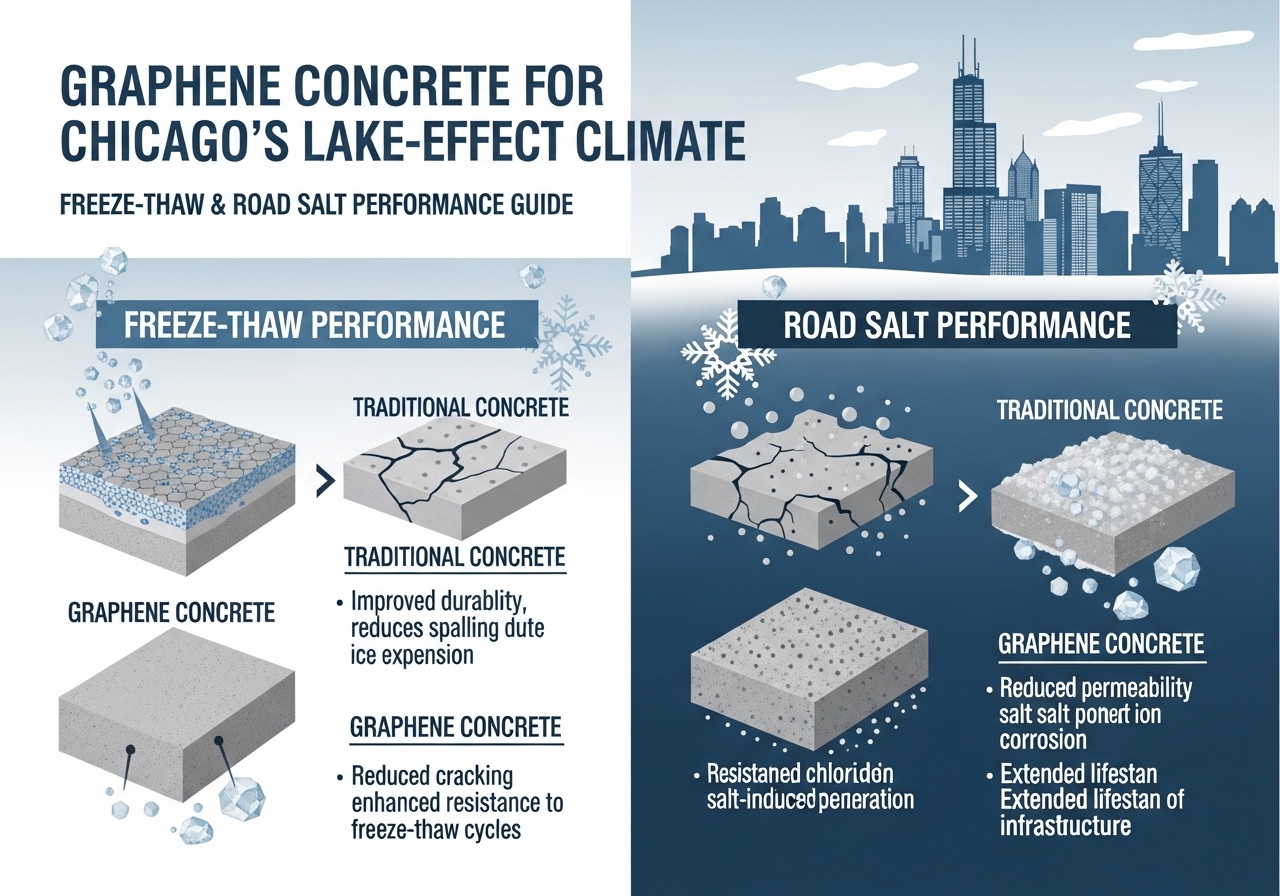
Graphene Concrete for Chicago’s Lake-Effect Climate — Freeze-Thaw & Road Salt Performance Guide
Chicago is not gentle on concrete. Anyone who has walked the Lakefront Trail in February, driven the Dan Ryan after a January thaw, or managed a commercial property along Michigan Avenue knows exactly what the city does to conventional building materials. The combination of lake-effect snowfall, dramatic temperature swings, and aggressive road salt application creates one of the most punishing environments for infrastructure in the entire United States. Traditional concrete, regardless of its mix design, simply was not engineered to survive this climate cycle after cycle without significant degradation.
That is changing. Graphene-enhanced concrete is emerging as the material best suited to Chicago’s brutal winters, offering a level of structural resilience that was previously unattainable with conventional Portland cement mixes. This guide breaks down exactly why Chicago’s climate is so damaging, how graphene changes the performance equation, and what contractors, engineers, and property owners throughout Illinois need to know before their next pour.
Understanding Chicago’s Lake-Effect Problem
Chicago sits at the southwestern edge of Lake Michigan, and that geography is central to understanding why its winters are so structurally destructive. Lake-effect snow occurs when cold Arctic air masses move across the relatively warmer open water of Lake Michigan, picking up significant moisture before dumping it on the city and surrounding communities. This mechanism produces snowfall events that are heavier, more localized, and far more frequent than the Midwest’s average would suggest.
What makes this particularly problematic for concrete is not just the snow — it is the accompanying temperature volatility. Chicago regularly experiences what engineers call multiple freeze-thaw cycles within a single week. Temperatures might climb above freezing during a midday sunny spell, partially thaw surface moisture, then plunge back into the teens or single digits overnight. Each of these cycles forces water that has penetrated the concrete’s surface pore structure to expand as it freezes. This expansion generates internal pressures that exceed the tensile strength of conventional concrete, resulting in surface scaling, delamination, and eventually full structural cracking.
The Illinois Department of Transportation has long documented the impact this climate has on roadways, bridges, and public infrastructure. Maintenance budgets for freeze-thaw-related damage represent a substantial portion of annual infrastructure spending, not because engineers made poor choices, but because the climate fundamentally limits how long traditional concrete can perform before requiring remediation.
The Road Salt Compounding Factor
Freeze-thaw damage alone would be serious enough. But Chicago layers a second, equally destructive force on top of it: road salt. The city and Illinois Department of Transportation apply millions of tons of deicing salts — primarily sodium chloride and calcium chloride — each winter across highways, arterials, side streets, sidewalks, bridges, and parking structures.
Road salt interacts with concrete in several damaging ways. Chloride ions migrate through the concrete’s pore network over time, eventually reaching embedded steel reinforcement and initiating a corrosion process that is both chemically aggressive and mechanically destructive. As rebar corrodes, it expands, generating internal pressure that causes the concrete cover to spall and delaminate from the inside out. This process, known as chloride-induced corrosion, is the primary failure mechanism in Chicago’s bridge decks, parking garage floors, and elevated highway slabs.
Beyond rebar corrosion, salt also accelerates surface scaling. Salt depresses the freezing point of water, creating a situation where more freeze-thaw cycling occurs at temperatures that would otherwise not be problematic. The saturated brine solution that forms when salt dissolves in surface moisture is particularly aggressive at attacking the concrete paste matrix, loosening aggregate particles and creating the rough, pitted surface texture that Chicagoans are familiar with on aging sidewalks and road pavements.
For a deeper look at how graphene concrete materials perform in Illinois’s specific construction environment, the broader context of statewide infrastructure challenges makes the case for innovation unmistakably clear.
What Graphene Does Differently
Graphene is a single layer of carbon atoms arranged in a hexagonal lattice. It is one of the strongest materials ever measured, with exceptional tensile strength, remarkable flexibility, and extraordinary ability to conduct both heat and electricity. When properly dispersed into a concrete mix, graphene does not simply add a coating or surface treatment — it changes the fundamental microstructure of the hardened cement paste.
The key mechanism is pore structure densification. Traditional concrete, even well-designed high-performance mixes, contains a network of capillary pores that form as excess mix water evaporates during curing. These pores are the primary entry point for both water and chloride ions. Graphene nanoplatelets, when uniformly dispersed, act as nucleation sites that encourage more complete hydration of cement particles and produce a far denser calcium silicate hydrate matrix. The result is a concrete with dramatically reduced porosity and a more tortuous pathway for any moisture or ionic species attempting to penetrate the material.
This microstructural change has direct consequences for freeze-thaw performance. Less water can enter the concrete, which means less ice formation within the pore network during freezing events. The internal pressure spikes that cause scaling and cracking are significantly reduced. Studies on graphene-modified cement composites have consistently demonstrated meaningful improvements in freeze-thaw resistance compared to conventional control mixes, with far less mass loss and surface deterioration after repeated cycling.
Freeze-Thaw Performance in Practical Terms
For Chicago contractors and engineers, the freeze-thaw performance question is not abstract. Illinois follows ASTM C666 testing protocols to evaluate concrete durability under freeze-thaw conditions, measuring relative dynamic modulus of elasticity as a proxy for internal microcracking after hundreds of freeze-thaw cycles. Conventional concrete, even with air entrainment — the standard approach for improving freeze-thaw resistance — typically shows measurable degradation between 200 and 300 cycles in aggressive testing conditions.
Graphene-enhanced concrete mixes show substantially better retention of structural integrity through the same testing protocols. The combination of reduced porosity and the graphene network’s inherent ability to arrest microcrack propagation produces a material that remains structurally sound over significantly more freeze-thaw cycles. This matters in Chicago because a typical winter season can expose horizontal concrete surfaces to dozens of real-world freeze-thaw events. Over a 10 to 20-year service life, that accumulates to a number that standard concrete was never designed to endure at full performance.
The crack-arresting behavior deserves particular attention. Graphene’s high tensile strength and its integration into the cement matrix means that when a microcrack does begin to form, the graphene platelets bridge the crack faces, requiring significantly more energy to propagate the crack further. This is analogous to how fiber reinforcement works in fiber-reinforced concrete, but operating at the nanoscale and therefore affecting the very first stages of crack initiation rather than only larger structural cracks.
For highway and roadway applications specifically, the graphene concrete roadway and highway construction benefits translate directly to longer pavement service life and reduced resurfacing frequency — a significant operational advantage for Illinois DOT projects and municipal road programs across the Chicago metro area.
Chloride Penetration and Rebar Protection
The road salt chloride penetration problem is where graphene’s reduced porosity delivers some of its most significant long-term benefits for Chicago infrastructure. Chloride ion diffusivity — the rate at which chloride ions move through hardened concrete — is directly related to the pore structure and connectivity of the cement paste. A denser, less permeable concrete dramatically slows this diffusion process.
For bridge decks, parking structures, and elevated roadways throughout the Chicago region, the difference between conventional concrete and graphene-enhanced concrete in terms of chloride diffusivity can translate into many additional years of service life before reinforcing steel begins to corrode. Given that bridge deck replacement and parking garage rehabilitation are among the most expensive and disruptive infrastructure projects that municipalities and private property owners face, this extended service window represents substantial value.
Concrete used in bridge and overpass infrastructure is particularly vulnerable to the combined assault of freeze-thaw cycling and chloride intrusion in northern Illinois. Graphene’s dual benefit — physical densification and crack suppression — addresses both damage mechanisms simultaneously, which is why bridge engineers are increasingly evaluating graphene-modified mixes as part of their high-performance concrete specifications for cold-climate applications.
Applications Across Chicago’s Built Environment
Chicago’s infrastructure challenges extend well beyond its famous expressway system. The city has an extensive network of parking structures, many of which are decades old and showing significant chloride-induced deterioration. Horizontal deck surfaces in multi-story parking garages are exposed to the same freeze-thaw and road salt conditions as open roadways, but with the added complication that deicing chemicals are tracked in by vehicles and concentrated in areas where drainage is imperfect.
Sidewalks, plazas, and hardscaping throughout the Loop and neighborhood commercial corridors experience direct salt application from building owners and city crews. The repeated scaling and surface deterioration that results from this treatment is both an aesthetic problem and a liability concern. Graphene-enhanced concrete for these flatwork applications offers surface durability that maintains its integrity far longer under repeated chemical exposure and freeze-thaw stress.
Industrial and warehouse facilities on Chicago’s southwest and northwest sides face their own version of the problem. Large-slab concrete floors near loading dock areas, where vehicle traffic combines with tracked-in winter moisture and salt, experience accelerated surface wear. The enhanced compressive strength and abrasion resistance of graphene concrete makes it well-suited for these high-traffic industrial floor applications as well.
For projects involving industrial facilities and warehouse construction, graphene concrete delivers a flooring solution that holds up against Chicago’s demanding seasonal conditions without the frequent surface treatment and patching cycles that conventional concrete requires.
Sustainability Considerations for Illinois Projects
Beyond raw performance, graphene concrete offers an important sustainability dimension that matters increasingly for Illinois public projects and private developments seeking LEED certification or sustainable design recognition. Because graphene’s enhancement of the cement matrix allows for achieving equivalent or superior structural performance with a reduced total cement content, graphene concrete mixes can meaningfully lower the embodied carbon footprint of a project.
Cement production is one of the most carbon-intensive industrial processes globally, responsible for a significant share of worldwide CO₂ emissions. Any technology that allows structural engineers to use less cement while maintaining or improving performance characteristics directly addresses this problem. For Illinois public infrastructure projects subject to environmental performance requirements, and for private developers building in Chicago’s increasingly sustainability-conscious market, this is a genuinely valuable co-benefit alongside the durability advantages.
Extended service life also carries its own sustainability argument. Infrastructure that does not require rehabilitation, resurfacing, or replacement within a shortened timeframe consumes fewer materials, generates less construction waste, and produces less disruption to urban mobility. For a city like Chicago, where major road projects and bridge rehabilitations routinely cause significant congestion and economic disruption, keeping infrastructure in service longer has cascading economic and environmental benefits.
Those interested in the full scope of graphene’s innovative applications can explore what graphene is and how it is used across industries, providing broader context for why this material’s construction applications are generating serious professional interest.
What Illinois Contractors Need to Know About Graphene Mix Design
Implementing graphene concrete successfully requires more than simply sourcing graphene and adding it to an existing mix design. Proper dispersion is the critical technical challenge. Graphene nanoplatelets have a strong tendency to agglomerate — to clump together — when introduced into a water-based cement slurry. Agglomerated graphene provides dramatically reduced performance compared to uniformly dispersed graphene, because the nanoscale surface area and the microstructural benefits depend entirely on the graphene being individually distributed throughout the cement matrix.
Established graphene concrete suppliers address this through pre-dispersed graphene solutions, typically aqueous suspensions in which the graphene has been processed with dispersing agents to maintain nanoplatelet separation until the mix is complete. Illinois contractors should specify graphene solutions that include documentation of dispersion quality and particle size distribution, as these are the technical indicators that predict actual performance enhancement.
Mix design optimization also matters. The optimal graphene loading level — the percentage by weight of cement — varies depending on the application, the target performance parameters, and the specific graphene product being used. Working with technically capable suppliers who can provide mix design support and application-specific guidance is essential for achieving the performance benefits that make graphene concrete the right choice for Chicago’s demanding conditions.
Looking Ahead: Chicago’s Infrastructure Renewal Opportunity
Chicago faces a substantial infrastructure renewal challenge over the coming decades. Much of the city’s concrete infrastructure was built in the postwar expansion era and has now reached or exceeded its design service life under the assumptions of conventional concrete performance. Bridge deck ratings, pavement condition indices, and parking structure assessments consistently point to a wave of capital-intensive rehabilitation or replacement projects that the city and surrounding municipalities must address.
This renewal cycle is an opportunity. Rather than replacing degraded conventional concrete with new conventional concrete and accepting the same future deterioration timeline, Chicago’s infrastructure owners have the chance to specify graphene-enhanced concrete that performs fundamentally differently in the lake-effect freeze-thaw and road salt environment. The performance data, the material science, and the growing body of field experience with graphene concrete all point toward a material that can deliver the infrastructure longevity that Chicago’s climate has historically made so difficult to achieve.
For Illinois infrastructure professionals ready to explore how graphene concrete applies to their specific projects and regional conditions, graphene concrete solutions in Illinois represent a practical starting point for understanding what is available, what has been demonstrated, and how to move from conventional specification to a higher-performance future.
Conclusion
Chicago’s lake-effect climate is unforgiving, and conventional concrete has always paid the price. The combination of relentless freeze-thaw cycling, aggressive road salt application, and the structural demands of a major metropolitan area has historically meant that concrete infrastructure deteriorates faster here than in most other American cities. Graphene concrete fundamentally changes this dynamic.
By densifying the cement microstructure, reducing porosity, slowing chloride penetration, and arresting crack propagation at the nanoscale, graphene-enhanced concrete addresses the actual mechanisms of failure that Chicago’s climate drives. The result is infrastructure that serves longer, requires less frequent rehabilitation, and ultimately delivers better value for the public and private investment behind it.
The question for Illinois contractors, engineers, and infrastructure owners is no longer whether graphene concrete performs better in cold-climate, high-salt environments. The science and growing field evidence confirm that it does. The question now is how quickly the industry moves to make graphene-enhanced mixes standard practice for Chicago’s most demanding applications — before another generation of conventional concrete is poured and the same premature deterioration cycle begins again.