


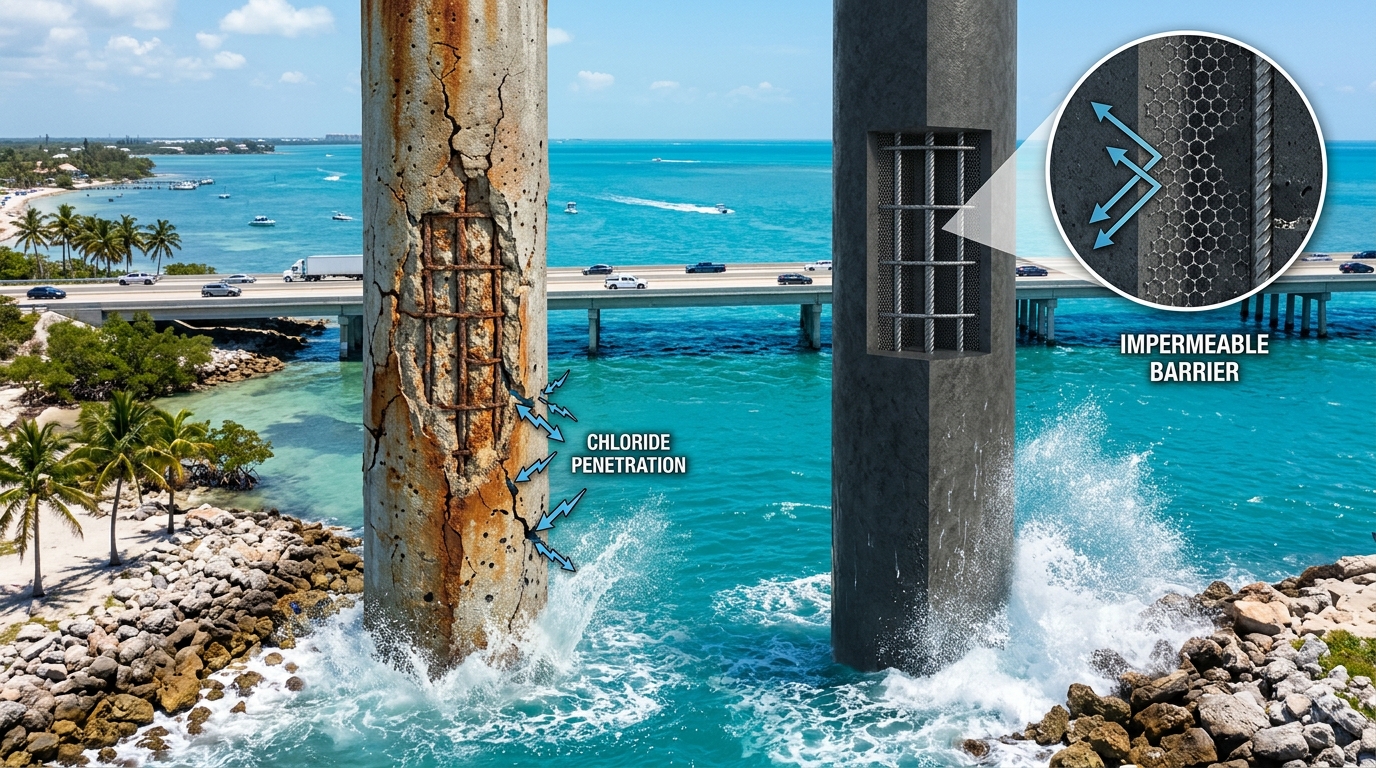
How Graphene Concrete Fights Florida’s Saltwater Corrosion
How Graphene Concrete Fights Saltwater Corrosion in Florida Bridges and Coastal Roads
There’s something almost poetic about Florida’s infrastructure problem, if you think about it.
The state is defined by water. Surrounded by it. Built on top of it, practically. The ocean breeze that makes Miami neighborhoods so livable, the salt air rolling off Tampa Bay, the tidal humidity of the Keys — these things are why people move here. They’re also quietly destroying Florida’s bridges and coastal roads every single day.
Saltwater corrosion is insidious. It doesn’t announce itself. It seeps into microscopic pores in concrete, attacks the steel rebar inside, causes rust that expands and cracks the surrounding material from within, and then — years later — you’re looking at spalling concrete, compromised structural integrity, and a repair bill that could have funded something a lot more interesting.
Florida spends enormous resources fighting this battle. And for a long time, the tools available were mostly variations on the same theme: better coatings, more corrosion-resistant rebar, more frequent inspection cycles. Helpful, but not transformative.
Graphene-enhanced concrete for Florida’s coastal infrastructure is something different. It addresses the corrosion problem at the molecular level, changing the fundamental behavior of the material rather than just protecting the surface. And the more you understand about how it works, the more obvious it becomes that Florida — specifically — needs this.
Why Florida’s Coastal Environment Is Basically Concrete’s Worst Enemy
Before we get into what graphene does, let’s be clear about what Florida concrete is up against.
Most places have one major infrastructure challenge. Ohio has freeze-thaw cycles. Arizona has extreme heat. Florida has a combination that’s almost uniquely brutal:
Saltwater chlorides are the primary villain. They penetrate concrete through its natural porosity, travel through the cement matrix, and reach the reinforcing steel inside. Once chloride ions hit the rebar in sufficient concentration, they break down the passive oxide layer that normally protects steel from rusting. Corrosion begins. Rust expands — iron oxide takes up significantly more volume than the steel it came from — and the expanding rust exerts internal pressure that fractures the concrete surrounding it.
Then there’s the relentless humidity. Moisture accelerates chloride transport. It keeps the concrete perpetually saturated in ways that inland structures simply don’t experience. And Florida’s heat cycles — hot summers, mild winters — create thermal expansion and contraction that opens and closes microcracks, giving chlorides repeated access as conditions change.
And unlike somewhere like Alaska, where you might get a seasonal break, Florida’s coastal environment is constant. Year-round. The bridges over Biscayne Bay, the causeways connecting barrier islands, the road overpasses in Broward County — they never get a rest from the conditions that are trying to degrade them.
Here’s what I keep thinking about: we’ve known about this problem for decades, and we’ve mostly managed it with maintenance. Managed it, not solved it. Graphene concrete for Florida’s bridge and highway infrastructure is the first material development in a long time that might actually change the equation.
6 Ways Graphene Concrete Changes the Fight Against Saltwater Corrosion
1. It Closes the Pores That Let Chlorides In
Everything about saltwater corrosion starts with one fact: chlorides need a way in.
Conventional concrete is porous. That’s inherent to how cement hydrates and hardens — the process creates capillary pores throughout the material. In most environments, this porosity is manageable. In coastal Florida, it’s the entry point for everything that causes long-term damage.
Graphene particles are extraordinarily thin and fill microscopic gaps in the cement matrix that standard materials can’t reach. The result is a significantly denser microstructure — one where chloride ions have far fewer pathways to travel through. Studies have shown chloride penetration rates dropping by 50-70% in graphene-enhanced mixes compared to conventional concrete.
Think of it like this: conventional concrete is a sponge sitting next to the ocean. Graphene concrete is closer to a tightly compressed block — still the same general material, but with the gaps that allow infiltration largely closed.
Real-world scenario: A bridge deck in the Florida Keys has its concrete surface exposed to salt spray 365 days a year. In conventional concrete, chloride ions begin reaching the rebar within 10-20 years depending on mix quality and cover depth. In a well-designed graphene concrete mix, that timeline extends dramatically — potentially beyond the designed service life of the structure. Which means the corrosion cycle might not start at all during the bridge’s useful life.
2. It Protects the Rebar Without Relying Only on Cover Depth
The traditional solution to chloride attack is simple in theory: put more concrete between the surface and the steel. More “cover depth” means more distance for chlorides to travel before reaching the rebar.
The problem is that more cover depth means heavier structures, sometimes more material cost, and it doesn’t solve the underlying permeability issue — it just buys more time before the same problem occurs.
Graphene concrete attacks the problem differently. By making the entire concrete matrix more resistant to chloride penetration, it protects the rebar throughout the full cross-section of the element, not just by extending how far the chlorides have to travel. The rebar is better protected because the material surrounding it is less permeable — everywhere.
This matters especially for older bridge structures being rehabilitated. When you’re retrofitting a structure that was built with conventional standards, you can’t easily add cover depth. But you can replace the concrete deck or repair sections with graphene-enhanced material and get substantially better chloride resistance without changing the structural geometry.
Quick tip: When evaluating any concrete upgrade for coastal infrastructure, chloride diffusion coefficient is the number to ask about. It measures how quickly chlorides move through the material. Graphene concrete’s coefficient is substantially lower than standard mixes — that single number tells you a lot about long-term corrosion risk.
3. Higher Compressive Strength Means Fewer Crack Entry Points
Here’s a thing about cracks that’s worth understanding: they’re not just cosmetic. Every crack in a concrete surface is a direct pathway for saltwater, oxygen, and chlorides to reach the interior faster than they’d penetrate through sound material.
Graphene concrete shows compressive strength improvements of 30-40% over standard mixes. Stronger concrete cracks less under load — which means fewer pathways for accelerated chloride ingress. It’s a secondary benefit, but it compounds the primary permeability improvement in a meaningful way.
For Florida’s coastal road surfaces — which take constant traffic loading on top of environmental exposure — the reduced cracking tendency is particularly valuable. Thermal expansion cracks, load-induced cracks, shrinkage cracks during curing — all of these are reduced in higher-strength concrete, and reduced further in graphene concrete specifically because the graphene fibers also distribute tensile stress more evenly through the material.
Real-world scenario: An overpass on US-1 in the Florida Keys — one of the most corrosive environments for infrastructure in the continental US — might show surface cracking in conventional concrete within 5-7 years under combined thermal and traffic loading. In graphene concrete, that surface integrity holds significantly longer, keeping the interior protected during the years when the material is most vulnerable.
4. Tensile Strength Improvements Fight the Rust-Expansion Problem Directly
This one is subtle but important.
When rebar corrodes inside concrete, the expanding rust exerts pressure on the surrounding material. If the concrete can’t handle that tensile stress — being pulled apart from the inside — it cracks and spalls. Those cracks then allow more chlorides in, accelerating the process. It’s a feedback loop that, once started, tends to accelerate.
Graphene’s improvement to tensile strength — how well the concrete resists being pulled or stretched — means the material is better at containing the early stages of rebar corrosion if it does begin. Not infinitely better. But meaningful.
Think of it as adding another layer of defense: graphene makes it harder for chlorides to reach the rebar (primary defense), and if some chlorides do get through and corrosion begins, the improved tensile strength makes it harder for that corrosion to fracture the surrounding concrete (secondary defense).
Honest caveat: this isn’t a cure. If saltwater exposure is severe enough and time is long enough, corrosion will eventually find a way in any material. The goal is extending the timeline dramatically, not claiming invincibility.
5. Reduced Water Absorption Cuts the Humidity Factor
Florida’s combination of heat and humidity keeps coastal concrete perpetually moist in ways that inland structures simply aren’t. And moisture is the medium chlorides travel through — dry concrete is much more resistant to chloride penetration than saturated concrete.
Graphene concrete’s reduced water absorption — typically 40-50% lower than conventional mixes — means the material spends less time in the saturated state that enables rapid chloride transport. In a dry climate, this might be a minor benefit. In coastal Florida, where the air itself carries moisture year-round, it’s significant.
There’s a compounding effect here too: less water absorption means less thermal cycling damage, because water expanding during temperature changes causes less stress inside a material that doesn’t absorb as much to begin with. For Florida’s road surfaces that go through daily temperature swings, this matters over a 20-30 year service life.
Real-world scenario: A coastal bridge in Tampa Bay faces salt spray from boat traffic below and humidity from the bay environment around the clock. Conventional concrete absorbs significant moisture over time, creating the saturated conditions that enable chloride transport. Graphene concrete, absorbing substantially less moisture, stays closer to a drier internal state — making the entire chloride transport mechanism less efficient.
6. Longer Service Life Changes the Economics of Coastal Infrastructure
Let’s talk numbers, because this is where the argument gets hard to dismiss.
Florida has hundreds of coastal bridges and thousands of miles of coastal roads. Many of them are on 20-30 year replacement or major rehabilitation cycles. Every rehabilitation means lane closures, traffic disruption, construction costs, and environmental permitting — all of which are significant in coastal and marine environments.
Graphene concrete’s impact on Florida’s coastal road service life shifts those economics meaningfully. If a bridge deck that would require major rehabilitation at year 20 instead holds up through year 35-40, you’ve eliminated one full rehabilitation cycle from the bridge’s life. That’s not 20% savings — it’s an entire project that doesn’t happen.
For a state with Florida’s coastline and infrastructure inventory, multiply that across hundreds of structures and the lifecycle cost picture changes dramatically. Higher upfront material cost, substantially lower total cost of ownership over the structure’s life.
And this doesn’t even account for the safety benefits. Bridge inspections regularly find structures with advanced corrosion damage that require immediate load restrictions or emergency repairs. Reducing the rate of corrosion-driven deterioration means fewer inspection surprises, fewer emergency closures, and safer roads for everyone.
Quick Comparison: Conventional vs. Graphene Concrete in Florida’s Coastal Environment
| Factor | Conventional Concrete | Graphene Concrete |
|---|---|---|
| Chloride Penetration Rate | High in coastal exposure | Reduced 50-70% |
| Water Absorption | High in humid conditions | 40-50% lower |
| Compressive Strength | Baseline | +30-40% |
| Tensile Strength | Moderate | Significantly improved |
| Crack Resistance | Standard | Enhanced |
| Expected Bridge Deck Life | 20-25 years (coastal) | 35-45+ years |
| Rebar Corrosion Risk | High without additional protection | Substantially reduced |
| Rehabilitation Cycles (50 yr) | 2-3 major events | 1 or fewer |
| Construction Method Changes | N/A | Minimal — same equipment |
Key Takeaways
- Saltwater corrosion attacks Florida infrastructure through chloride penetration into porous concrete — graphene concrete addresses this at the molecular level by closing the pores chlorides travel through.
- Chloride penetration rates drop 50-70% in graphene concrete, dramatically extending the timeline before corrosion can begin.
- Improved compressive and tensile strength reduce cracking, which eliminates secondary pathways for accelerated chloride ingress.
- Lower water absorption keeps the concrete in a drier state, making chloride transport less efficient year-round in Florida’s humid coastal environment.
- The lifecycle economics are compelling: one fewer major rehabilitation cycle on a coastal bridge can offset years of higher material costs.
- Graphene concrete uses the same construction equipment and methods as conventional concrete — the transition is practical, not theoretical.
- Florida’s coastal infrastructure is facing this problem right now. The technology to address it is available right now.
The Honest Bottom Line
Florida has some of the most challenging infrastructure conditions in the country. The saltwater environment that makes the state beautiful is genuinely relentless on concrete — and we’ve been managing that reality with the same basic toolkit for decades.
Graphene concrete doesn’t solve every problem. It doesn’t make bridges immortal. And I’d be skeptical of anyone who told you otherwise. But it does represent a genuine step change in how well concrete holds up against the specific conditions that define coastal Florida — chlorides, humidity, heat, constant exposure.
The question isn’t really whether the material works. The evidence on that is solid. The question is how quickly Florida’s infrastructure planning catches up to what’s available.
If you’re involved in local government, community advocacy, or just paying attention to the bridges and roads your family drives across every day — understanding what graphene concrete can do for Florida’s coastal infrastructure is worth your time. The technology is here. The case is strong. And Florida’s coastline can’t wait indefinitely for the materials it uses to catch up.
Want to explore how graphene concrete specifically applies to Florida’s highway and bridge construction challenges? The full picture is worth a read — it’s more immediately relevant than most people realize.