

FDOT Innovation Materials & Graphene Concrete: A Florida Contractor’s Guide
FDOT Innovation Materials & Graphene Concrete: A Florida Contractor’s Guide
Picture this.
It’s mid-August on the Suncoast. You’re standing on a bridge deck that you poured three years ago, watching a FDOT inspector point at spalling along the edge of a joint — the kind of deterioration that starts quiet and announces itself loudly. Salt air, relentless humidity, concrete that did everything it was supposed to do by the spec… and here you are anyway.
Nobody in this industry goes into a project expecting failure. But Florida is genuinely one of the harshest environments in North America for concrete infrastructure. The combination of chloride exposure from marine environments, intense UV, heat, and moisture creates conditions that age concrete faster here than almost anywhere else in the country. And if you’ve been doing FDOT work for any length of time, you’ve felt the gap between what the specs require and what the environment demands.
That gap is exactly why FDOT’s materials innovation programs exist — and it’s exactly why graphene-enhanced concrete has started showing up in serious conversations with FDOT engineers and project managers.
This guide is for contractors who want to understand both sides of that equation: what FDOT’s innovation materials framework actually looks like, and where graphene concrete honestly fits within it right now. If you’ve been curious but unsure where to start, stick with me.
Florida’s Infrastructure Problem Is Kind of Unique
Before we get into materials and specs, it helps to understand what we’re actually up against.
Florida has roughly 12,000 state-maintained bridges and thousands of miles of highway, a significant portion of which sits in coastal or near-coastal environments. The Florida Keys, the Tampa Bay corridor, the Jacksonville waterfront, the Miami metro — these are places where chloride is basically in the air, where concrete surfaces face salt spray, tidal exposure, and relentless heat cycling.
The failure mode for concrete in these conditions is well understood: chlorides penetrate the concrete matrix, reach the rebar, trigger corrosion, cause expansion, and eventually crack the cover concrete from the inside out. It’s a slow process, but it’s almost inevitable without the right material design and protection strategy.
FDOT spends enormous amounts of money on bridge and pavement rehabilitation every year. That’s not a criticism — it’s the reality of maintaining infrastructure in this environment. But it does create a strong institutional motivation to find materials that perform better over time, not just in initial cost. And that motivation is exactly what opened the door to FDOT’s innovation programs.
What FDOT’s Innovation Materials Framework Actually Is
Here’s where a lot of contractors get fuzzy — understandably — because “innovation program” can mean a lot of different things depending on who you’re talking to.
FDOT has several mechanisms for evaluating and incorporating new materials and technologies into its specifications. The most relevant for our purposes are:
Innovative Materials and Products (IMP) Program. This is FDOT’s formal pathway for evaluating materials that don’t yet appear in standard specifications. It involves technical review, testing requirements, and a determination of whether the material meets FDOT’s performance standards. It’s not fast, but it’s the legitimate route for getting a new material into FDOT-approved use.
Special Provisions. On specific projects, FDOT can include special provision language that allows materials or approaches outside standard specs. This is often how new materials get their first real-world testing on state work — project-specific approval backed by documented performance data.
Performance-Based Specifications. FDOT has been expanding the use of performance-based specs on some project types. Instead of prescribing exactly what goes in the mix, these specs define what the end product needs to achieve — strength, permeability, durability — and leave the material design more open.
Research and Pilot Projects. FDOT funds and participates in materials research through the Florida Department of Transportation’s Research Center and partnerships with Florida universities. Pilot applications of innovative materials sometimes happen through this channel.
Understanding which pathway applies to a specific situation is crucial. The answer isn’t always obvious, and it changes project by project.
Enter Graphene Concrete — And Why It Matters for Florida Specifically
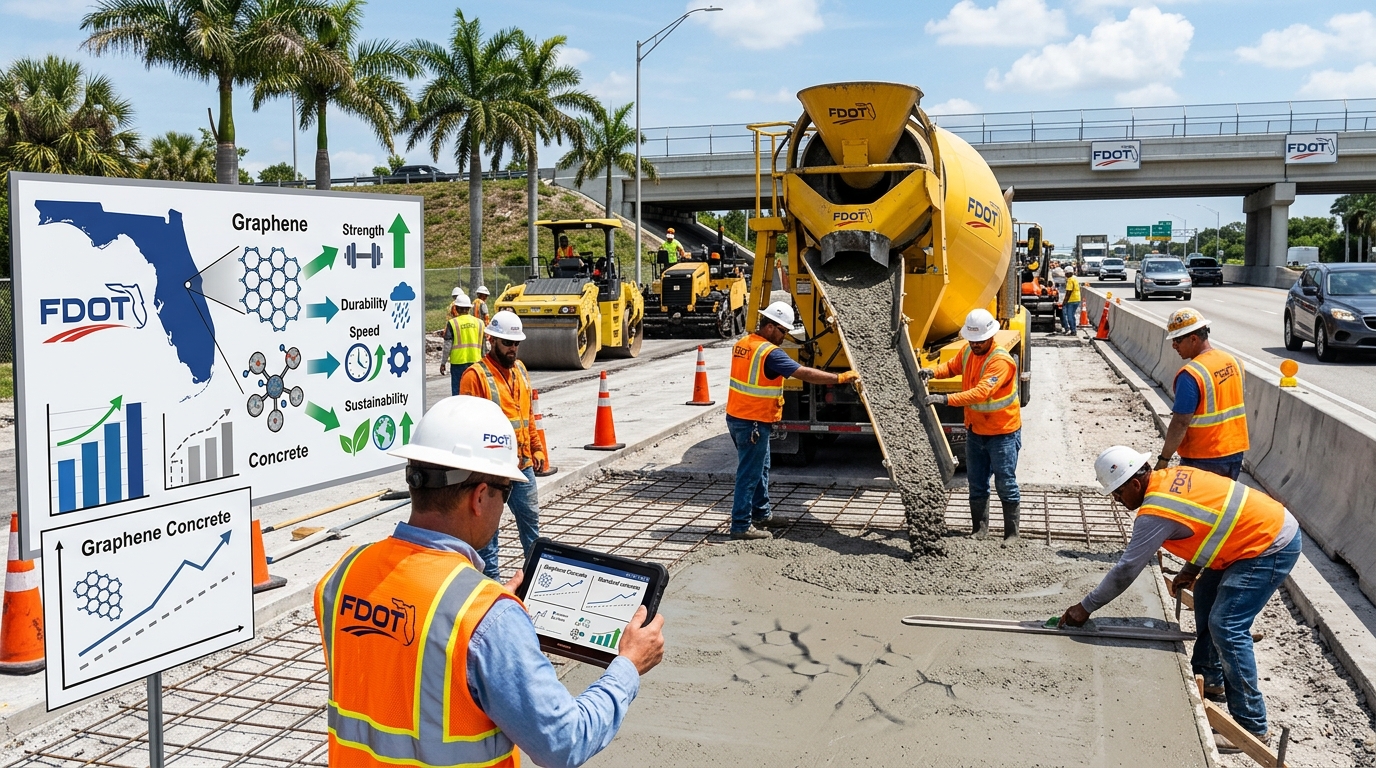
Graphene concrete for Florida roadways and highway construction isn’t a speculative technology anymore. The material science has been validated. Real-world applications are accumulating. And the specific performance characteristics of graphene-enhanced concrete map almost perfectly onto Florida’s most pressing infrastructure challenges.
Here’s what I mean by that.
The core problem in Florida’s coastal environments is permeability. Concrete that lets chlorides in corrodes from the inside. Anything that significantly reduces permeability extends service life — and reduces the frequency and cost of rehabilitation.
Graphene-enhanced concrete consistently demonstrates major reductions in water permeability compared to equivalent control mixes. We’re talking about concrete that is meaningfully more resistant to moisture infiltration, not marginally so. In Florida’s marine environments, that difference translates directly into years of additional service life before the deterioration cycle kicks in.
Beyond permeability, graphene concrete delivers compressive and flexural strength improvements — typically in the 20–30% range with proper mix design — and better resistance to thermal cycling and UV degradation. In a state where surface temperatures on dark pavement regularly exceed 150°F in summer, that thermal resilience matters.
The honest question isn’t whether graphene concrete performs better for Florida’s conditions. The data increasingly says it does. The real question is how to work with FDOT’s approval processes to actually use it.
The Approval Reality: Where Things Actually Stand
Let me be straight with you about this, because I think vague optimism doesn’t help anyone.
Graphene concrete is not currently a standard-specification material for FDOT projects. You can’t just spec it in like you’d spec Type II Portland cement or a standard fly ash blend. If you try to substitute it into a project without the right groundwork, you’re going to run into a wall.
But “not standard spec” is not the same as “not possible.” And that’s an important distinction.
The IMP pathway is real and has been used for other innovative materials. It requires documented testing data, performance comparisons against standard materials, and technical review — but it’s been navigated successfully by contractors and suppliers who did the preparation work.
Special provisions on specific projects have allowed innovative materials to be used on FDOT work, particularly on research or demonstration projects where FDOT has an interest in gathering performance data.
And performance-based specs, where they exist, give contractors more room to propose innovative materials if the performance case is well-documented.
The performance characteristics of graphene concrete in Florida highway applications are the foundation of any FDOT approval conversation. You need third-party testing data, mix design documentation, and a clear comparison against standard materials. That documentation doesn’t materialize overnight — which is exactly why contractors who start building it now are ahead of those waiting for graphene to appear in a standard spec.
What the Experts Are Actually Saying
Contractors who are actively engaged with FDOT’s materials engineers on this issue are hearing something interesting: FDOT isn’t hostile to graphene concrete. They’re appropriately cautious — that’s their job — but there’s genuine curiosity within the agency about materials that could address Florida’s infrastructure durability challenges.
The conversations that tend to go well are the ones where the contractor or supplier comes in with data, not just enthusiasm. FDOT engineers aren’t going to approve something because it sounds promising. They’re going to ask about compressive strength at 28 days, chloride permeability by ASTM C1202, freeze-thaw resistance, coefficient of thermal expansion. Answer those questions with documented results from credible testing, and the conversation is very different than if you show up with a product brochure.
Here’s something worth knowing: FDOT’s Research Center and the State Materials Office are the people to talk to early in any serious materials innovation conversation. They’re not gatekeepers to avoid — they’re the pathway. Building a relationship there, understanding what they need to see, and then delivering it is how new materials find their way into FDOT projects.
It’s slow. But it works.
Practical Steps: What Florida Contractors Should Do Right Now
If you’re reading this and thinking “okay, I want to actually position myself for this” — here’s what makes sense.
Start building your documentation file. If you’re going to make a case to FDOT for graphene-enhanced concrete on a project, you need a documentation package ready. That means third-party testing data, mix design specifications, performance comparisons, and supplier credentials. Start assembling this before you need it.
Identify the right projects. Not every FDOT project is a realistic candidate for graphene concrete in 2026. Performance-spec projects, design-build work with VE provisions, and research or pilot designations are where the opportunity is most accessible. Know which projects you’re targeting before you start the approval conversation.
Talk to a qualified graphene concrete supplier. This matters more than it might seem. The performance characteristics of graphene-enhanced concrete depend heavily on mix design — specifically on how the graphene is dispersed throughout the mix. A supplier who can provide technical support, documented performance data, and QC protocols is essential. This isn’t a commodity purchase.
Engage FDOT’s State Materials Office early. I can’t emphasize this enough. The worst time to raise a materials question is mid-project. The best time is during design or pre-bid, when there’s still room to work through the approval process without schedule pressure.
Run a non-FDOT trial first. Local government projects, private commercial work, county roads — these give you operational experience with graphene-enhanced concrete without the full weight of state approval requirements. That experience matters both for your crews and for the credibility of any FDOT conversation you have later.
FAQ: Real Questions Florida Contractors Are Asking
Is graphene concrete approved for FDOT projects?
Not as a standard specification material, as of 2026. But FDOT has formal pathways — the Innovative Materials and Products program, special provisions, and performance-based specs — that can allow it on specific projects with proper documentation and approval. The path exists; it requires preparation to walk it.
What testing does FDOT typically require for new concrete materials?
FDOT leans heavily on established ASTM standards: compressive strength (C39), chloride permeability (C1202), freeze-thaw durability (C666), and scaling resistance (C672) are among the most relevant for concrete mix evaluation. Any graphene concrete documentation package should address these directly.
Does the marine environment in Florida actually make graphene concrete worth the premium?
Honestly, yes — at least in my reading of the performance data. The permeability reduction is the key variable, and it’s directly relevant to chloride-driven deterioration. Whether the lifecycle cost math works on a specific project depends on a lot of factors, but the performance case for Florida’s coastal environment is strong.
Can graphene concrete be used with standard FDOT mix designs?
The short answer is that graphene-enhanced concrete typically requires a purpose-built mix design rather than a simple additive to an existing mix. Dispersion of graphene particles throughout the mix is the critical variable — it’s where most mix design work focuses. A knowledgeable supplier can help engineer the right design for your application.
What’s the realistic timeline for graphene concrete becoming a standard FDOT specification?
I don’t want to guess too precisely because this genuinely depends on how quickly performance data accumulates from real-world applications and how FDOT’s materials review cycle moves. What I can say is that the trajectory is clear — more data, more real-world applications, and growing institutional interest in durable materials. Two to five years for some form of standard specification recognition isn’t an unreasonable estimate. But the contractors doing the groundwork now won’t be waiting for that.
The Bottom Line — And Where to Go From Here
Florida’s infrastructure environment is genuinely one of the most demanding in the country. Salt air, relentless heat, moisture, and heavy traffic loads combine to age concrete faster here than almost anywhere else. FDOT knows this. It’s why they have innovation programs, research partnerships, and a materials review process that’s genuinely trying to find better solutions.
Graphene concrete is a better solution for many of Florida’s most challenging infrastructure applications. The performance data supports that. The challenge is the approval process — and that challenge is navigable with the right preparation, the right partners, and the right conversations with FDOT’s materials engineers.
If you want to understand more about how graphene concrete is being applied in Florida highway construction, that’s a solid next step. And if you’re seriously thinking about bringing this into a future FDOT bid, reach out to the people who’ve already mapped the pathway.
The infrastructure problem isn’t going away. But the materials to address it better are here — and getting them into use is a matter of doing the work, not waiting for someone else to clear the path first.