

The Concrete Innovation Act & What It Means for NC Roads
The Concrete Innovation Act Just Changed the Game for North Carolina Roads
Here’s a thing that doesn’t happen often: a genuinely bipartisan infrastructure bill quietly works its way through the Senate, and almost nobody outside the industry notices.
The Concrete and Asphalt Innovation Act of 2025 — co-sponsored by Senator Thom Tillis of North Carolina alongside Senator Chris Coons of Delaware — is one of those bills. It doesn’t have the drama of a budget showdown or the visibility of major spending packages. But if you care about the roads North Carolinians drive on every day, or about whether the materials going into those roads are actually the best available, it matters quite a bit.
And here’s why it connects directly to graphene concrete: the legislation is explicitly designed to accelerate the research, development, and commercial deployment of next-generation concrete and asphalt technologies. Graphene-enhanced concrete — which offers meaningful improvements in strength, durability, and longevity over conventional mixes — is exactly the kind of innovation this bill is meant to bring from the lab to the road.
If you want to understand what graphene concrete means for North Carolina’s highway infrastructure, the policy environment matters as much as the material science. And right now, the policy environment is moving in an interesting direction.
What You Need to Know Going In
Before we walk through how all of this connects, a few grounding points:
The bill’s full name is the Concrete and Asphalt Innovation Act of 2025 (S.1067, 119th Congress). It’s a bipartisan effort focused on reducing emissions from concrete and asphalt production while strengthening American competitiveness in industrial manufacturing.
Senator Tillis’s stated rationale was direct: the legislation is “a smart, bipartisan investment in America’s industrial future” that “will strengthen domestic manufacturing, create jobs, and reduce emissions.” That’s worth noting because it frames this as an economic and innovation argument, not just an environmental one.
North Carolina’s infrastructure context is real and relevant. The state has significant highway maintenance needs, a growing population putting more stress on existing roads, and a mountain-to-coast geography that subjects roads to varied and sometimes harsh conditions — from the freeze-thaw cycles of the western mountains to the salt-air humidity of the coastal plain.
Graphene concrete isn’t mentioned by name in the legislation — the bill is material-agnostic, focused on creating the research and commercial pathways for innovative technologies to get deployed. But graphene concrete fits squarely within the technologies the bill is meant to support.
[IMAGE: Side-by-side comparison of conventional concrete mixing process vs. graphene-enhanced concrete batch preparation, showing the admixture introduction step that makes graphene concrete compatible with existing equipment]
Step 1: Understand What the Concrete and Asphalt Innovation Act Actually Does
It’s tempting to read “innovation act” as vague Washington-speak. But the bill has specific mechanisms worth understanding.
The legislation directs the Department of Energy to establish a research and development initiative covering emissions reduction in cement and concrete production, demonstration projects for next-generation materials, and pathways for commercial application. That last part is the critical one. A lot of good material science dies somewhere between laboratory validation and actual deployment on real infrastructure. This bill is specifically designed to close that gap.
For graphene concrete, this matters because one of the persistent barriers to adoption isn’t the material performance — the evidence on that is solid — it’s the commercialization and procurement pathways. State DOTs work from approved materials lists. Innovation requires going through qualification processes. Pilot projects generate the data those processes require. Federal legislation that funds and legitimizes that pipeline accelerates everything downstream.
Think of it this way: the material science is largely done. What’s needed now is the institutional infrastructure to move graphene concrete from “technically superior” to “standard specification.” The Concrete and Asphalt Innovation Act is building part of that institutional infrastructure at the federal level.
[IMAGE: Diagram showing the innovation pipeline from laboratory research → demonstration projects → commercial deployment → DOT specification approval, with the Concrete and Asphalt Innovation Act’s role indicated at each stage]
Step 2: See Why North Carolina Is Particularly Well-Positioned
Geography matters here. A lot.
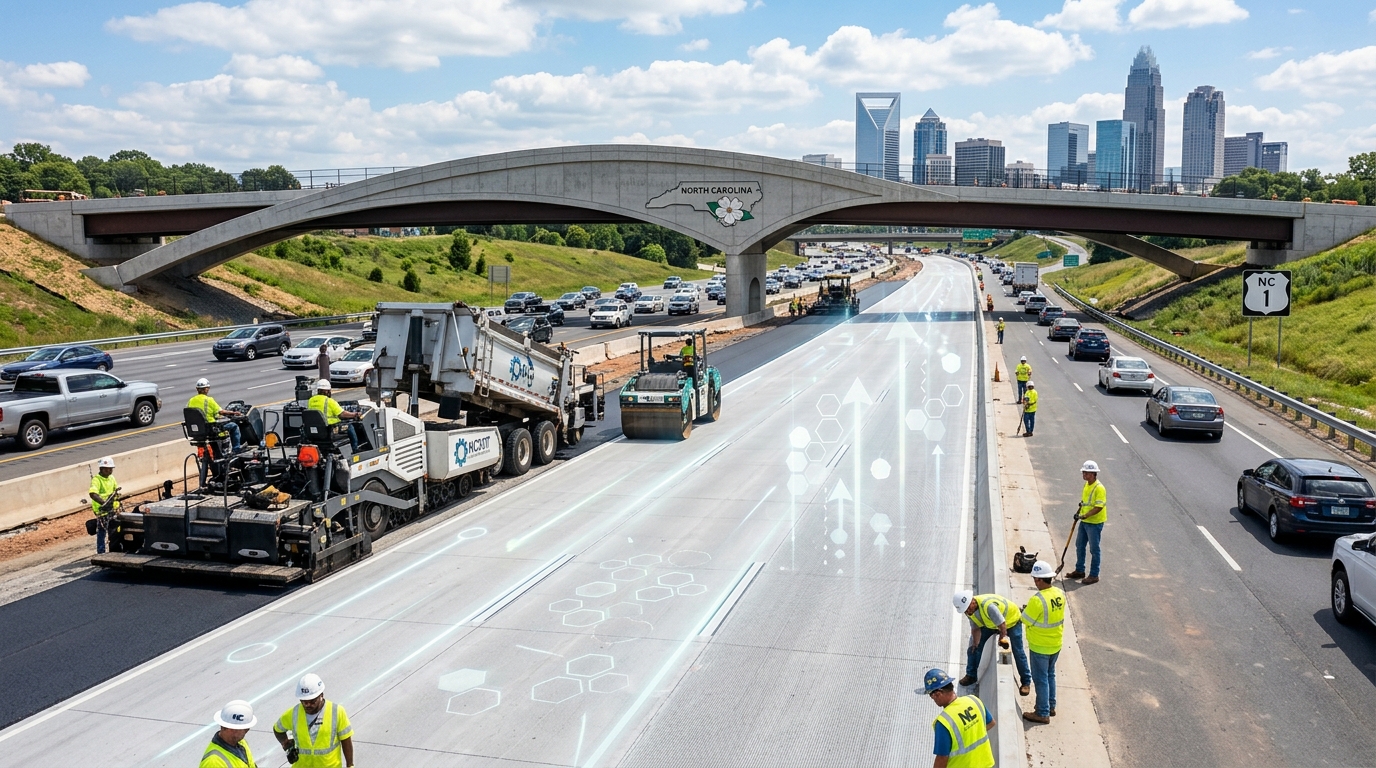
North Carolina has a more varied road environment than most states its size. The western mountain region — western I-40, the Blue Ridge Parkway access routes, the roads serving Asheville and the surrounding counties — faces freeze-thaw cycles that damage conventional concrete through the same mechanism that plagues Ohio highways. Water infiltrates pores, freezes, expands, and fractures the material from within.
Move east and the conditions shift entirely. The coastal plain and the Outer Banks corridors deal with salt-air exposure, humidity, and storm damage. Bridges over sounds and estuaries face chloride penetration risks similar to Florida’s coastal structures. Conventional concrete in those environments corrodes from the inside out.
And through the middle of the state — the I-85, I-40, and I-77 corridors connecting Charlotte to the Triangle to the Piedmont — you’ve got high-volume freight traffic putting sustained load stress on pavement that has to perform for decades.
One material solution that addresses all three of these environments is asking a lot. But graphene concrete for North Carolina’s diverse road network offers a genuinely stronger case than most alternatives — improved strength, water resistance, and durability that benefits mountain roads, coastal bridges, and high-traffic corridors alike.
A state with this range of infrastructure challenges is exactly where a versatile material innovation creates the most value. North Carolina isn’t a single use case. It’s several.
Step 3: Understand the Research-to-Road Pipeline
Here’s where a lot of people get frustrated with infrastructure innovation — and honestly, the frustration is fair.
There are materials available right now that would outperform what’s going into American roads. Graphene concrete is one of them. So why isn’t it everywhere?
The answer isn’t technical. It’s institutional. State DOTs are — appropriately — conservative about what goes into public infrastructure. You can’t experiment with a bridge carrying 50,000 vehicles a day. The qualification process for new materials involves performance testing, pilot projects, long-term monitoring, and data accumulation before a material gets onto the approved list. That process takes time. Without active policy support, it can take a very long time.
The Concrete and Asphalt Innovation Act creates federal backing for that pipeline. Demonstration projects funded and monitored under the initiative generate the kind of real-world performance data that state DOTs need to move a material from “interesting new option” to “standard specification.” For graphene concrete specifically, this could meaningfully accelerate the timeline from pilot to procurement.
And here’s the thing that’s easy to miss: every year the adoption curve is delayed is another year of roads being built with materials that will cost more over their lifetime, require more maintenance, and perform less well than available alternatives. The urgency isn’t abstract.
Step 4: Know What the Jobs and Manufacturing Angle Means
Senator Tillis framed this legislation partly around strengthening domestic manufacturing. That framing isn’t just political — it connects to something real about graphene concrete’s trajectory.
Graphene production is scaling. Costs have been falling as manufacturing processes improve and demand grows. The United States has an opportunity to be part of that manufacturing story — developing the production capacity and supply chains that will make graphene-enhanced materials cost-competitive at scale.
Legislation that signals federal support for next-generation concrete technology doesn’t just accelerate adoption on highways. It creates a demand signal for the manufacturing side. Companies building out graphene production capacity need to know there’s an actual market. Federal R&D investment and demonstration programs help create that market certainty.
For North Carolina specifically, there’s a meaningful jobs argument here. The state has significant construction and materials manufacturing presence. If graphene concrete becomes a standard specification for NC DOT projects, the materials need to be produced, tested, and supplied — creating value in the state’s supply chain beyond just better roads.
[IMAGE: Map of North Carolina highlighting key infrastructure corridors — western mountain routes, coastal bridges, and major I-85/I-40/I-77 freight corridors — showing the geographic diversity of road environments the state must maintain]
Troubleshooting: What Could Slow This Down
Let’s be realistic about the obstacles, because there are some.
Legislative timelines move slowly. The Concrete and Asphalt Innovation Act was introduced in mid-2025 and referred to committee. Bipartisan support is a real asset — both parties have infrastructure interests, and the combination of economic competitiveness and emissions reduction gives the bill appeal across the aisle. But committee timelines aren’t predictable, and even passed legislation requires implementation rulemaking before it changes anything on the ground.
State DOT procurement moves even more slowly. Federal legislation can create the research framework and funding, but individual state DOTs make their own materials specifications. North Carolina DOT will adopt graphene concrete specifications on its own timeline, shaped by its own pilot project experience and budget priorities. Federal support helps, but doesn’t shortcut the state-level process.
Cost remains a genuine question. Graphene concrete carries a higher upfront cost per cubic yard than conventional mixes. The lifecycle economics are compelling — fewer rehabilitations, longer service life, lower total cost of ownership — but infrastructure budgets often focus on capital expenditure rather than lifecycle cost. Making the lifecycle argument stick in budget discussions requires work.
The material supply chain is still developing. Graphene concrete at the scale of a major highway project requires consistent, high-quality graphene supply. The manufacturing capacity exists and is growing, but it’s not yet as mature as the conventional concrete supply chain. Pilot projects help develop that supply chain alongside the technical validation.
Expert Tips: What to Actually Watch For
A few things worth tracking if you’re following this topic:
Watch for NCDOT pilot project announcements. If federal funds flow from the Concrete and Asphalt Innovation Act into demonstration projects, North Carolina is a natural candidate given its geographic diversity and infrastructure needs. A pilot on an I-40 corridor in the mountains or a coastal bridge rehabilitation would be significant.
The bipartisan framing matters for staying power. Infrastructure legislation that can claim both economic competitiveness and emissions reduction benefits has a better chance of surviving the political cycles that can strand single-issue bills. Tillis framing this as a manufacturing and jobs bill, not just a climate bill, was strategically durable.
Track graphene concrete cost curves. The material economics are improving year over year as production scales. The break-even point — where graphene concrete’s lifecycle savings clearly outweigh its upfront premium in standard procurement calculations — is getting closer. When the economics become undeniable even in capital-focused budget frameworks, adoption accelerates.
Understand that the material is ready. This is maybe the most important expert tip. The question isn’t whether graphene concrete works for North Carolina highway applications — the material science is solid and the construction compatibility with existing equipment is confirmed. The question is how quickly the institutional and policy environment moves to make adoption standard practice.
Summary and Next Steps
Here’s where things stand, honestly.
Senator Tillis and his co-sponsors introduced a bipartisan bill that creates federal support for deploying next-generation concrete and asphalt technologies. The legislation is squarely aimed at the gap between proven innovation and actual deployment. Graphene concrete — with its demonstrated improvements in strength, water resistance, chloride resistance, and service life — fits exactly the profile of technology this bill is designed to accelerate.
North Carolina, with its mountain freeze-thaw conditions, coastal salt-air exposure, and high-traffic Piedmont corridors, is a state where better concrete materials create real, measurable value across multiple road environments. The case for graphene concrete isn’t theoretical here. It’s geographic.
The practical next steps are real:
- Follow the bill’s progress — S.1067 in the 119th Congress is worth tracking through committee and floor activity
- Pay attention to NCDOT materials news — pilot projects and specification updates will signal when graphene concrete starts moving into the mainstream procurement pipeline
- Engage locally — if you’re connected to local business, construction, or civic organizations, the infrastructure materials conversation is happening at the county and regional planning level too, not just in Washington
If you want to understand where graphene concrete stands in the North Carolina highway construction picture right now — including what’s technically feasible and what the real-world applications look like — that’s the right place to start.
The policy momentum is real. The material is ready. North Carolina’s roads deserve both.
Curious how graphene concrete is being applied to specific highway and bridge projects beyond the legislative picture? Explore the full case for graphene concrete in North Carolina — the technical story and the policy story are moving in the same direction.