Industrial Facilities

  • Home
  • Industrial Facilities

🏭 Graphene Concrete for Industrial Facilities and Warehouse Construction

You know that sound.

It’s the thud-clunk of a forklift hitting that one bad expansion joint in the main aisle. It jars the driver, it rattles the expensive inventory on the pallet, and honestly, it probably spikes your blood pressure just a little bit.

If you manage a warehouse, a distribution center, or a manufacturing plant, you know that the floor isn’t just a surface. It’s the platform for your entire operation. And when that platform starts to fail—when cracks open up, when the surface starts dusting and covering your stock in fine white powder, or when spalling creates tripping hazards—it’s not just an annoyance.

It’s a liability.

We see it all the time. You’re trying to run a lean, efficient operation, but you’re constantly fighting a losing battle against your own infrastructure. You patch the concrete, wait for it to cure (losing valuable production time), and then watch it crack again six months later under the weight of heavy machinery.

It feels like a cycle you can’t break. But what if the problem isn’t the maintenance schedule? What if the problem is the material itself?

That’s where we come in. We are changing the baseline of industrial construction by introducing graphene into the mix.

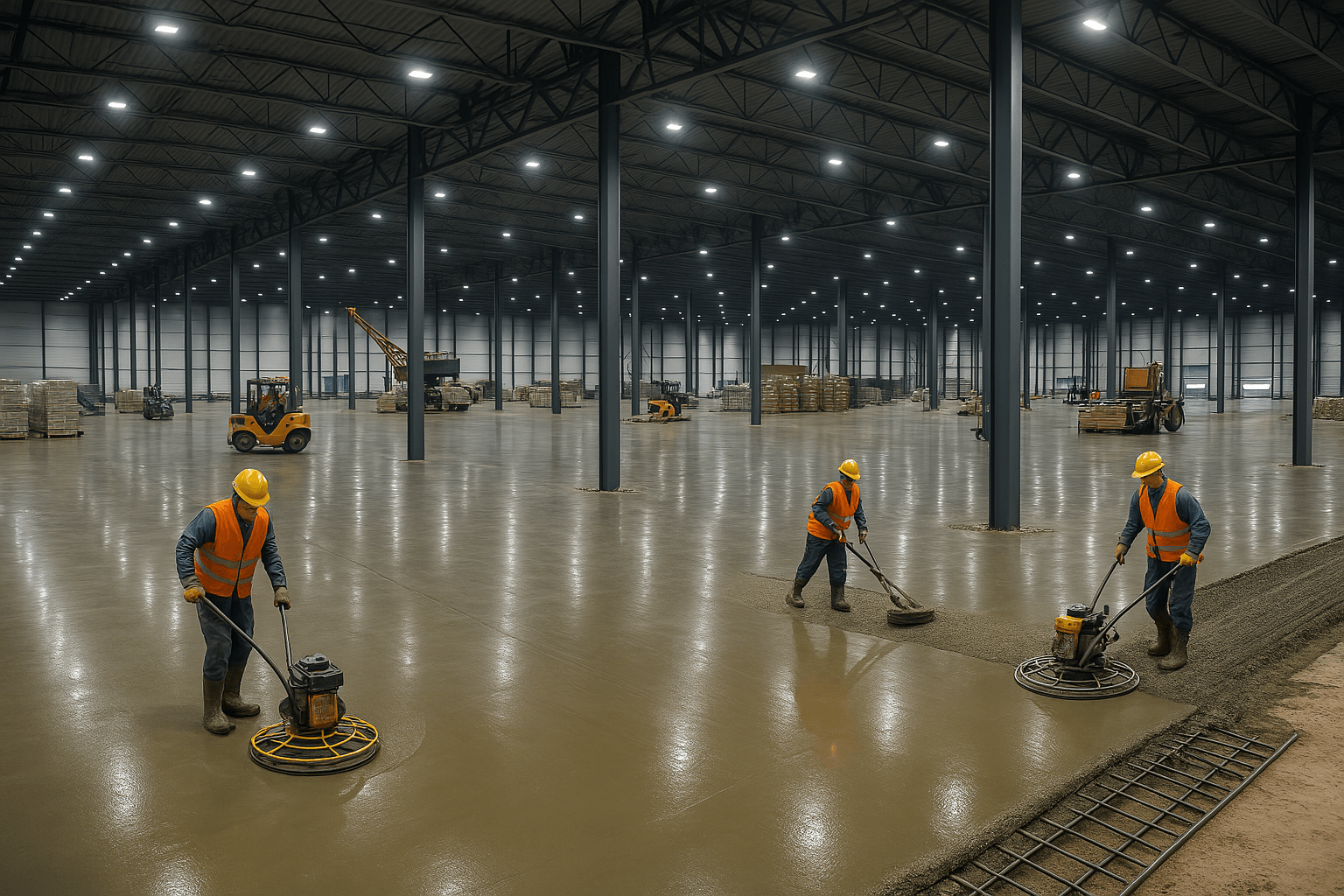
Workers applying graphene-enhanced concrete in a large industrial warehouse, showcasing durable flooring installation under bright overhead lights, with heavy machinery in the background.

The Hidden Cost of "Standard" Concrete

Let’s be real for a minute. Standard concrete has served us well for a long time. But in a modern industrial setting, the demands are brutal. You’ve got forklifts carrying thousands of pounds, turning on a dime, grinding tires into the surface 24/7. You’ve got potential chemical spills. You’ve got heavy racking systems creating massive point loads.

When you settle for standard concrete in these environments, you’re essentially signing up for a “hidden tax” of maintenance.

Think about the dust. That fine silica dust that seems to settle on everything? That’s your floor slowly disintegrating under abrasion. In a clean manufacturing environment or a food storage warehouse, that’s a nightmare.

And then there’s the downtime. Shutting down an aisle or a loading dock to jackhammer out a bad section of slab costs way more than just the repair bill. It costs you throughput. It messes up your logistics flow.

We believe you shouldn’t have to choose between constant repairs and shutting down your business.

How Graphene Changes the Game

So, what are we actually talking about here? We aren’t suggesting you pave your warehouse with some experimental, alien material. We are talking about taking high-quality concrete and optimizing it at a molecular level.

Graphene is a nanomaterial—basically a single layer of carbon atoms arranged in a honeycomb lattice. It is incredibly strong (about 200 times stronger than steel). When we mix a specific dosage of graphene into the concrete batch, it acts like a microscopic support web.

It doesn’t just sit there; it changes how the concrete cures. It makes the bond between the cement and the aggregate tighter, denser, and significantly less porous.

Our Process: Simple Implementation, Massive Results

You might be worried that using “advanced materials” means a complicated, slow construction process. Honestly, it’s the exact opposite.

Here is how we handle a Graphene Concrete project for industrial sites:

  • Site Assessment: We walk your facility (or review your blueprints) to understand your specific load requirements. Are you storing heavy steel coils? High-stacking consumer goods? We need to know the stress points.

  • Mix Design: We formulate the precise graphene admixture dosage. This isn’t one-size-fits-all; it’s tailored to your aggregate and cement type.

  • The Pour: We deliver the treated concrete. Your crew (or ours) pours it just like standard concrete. It pumps the same, it finishes the same. No special hazmat suits required.

  • Curing: This is where you save time. Graphene concrete often reaches its target structural strength faster than standard mixes, meaning you can get back on the floor sooner.

  • Final Inspection: We verify the finish and ensure the surface is ready for the heavy hauling.

Why Industrial Managers Are Making the Switch

When we talk to facility managers who have made the switch, they don’t usually rave about the molecular chemistry. They talk about the quiet. The smoothness. The lack of dust.

Here is why industrial flooring with graphene is the smart play for your next project:

  • Extreme Durability: We’re seeing massive increases in tensile and compressive strength. That means the floor can handle heavier racks and more forklift traffic without cracking.

  • Abrasion Resistance: This is huge for warehouses. The surface is harder, which means it doesn’t wear down into dust. Your inventory stays cleaner, and your air quality improves.

  • Water and Chemical Resistance: Because graphene makes the concrete denser, it’s much harder for water, oils, or chemicals to penetrate and stain (or weaken) the slab.

  • Crack Control: Graphene helps distribute thermal stress. This means fewer shrinkage cracks during curing and fewer stress cracks during operation.

  • Sustainability: Because the concrete is stronger, we can often use less cement to achieve the same load rating. It’s a great way to choose eco-friendly alternatives without sacrificing performance.

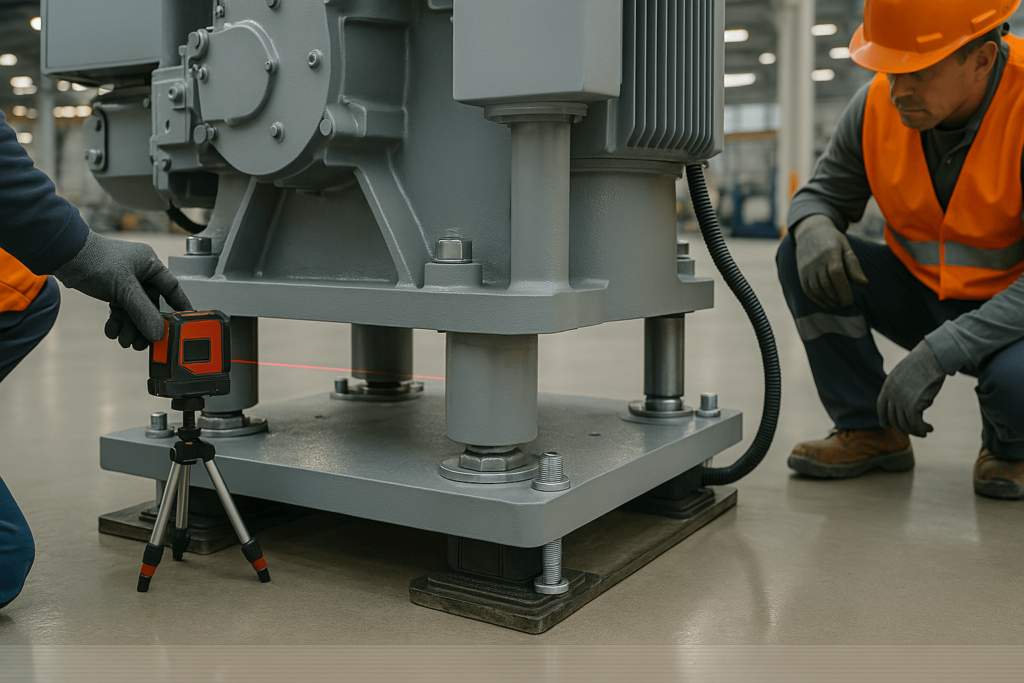
Workers measuring equipment alignment in an industrial facility using a laser level, emphasizing precision and durability in construction.
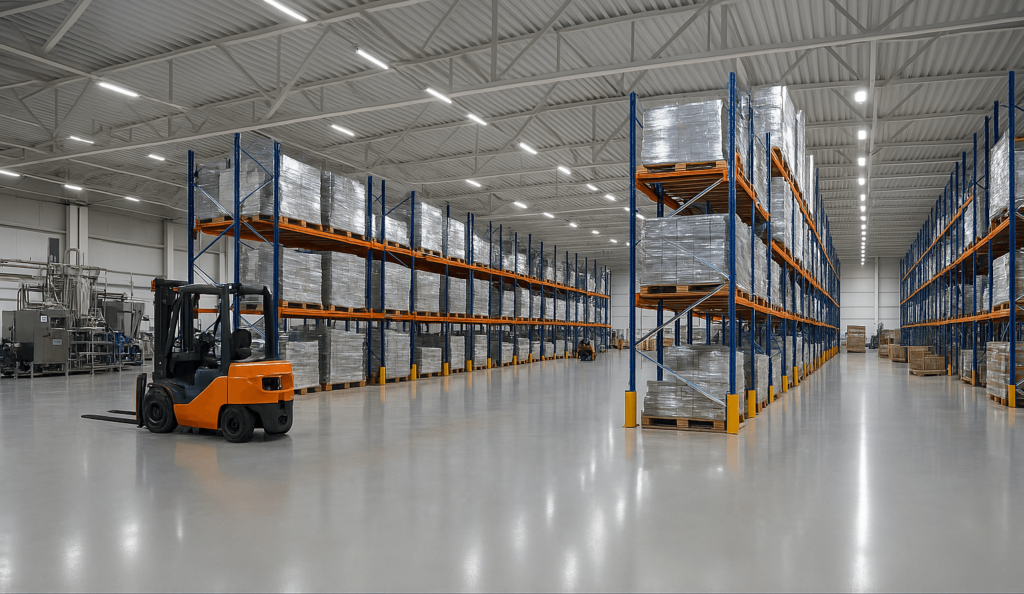
Warehouse interior with high shelves stacked with materials, orange forklift in foreground, showcasing durable flooring suitable for industrial applications and optimized for graphene-enhanced concrete.

🔧 Key Benefits of Graphene Concrete for Industrial Builds

Whether constructing distribution centers, production plants, or logistics hubs, graphene concrete brings measurable performance improvements that optimize every inch of the facility:
  • High-impact resistance for machinery, pallets, and equipment loads
  • Longer service life with reduced repair frequency and downtime
  • Better thermal resistance for hot and cold environments
  • Reduced curing times to accelerate construction timelines
  • Slip-resistant surface options for warehouse safety
  • Sustainable composition with lower carbon emissions
The Graphene Solution delivers industrial-grade concrete that’s as tough as your operations demand. It’s time to build smarter, stronger, and longer-lasting.

❓ Frequently Asked Questions About Graphene in Industrial Construction

Industrial developers and engineers often ask how graphene can make a measurable difference in their facility’s performance and cost savings. Here are some common questions answered with clarity and detail.

The upfront material cost is slightly higher, yes. But you have to look at the total cost of ownership. When you factor in the potential for thinner slabs (less material volume), faster cure times (less downtime), and the massive reduction in future maintenance, it often comes out cheaper in the long run.

It’s fantastic for both. If you’re expanding a warehouse, it’s a no-brainer. But we also use it for overlay projects where we need to resurface a damaged floor and ensure it bonds tight and lasts.

No. Any professional concrete crew can work with it. The slump and workability are very similar to standard high-performance mixes. We provide the guidance on the mix design, but the finishing techniques are standard.

While every mix is unique, graphene concrete typically achieves structural competence faster than standard OPC (Ordinary Portland Cement). We can look at your schedule and design a mix that gets you operational as fast as possible.
Graphene Solution logo featuring a molecular structure symbolizing innovative graphene-enhanced concrete technology.Smart Applications of Graphene Concrete

Breakthrough Uses of Graphene in Modern Construction

At The Graphene Solution, we believe that innovation begins with material science. Our graphene-infused concrete is leading the way in sustainable, high-performance infrastructure across various sectors. This powerful technology doesn’t just strengthen construction — it redefines what’s possible in terms of longevity, safety, and efficiency. Below, discover the ten most impactful uses of graphene concrete across industries that demand excellence.

High-Rise Buildings

Graphene-enhanced concrete provides the superior compressive strength needed for tall, modern skyscrapers. Its lightweight properties and structural stability reduce the load on foundations while enhancing safety in seismic zones.

Bridges and Overpasses

In critical infrastructure like bridges, graphene adds durability and crack resistance. It ensures longer lifespans with reduced maintenance, even under heavy loads and extreme weather conditions.

Roadways and Highways

Graphene concrete helps roads last longer by resisting cracking and surface wear. It's ideal for busy highways where traffic and climate changes typically cause rapid deterioration.

Marine Structures

From piers to seawalls, graphene protects concrete from saltwater corrosion. It significantly improves the longevity of marine structures by resisting moisture and harsh coastal conditions.

Dams and Reservoirs

Graphene-infused concrete ensures leak-proof construction in water retention systems. Its impermeability and high strength make it perfect for dams, spillways, and reservoirs.

Nuclear and Energy Infrastructure

Safety is non-negotiable in nuclear and energy projects. Graphene-enhanced concrete offers unmatched fire resistance and structural integrity, critical for power stations and reactor containment.

Tunnel Construction

Underground environments demand resilient materials. Graphene concrete excels in tunnel construction, offering faster curing times, high load resistance, and long-term durability.

Residential and Commercial Buildings

For everyday construction, graphene offers eco-friendly, cost-effective solutions. It’s ideal for foundations, walls, and slabs in both commercial and residential settings, reducing material waste and emissions.

Industrial Facilities

Warehouses, factories, and heavy-duty plants benefit from graphene’s load-bearing strength and resistance to chemicals. It ensures longer-lasting floors and structural components in demanding industrial zones.

Airport Infrastructure

From runways to terminals, graphene concrete supports aviation’s demanding needs. Its toughness under high traffic and weather fluctuations makes it a go-to for modern airport development.

Graphene concrete for dam construction, highlighting durability and watertight properties for modern infrastructure.
Graphene-enhanced concrete applications in dam construction showcasing durability and sustainability benefits.
Graphene Solution logo featuring a molecular structure symbolizing innovative graphene-enhanced concrete technology.UPDATES AND NEWS

Explore the Latest in Graphene Concrete Innovation

Stay informed with expert insights, industry news, and project breakthroughs from The Graphene Solution. Our blog covers everything from graphene applications in construction to sustainable building trends and performance tips—designed to help you build smarter.