


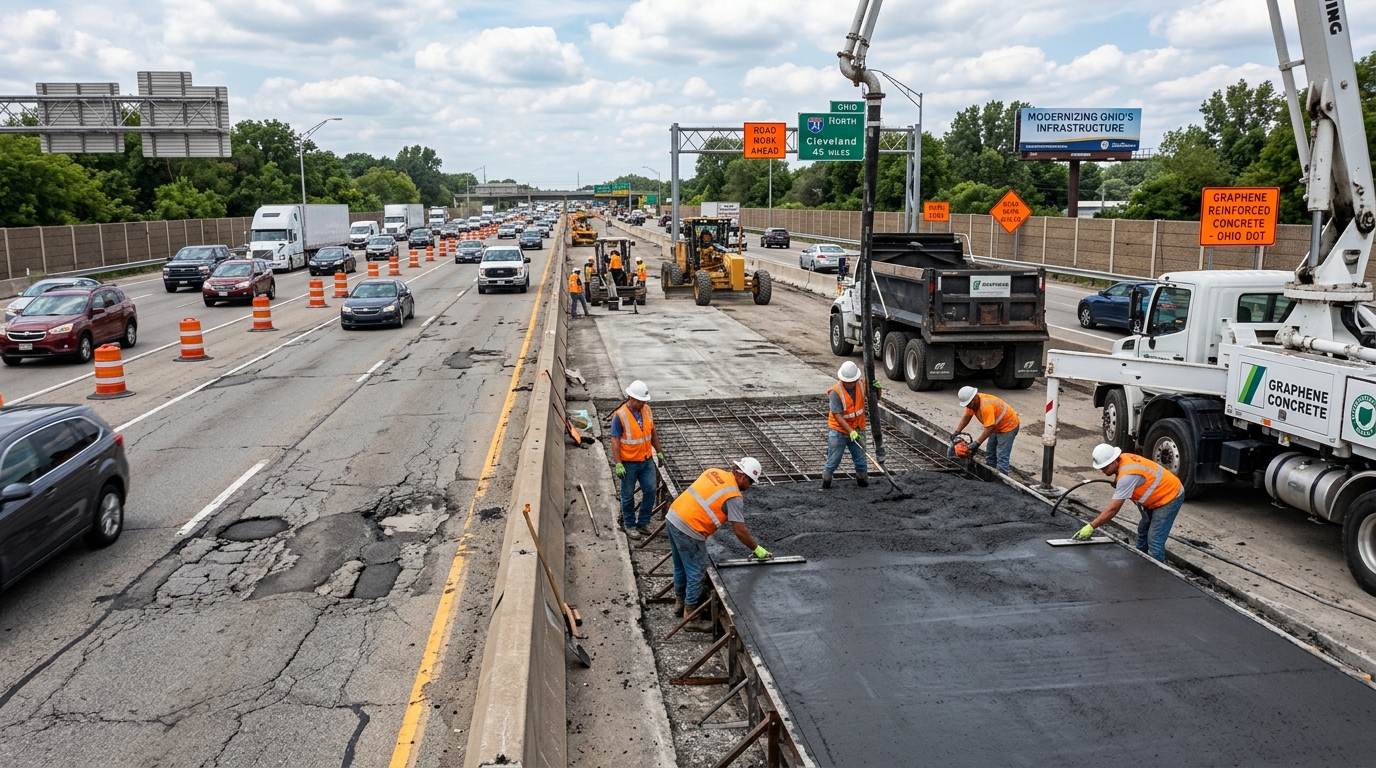
How Graphene Concrete Is Finally Fixing Ohio’s Crumbling Highways
How Graphene Concrete Is Finally Fixing Ohio’s Crumbling Highways
If you’ve driven on an Ohio highway after a hard winter, you know the feeling. That rhythmic thunk-thunk-thunk as your tires hit another patch job. The way your coffee sloshes right as you hit a frost heave you couldn’t dodge. The potholes that appear in February like clockwork, same spots, every single year.
It’s not a funding problem, exactly. And it’s not that engineers don’t know how to pave a road. It’s something more fundamental — Ohio’s freeze-thaw cycle is genuinely brutal on traditional concrete, and we’ve been fighting it with the same tools for decades.
But that’s changing. Graphene-enhanced concrete for roadways and highway construction is no longer a lab experiment. It’s being deployed on actual infrastructure, and the results are the kind of thing that makes highway engineers genuinely excited. Which, honestly, is rare.
Here’s what’s actually happening — and why it matters for everyone who drives on Ohio roads.
Why Ohio’s Roads Have Such a Hard Time
Before we get into the solution, let’s be honest about the scale of the problem.
Ohio sits in a climate zone that’s almost perfectly designed to destroy concrete. Temperatures swing above and below freezing dozens of times every winter — sometimes in the same day. Water seeps into microscopic cracks in the pavement, freezes, expands, and physically tears the concrete apart from the inside. Then it thaws, contracts, and leaves a little more damage behind.
Repeat that process 50, 60, 100 times in a single winter. You start to understand why Ohio roads look the way they do by March.
And here’s the thing: traditional concrete is porous. Water finds a way in. Every patch and repair is fighting the same physics that wrecked the road in the first place. It’s a cycle that costs Ohio hundreds of millions in maintenance every year — and that cost gets passed along to everyone through taxes, wear on vehicles, and time lost in construction delays.
There had to be a better material. And it turns out, there is.
What Graphene Actually Does to Concrete
Okay, “graphene” gets thrown around a lot. It’s one of those words that sounds futuristic and slightly made-up. So let me explain it the way I’d explain it to a friend.
Graphene is essentially a single layer of carbon atoms arranged in a honeycomb pattern. It’s incredibly strong — stronger than steel by weight — and incredibly thin. When you mix graphene into concrete at the molecular level, it fills in the gaps between cement particles and creates a material that’s fundamentally denser and more resistant to cracking.
Think of traditional concrete like a sponge — lots of tiny air pockets water can infiltrate. Graphene concrete is more like a tightly woven fabric. Water has nowhere to go.
For Ohio roads specifically, this matters enormously. The freeze-thaw problem in graphene concrete highway applications comes down to one key thing: if water can’t penetrate the surface, it can’t freeze and expand inside the pavement. The cycle that destroys conventional roads gets interrupted at step one.
7 Ways Graphene Concrete Solves the Freeze-Thaw Problem
1. It Dramatically Reduces Water Absorption
Traditional concrete absorbs water. That’s just the nature of the material — it’s got pores, and water finds them.
Graphene concrete absorbs significantly less water because the graphene particles fill those microscopic gaps in the cement matrix. Studies have shown water absorption rates drop by 50% or more compared to standard mixes. On a wet Ohio highway in January, that’s not a small thing. That’s the difference between a road that survives the winter and one that needs patching by April.
The practical upshot: Less water in the pavement means fewer freeze-thaw cycles that matter. It’s that direct.
2. Compressive Strength Goes Up — Significantly
Here’s something that surprised me when I first dug into this: graphene doesn’t just make concrete more waterproof. It makes it physically stronger.
Compressive strength — how much weight or force concrete can handle before it cracks — increases by roughly 30-40% in graphene-enhanced mixes. For a highway carrying semi trucks all day, every day, that’s meaningful. Cracks from traffic stress are often the entry point for water. Stronger concrete means fewer cracks, which means fewer opportunities for moisture to get in and do damage.
Real-world scenario: A section of Ohio interstate that might start showing stress fractures after 8-10 years under heavy truck traffic could potentially last 20 years or more with graphene concrete. That’s not a rounding error — that’s a fundamentally different maintenance schedule.
3. Tensile Strength Improves Too (This One’s Important)
Compressive strength is how well concrete handles being squished. Tensile strength is how well it handles being pulled or stretched — which is what happens during thermal expansion and contraction.
Concrete expands when it’s warm and contracts when it’s cold. Traditional concrete is relatively brittle under that kind of stress, which is why you see those characteristic thermal cracks running perpendicular to the highway. Graphene’s molecular structure distributes tensile stress more evenly throughout the material, so instead of cracking at the weakest point, the whole slab flexes slightly.
Think of it this way: a wooden board snaps when you bend it. A piece of bamboo bends without breaking. Graphene is nudging concrete toward the bamboo end of that spectrum.
4. Chloride Resistance Means Deicing Salt Does Less Damage
Ohio uses a lot of road salt. A lot. It’s the standard solution to icy highways, and it works — but it accelerates concrete degradation because chloride ions penetrate the surface and attack the rebar inside, causing rust expansion that cracks the concrete from within.
Graphene concrete is significantly more resistant to chloride penetration. The dense molecular structure that blocks water also blocks the salt. This matters particularly for Ohio because we’re not just dealing with freeze-thaw damage — we’re dealing with freeze-thaw damage plus aggressive chemical attack from the deicing compounds we need to keep roads safe.
Eliminating one of those stressors is genuinely significant. Combined with reduced water absorption, you’re looking at a material that holds up against the two biggest enemies of Ohio pavement simultaneously.
5. Longer Lifespan Means Fewer Construction Zones
Let’s be honest: nobody hates road construction because they don’t want good roads. People hate it because it’s disruptive, it slows commutes, and — here’s the part that really stings — the same stretch of highway seems to be under construction every few years anyway.
Graphene-enhanced concrete roadway projects are designed with dramatically longer service lives in mind. When a road lasts 25-30 years instead of 12-15, you’re not just saving money on materials and labor. You’re reducing the number of years those orange barrels are sitting on the shoulder. You’re reducing the accidents that happen in construction zones. You’re giving commuters their time back.
That’s a quality-of-life benefit that doesn’t always show up in the infrastructure budget line — but it’s real.
6. Lower Carbon Footprint per Mile (This One’s Counterintuitive)
Graphene sounds expensive and resource-intensive. But here’s the counterintuitive part: because graphene enhances the properties of concrete so significantly, you can achieve the same structural performance with less material overall.
Less concrete per mile. Less cement production, which is one of the most carbon-intensive industrial processes there is. Over a 30-year lifespan where you’re not repaving every decade, the environmental math gets even better.
I’m not going to claim graphene concrete is perfect from a sustainability standpoint — the material is still being refined, and costs vary. But the lifecycle analysis looks genuinely promising compared to the current model of pave-crack-patch-repave.
7. It’s Compatible with Existing Construction Methods
This is the one that actually makes implementation realistic.
Some materials that sound great in theory require completely different construction equipment, specialized crews, and new supply chains. Graphene concrete doesn’t. It’s mixed and poured using equipment that’s already on job sites. The graphene is introduced during the mixing process, and from there, the workflow is largely the same as standard concrete work.
That compatibility is huge. It means the transition from traditional concrete to graphene-enhanced mixes doesn’t require Ohio’s highway contractors to retrain their entire workforce or buy new equipment. It’s an upgrade, not a revolution. And upgrades actually happen.
A Quick Comparison: Traditional vs. Graphene Concrete for Ohio Roads
| Factor | Traditional Concrete | Graphene Concrete |
|---|---|---|
| Water Absorption | High | Reduced by ~50% |
| Compressive Strength | Baseline | +30-40% |
| Tensile Strength | Moderate | Significantly improved |
| Chloride Resistance | Vulnerable | Substantially better |
| Expected Road Lifespan | 12-15 years | 25-30+ years |
| Freeze-Thaw Cycle Resistance | Low | High |
| Construction Method Changes | N/A | Minimal — same equipment |
| Long-term Cost | High (frequent repair) | Lower over lifecycle |
Key Takeaways
- Ohio’s freeze-thaw problem isn’t just about cold temperatures — it’s about water penetration. Fix the water problem and you break the damage cycle.
- Graphene concrete reduces water absorption by up to 50%, which is the single most important factor for freeze-thaw resistance.
- Strength improvements (both compressive and tensile) mean fewer crack entry points and better handling of thermal stress.
- Chloride resistance addresses the deicing salt problem that compounds freeze-thaw damage on Ohio roads.
- Longer road lifespan means fewer construction zones, less disruption, and lower long-term costs.
- Graphene concrete works with existing construction equipment — it’s a practical upgrade, not a theoretical one.
- The lifecycle environmental case is stronger than you might expect.
What This Means for Ohio — Right Now
Here’s where I want to be honest with you: this isn’t going to fix every Ohio road overnight. Infrastructure transitions take time. There are budgets, contracts, legislative cycles. The machinery of state highway departments moves slowly.
But the direction is clear. Graphene-enhanced concrete for Ohio highway construction is moving from pilot projects to serious consideration for major infrastructure. The data is there. The material works. The construction compatibility is real. The economic case over a 30-year lifecycle is increasingly hard to argue against.
What changes things is awareness and demand. When communities understand that there’s a better material available — one that could mean not resurfacing that same stretch of I-71 every seven years — that creates pressure for adoption. Engineers want to use the best tools available. They need the public and the policy environment to support making the switch.
So maybe the most useful thing you take from this is exactly that: the technology exists. The solution to Ohio’s chronic highway problem isn’t just more money poured into the same materials. It’s smarter materials that fight the physics of a Midwest winter instead of just tolerating it.
That’s worth knowing. And honestly, it’s worth asking your local representatives about.
Want to learn more about how graphene technology is being applied to Ohio infrastructure? Explore the full case for graphene concrete in highway construction — it’s more accessible than you might think.