

Graphene Concrete for ODOT Projects: What Ohio Contractors Must Know
Graphene Concrete for ODOT Projects: What Ohio Contractors Must Know
There’s a moment on every job site when you look at a freshly poured slab and wonder — honestly wonder — how long this thing is actually going to hold up.
You’ve done everything right. Right mix design, right slump, right curing. And still, a few Ohio winters later, you’re watching freeze-thaw cycles do what they always do. The cracks show up. The surface spalls. The phone rings.
That cycle — pour, perform, deteriorate, repair — has been the rhythm of concrete construction for decades. But something is changing. And if you’re bidding ODOT work right now, you need to know about it.
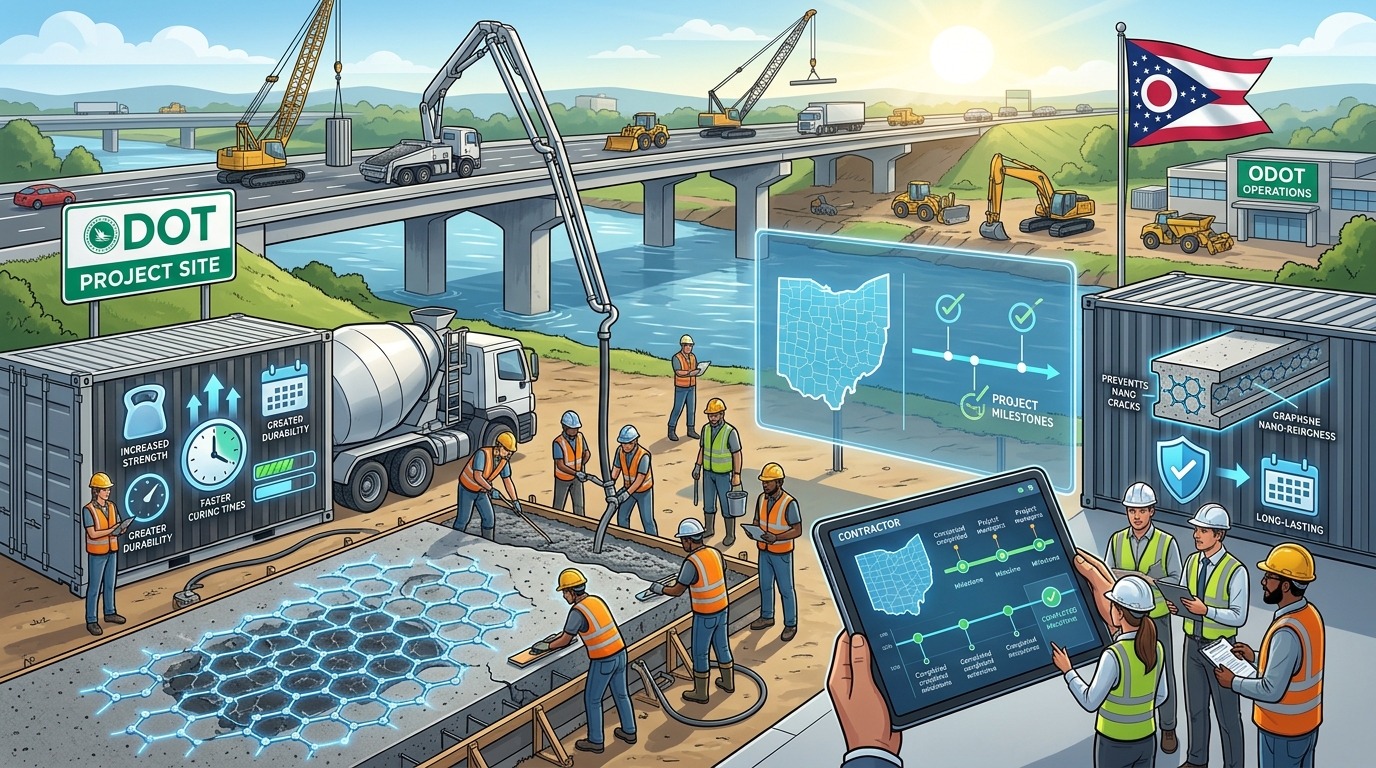
Graphene-enhanced concrete is moving out of research papers and into real infrastructure projects. That includes Ohio. And contractors who understand what it is, how it performs, and where it’s headed are going to have a real edge over those who don’t.
So let’s talk about it — no jargon, no hype, just what you actually need to know.
First, What Even Is Graphene Concrete?
Here’s the thing about graphene: the name sounds futuristic, but the concept is surprisingly straightforward.
Graphene is a single layer of carbon atoms arranged in a hexagonal lattice. It’s basically the thinnest possible version of graphite — the stuff in your pencil. But at that atomic scale, something remarkable happens. It becomes one of the strongest materials ever measured, while also being incredibly lightweight and highly conductive.
When you introduce graphene nanoplatelets into a concrete mix, even in tiny quantities — we’re talking fractions of a percent by weight — the material changes at a microstructural level. The graphene particles fill in voids, reinforce the cement paste matrix, and create a denser, more cohesive final product.
The result? Concrete that’s significantly stronger in compression and flexure, more resistant to water infiltration, and better at handling the kind of thermal stress that Ohio weather loves to inflict.
It’s not a magic bullet. But it’s a genuinely meaningful improvement. And for ODOT applications — where durability and lifecycle cost matter enormously — that improvement translates directly into value.
Why ODOT Projects Are the Right Fit
Think about what ODOT infrastructure actually goes through.
Freeze-thaw cycles, heavy truck loads, de-icing salts, constant moisture exposure. Ohio’s roads and bridges are some of the most mechanically stressed surfaces in the country. The standard approach has been to build thick, build strong, and budget for repairs. It works, but it’s expensive — both upfront and over time.
Graphene concrete for roadways and highway construction addresses the core problem differently. Instead of just adding more material, it makes the material itself better. You get more performance out of the same volume of concrete.
For ODOT specifically, that matters for a few reasons:
Lifecycle cost is the whole ballgame. ODOT evaluates projects on long-term cost, not just initial bid price. Concrete that lasts longer and requires fewer repairs wins on that metric, even if the upfront mix costs a bit more.
Performance specs are getting stricter. ODOT has been increasingly attentive to material performance specifications on major projects. Graphene-enhanced mixes that can demonstrate compressive strength gains and reduced permeability are well-positioned as those specs evolve.
The repair cycle is politically visible. Nobody loves seeing freshly paved roads deteriorate in three winters. Longer-lasting infrastructure is good for the agency and good for the contractors who build a reputation for quality work.
What the Performance Numbers Actually Look Like
Let’s get concrete about this — pun intended.
Research and real-world applications have shown graphene-enhanced concrete can deliver:
- 20–30% improvement in compressive strength compared to equivalent control mixes
- Significant reductions in water permeability — which is the key driver of freeze-thaw damage and chloride penetration
- Improved flexural strength, meaning the slab is less likely to crack under bending loads
- Better resistance to carbonation, which extends the timeframe before rebar corrosion becomes a concern
Now, those numbers vary. Mix design matters. The type and quality of graphene additive matters. The base cement type matters. You’re not going to see those gains by just dumping graphene into a standard mix without understanding the chemistry.
But when it’s done right — with proper mix engineering and quality control — the performance improvements are real and repeatable. That’s not marketing. That’s what the data shows.
The Honest Challenges (Because There Are Some)
I’d be doing you a disservice if I made this sound like pure upside with no complications. There are real challenges, and you should know about them going in.
Dispersion is the critical variable. Graphene particles are tiny, and they tend to clump. If they’re not properly dispersed throughout the mix, you don’t get uniform performance — you get inconsistent results. Good graphene concrete requires a supplier who’s solved the dispersion problem, and a mix design that accounts for it.
Familiarity takes time. Your crews know conventional concrete. They know how it pours, how it finishes, how it cures. Graphene-enhanced concrete behaves similarly but not identically. There’s a learning curve, and the first few jobs aren’t the time to cut corners on QC.
Spec approval is still evolving. ODOT has a process for approving new materials, and it’s not instant. If you’re bidding a project that doesn’t yet have graphene concrete written into the specs, you may need to work through that approval process — which takes time. Starting those conversations early, before bid day, is a lot smarter than trying to substitute mid-project.
Cost differential is real but shrinking. Graphene additives cost more than standard cement. But as production scales and the technology matures, that premium is coming down. And when you factor in lifecycle performance, the cost comparison looks a lot more favorable than the raw material price suggests.
None of these challenges are dealbreakers. They’re just things you need to plan for.
Expert Perspective: How Contractors Are Actually Using This
Here’s what I’ve seen from contractors who are getting ahead of this technology rather than waiting to see how it shakes out.
The smart ones aren’t treating graphene concrete as an all-or-nothing proposition. They’re identifying specific project types where it makes the most sense — bridge decks, pavement overlays, structures with aggressive exposure conditions — and building experience there.
They’re also talking to suppliers early. Understanding the mix design requirements, the batching process, the QC protocols. Getting their crews familiar with the material before it’s on a high-stakes ODOT job.
And they’re paying attention to the specification landscape. When ODOT starts formally incorporating performance-based material specs, contractors who already have experience with graphene-enhanced concrete are going to have a real competitive advantage.
This isn’t about chasing novelty. It’s about understanding where infrastructure materials are heading and positioning your operation accordingly.
Practical Steps for Ohio Contractors
If you’re thinking about getting into this space — or just want to understand it better before it shows up in a spec — here’s what actually makes sense to do:
Get educated on the material. Start with the basics of graphene concrete for highway construction and understand what performance claims are backed by data. There’s a lot of noise in this space. Learn to separate the science from the marketing.
Talk to a qualified supplier. Not all graphene additives are created equal. Find suppliers who can provide third-party performance data and who understand the ODOT context specifically. Ask about dispersion methodology, mix design support, and QC documentation.
Start a conversation with ODOT. If you’re serious about this on future work, getting a dialogue going with ODOT’s materials division isn’t a bad idea. Understanding their approval process and what documentation they’d need is valuable intelligence.
Run a trial project. Before you commit to graphene concrete on a major ODOT job, find a smaller project where you can build experience. Private commercial work, a municipal contract — somewhere you can learn without the full weight of a state contract hanging over you.
Document everything. Mix designs, batch records, QC test results, field performance observations. The contractors who build a track record with documented performance data are the ones who’ll be able to make the case to ODOT project managers down the road.
FAQ: What Contractors Actually Ask About Graphene Concrete
Does graphene concrete require different placement or finishing techniques?
Mostly no — it places and finishes similarly to conventional concrete. Some mixes have slightly different workability characteristics, which is why understanding your specific mix design matters. Your crews will adapt quickly, but don’t skip the pre-job briefing.
Will ODOT specs allow graphene concrete on current projects?
It depends on the project and the spec language. Performance-based specs that don’t prescribe specific materials are more open to it. Prescriptive specs may require a formal materials approval process. Check the project-specific requirements and start that conversation early if there’s ambiguity.
How much does it add to the cost of a mix?
It varies significantly by supplier and graphene type, but you’re generally looking at an added cost in the range of a few dollars to tens of dollars per cubic yard depending on dosage and graphene quality. Against a backdrop of ODOT’s lifecycle cost analysis, that premium often looks very different than it does in isolation.
Is the strength improvement consistent across different cement types?
Generally yes, though performance does vary with base mix design. This is one reason good mix engineering support from your graphene supplier is important — you want documented performance data for your specific mix, not just generic claims.
What’s the timeline for graphene concrete becoming mainstream in ODOT work?
Honestly, it’s hard to say precisely. But the trajectory is clear. As more performance data accumulates and material costs continue to come down, adoption will accelerate. Contractors who build experience now won’t be scrambling to catch up when it becomes standard.
The Bottom Line
Here’s what it really comes down to.
Ohio’s infrastructure needs are significant, ODOT’s standards are high, and the pressure to deliver durable, cost-effective work isn’t going away. Graphene concrete isn’t a silver bullet — but it’s a real, data-backed improvement over conventional materials, and it’s moving from experimental to practical faster than a lot of people realize.
The contractors who’ll benefit most from this shift aren’t necessarily the biggest or the best-capitalized. They’re the ones paying attention, asking good questions, and building knowledge before they need it.
If you want to understand more about how graphene concrete is being applied in Ohio roadway and highway construction, that’s a great place to dig deeper.
And if you’re already thinking about how this might fit into your next bid or your next conversation with a project owner — reach out. The people who are figuring this out are doing it together, not in isolation. That’s always been true in this industry, and it’s still true now.
The concrete is changing. Might as well understand it before your competitors do.