Imagine standing at the base of a dam. You look up at that massive gray wall, and you know that on the other side, millions of gallons of water are pushing against it with relentless force.
It doesn’t stop at night. It doesn’t stop on holidays. That pressure is constant.
For those of us who manage water infrastructure—whether it’s a municipal reservoir, a hydroelectric dam, or an agricultural retention pond—that pressure is always in the back of our minds. We know that water is the ultimate solvent. It is patient. It will find the tiniest microscopic void in the concrete, work its way in, and start popping the structure apart from the inside.
The scary reality is that traditional concrete, for all its strength, is naturally porous. It’s like a hard sponge. Over time, water seeps through, carrying salts and chemicals that rust the rebar and weaken the core.
When you see a wet spot on the downstream face of a dam, your stomach drops. You know what it means. It means the water is winning. It means expensive repairs, drained reservoirs, and sleepless nights worrying about structural integrity.
But what if the concrete wasn’t a sponge? What if we could change the molecular structure of the wall itself to make it essentially impermeable?
That is exactly what we are doing with graphene.
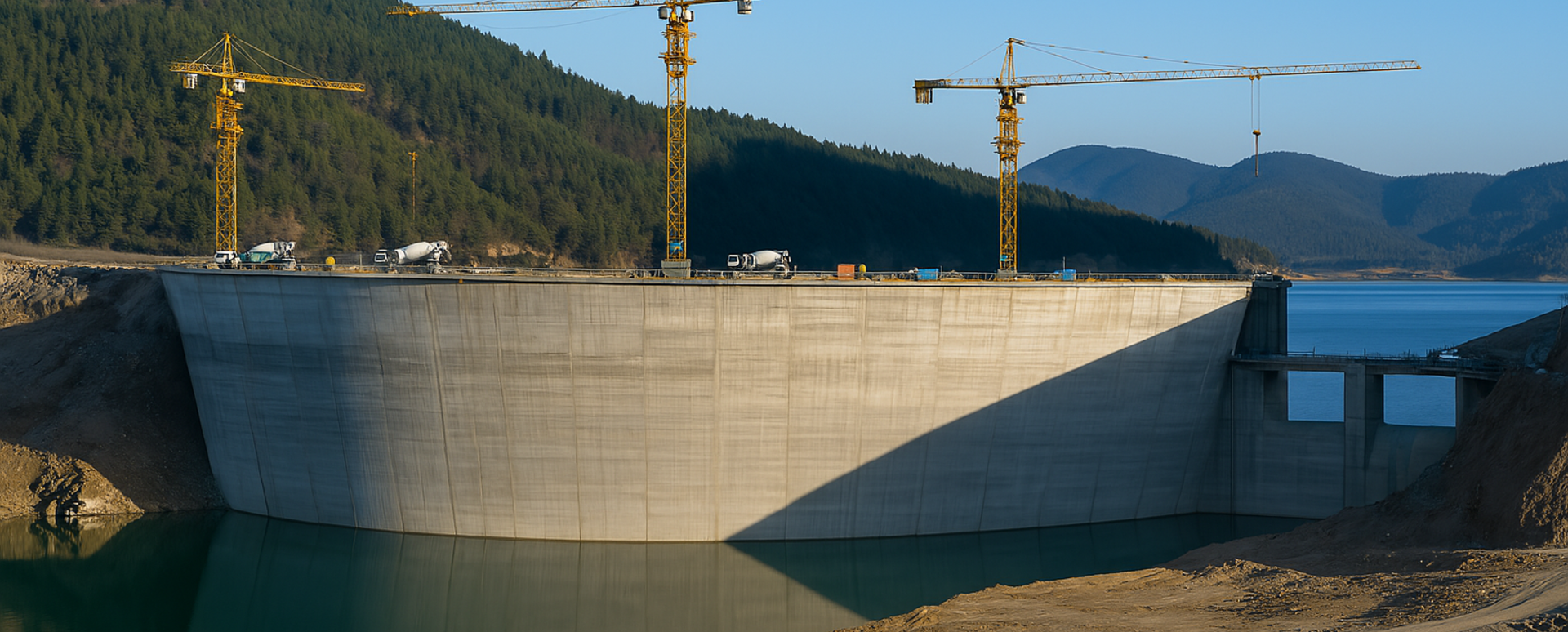
We have been building dams the same way for decades. We pour massive amounts of Ordinary Portland Cement (OPC), reinforce it with steel, and hope for the best.
But here is the problem: the environment is changing, and our infrastructure is aging faster than we predicted.
When water permeates concrete, it triggers a chain reaction. You get freeze-thaw damage in colder climates. You get Alkali-Silica Reaction (ASR), which expands and cracks the concrete like a slow-motion explosion. And if you are managing graphene concrete for marine and coastal structures or reservoirs with high mineral content, chemical attack is a constant threat.
Ignoring these early signs—those hairline cracks or that efflorescence (white powder) on the surface—is dangerous.
Repairing a dam isn’t like patching a driveway. You often have to drain the reservoir, which disrupts water supply and power generation. The costs are astronomical. And if a failure occurs? The safety risks to downstream communities are something no engineer wants on their conscience.
We need a material that pushes back. We need a barrier, not just a buffer.
This is where the conversation shifts from “pouring concrete” to “engineering materials.”
Graphene is a nanomaterial—a single layer of carbon atoms arranged in a honeycomb lattice. It is incredibly strong, yes, but for dams and reservoirs, its most important property is its surface area.
When we mix graphene into the concrete, it acts as a nucleation agent. It forces the cement crystals to grow in a tighter, denser structure. It effectively locks the door against water molecules.
If you are interested in the physics of it, you can read about how graphene strengthens concrete at a molecular level, but the practical result is simple: you get a material that is virtually waterproof from the inside out.
Here is how we approach a critical infrastructure project:
Hydraulic Analysis: We look at the water pressure, the chemical composition of the water, and the thermal stresses the structure will face.
Custom Mix Design: We formulate the concrete with the precise dosage of graphene needed to achieve low permeability and high tensile strength.
Controlled Pour: Graphene concrete has unique rheology (flow). We work with your contractors to ensure it is placed and vibrated correctly to eliminate voids.
Curing Management: Proper curing is vital. Graphene helps regulate the heat of hydration, reducing the thermal cracking that often plagues massive pours.
Quality Assurance: We test the cured concrete to verify that it meets the rigorous impermeability standards required for water retention.
Houston, Tx 77066
More than 80% of US bridge deterioration traces back to just two underlying mechanisms — yet standard portland cement concrete provides almost no defense against either. Graphene changes both equations at the molecular level.
Deicing salts on northern bridge decks and sea-spray on coastal structures drive chloride ions deep into conventional concrete matrix, eventually reaching embedded steel reinforcement. Once chloride concentration at the rebar surface exceeds a threshold, electrochemical corrosion begins — expanding rust exerts tensile stress on the surrounding concrete, triggering delamination and spalling that accelerates exponentially.
Graphene's nano-scale platelet geometry creates a near-impermeable tortuous path through the cement matrix. Independent testing consistently shows chloride diffusion reduced by up to 90%, dramatically delaying the onset of active corrosion and extending rebar service life by decades. For graphene-enhanced protective coatings applied to existing structures, the barrier effect works on existing surfaces as well.
Water that infiltrates micro-pores expands by roughly 9% on freezing. Over hundreds of freeze–thaw cycles — typical for bridge decks in the Midwest, Mid-Atlantic, and Northeast — this internal pressure widens existing micro-cracks into full delamination. Conventional air-entrainment reduces damage but does not eliminate it.
Graphene platelets function as nano-scale crack arrestors. When a micro-crack begins to propagate under thermal stress, graphene bridges and reinforces the crack faces, requiring exponentially more energy for the crack to advance. Combined with the pore-filling effect that limits initial water ingress, graphene-enhanced concrete demonstrates dramatically reduced freeze–thaw damage in accelerated cycle testing. This same mechanism benefits highway and roadway applications exposed to identical thermal cycling.
Together, these two properties target the root causes responsible for the overwhelming majority of structural degradation in US bridge infrastructure — making graphene not a marginal upgrade, but a foundational shift in how bridge concrete performs over its service life.
Speak directly with our graphene concrete specialists about your bridge project.
Graphene's performance advantages are not limited to a single bridge element — they compound across every concrete component in the structure. Here is how each application benefits from graphene admixture technology.
The bridge deck is the highest-wear, most salt-exposed element in any northern or coastal structure. Graphene concrete specified for new deck pours produces a denser hydration product with fewer interconnected capillary pores — the primary ingress pathway for chloride ions. For rehabilitation projects, graphene-modified overlay compounds bond to existing deck concrete while introducing a chloride-impermeable surface layer, extending the useful life of the underlying structure without full deck replacement. The same structural repair technology used in Houston's aggressive coastal environment applies directly to deck rehabilitation nationwide.
Bridge piers and abutments operate in the most aggressive exposure zones: tidal splash zones, scour-impacted foundations, and soil environments with chloride or sulfate contamination. Conventional concrete in these locations requires expensive sacrificial cover depths and cathodic protection systems. Graphene concrete's reduced permeability allows engineers to specify thinner, more precisely dimensioned cross-sections while achieving greater resistance to both chloride attack and sulfate-induced expansion. For coastal bridge substructures, this application directly parallels marine infrastructure applications where graphene has demonstrated exceptional durability in continuous salt-water exposure.
Approach slabs sit at the intersection of bridge and roadway — subject to heavy dynamic loading, frost-line temperature fluctuations, and drainage patterns that concentrate deicing chemical runoff. They are chronically the first bridge element to require rehabilitation. Graphene concrete in approach slab applications targets both failure modes simultaneously: enhanced flexural toughness resists the dynamic loading environment while reduced permeability limits chloride ingress beneath slab surfaces where ponding water carries salt infiltration. DOT programs frequently specify approach slab rehabilitation on independent schedules, creating a natural pilot project entry point for graphene concrete trials.
Prestressed and post-tensioned bridge girders demand high early-strength concrete to facilitate accelerated strand release at precast plants — and maximum long-term durability to protect high-stress tendons from chloride-induced stress corrosion cracking. Graphene admixtures accelerate hydration kinetics, delivering higher early compressive strength with equivalent or reduced cement factor, while the nano-scale pore-filling effect provides exceptional protection for embedded prestressing strand. For precast producers supplying DOT contracts, graphene-enhanced mixes can simplify accelerated curing schedules and reduce the risk of chloride-initiated tendon failure at minimum cover depths.
Emergency bridge rehabilitation — spalling repairs, pothole patching, joint reconstruction — demands rapid-set repair mortars that achieve structural strength within hours to minimize lane closure duration. Standard rapid-repair mortars often exhibit higher shrinkage and weaker bonding than parent concrete, creating new failure interfaces. Graphene-modified rapid repair compounds achieve superior bond strength, reduced shrinkage cracking, and the same chloride-barrier properties as full-depth graphene concrete. This means repairs on salt-exposed decks do not create new chloride ingress pathways at patch perimeters — the most common cause of repair failure in northern states. Our structural repair solutions are formulated for exactly these demanding rapid-turnaround conditions.
Technical data sheets, mix design parameters, and DOT submittal support — all available through our team.
Three states represent the highest-volume near-term markets for graphene concrete adoption in bridge infrastructure — each driven by documented deficiency backlogs, aggressive rehabilitation funding, and DOT leadership receptive to performance-based material innovation.
PennDOT manages one of the largest bridge inventories in the nation, with over 4,000 structures rated structurally deficient — a legacy of aggressive road salt use and aging steel-reinforced concrete decks built between the 1950s and 1980s. Pennsylvania's Rapid Bridge Replacement Program has moved aggressively on high-volume deck replacements, creating procurement windows for contractor-specified material innovations. PennDOT's move toward performance-based specifications — particularly for bridge deck concrete — provides a direct pathway for graphene admixture qualification under compressive strength, permeability, and freeze–thaw durability criteria. Our team has specific experience navigating graphene concrete qualification in Pennsylvania construction programs.
ODOT has accelerated bridge replacement funding substantially since 2022, with a particular focus on rural county bridges and urban interstate overhead structures where chloride exposure from winter maintenance operations has driven rapid deck deterioration. Ohio's climate creates among the highest annual freeze–thaw cycle counts for bridge decks in the contiguous US. The combination of extreme thermal cycling and heavy deicing salt usage makes graphene concrete's dual mechanism of chloride barrier performance and crack-arrest properties especially relevant to ODOT's technical challenges. Ohio's construction industry has shown strong uptake of innovative concrete admixtures where performance data supports specification language, positioning it as an ideal state for pilot bridge deck projects.
FDOT manages approximately 12,000 bridges, a large proportion of which cross marine and tidal waterways where chloride exposure is continuous and aggressive. Florida's coastal bridge deterioration challenges mirror — and in many cases exceed — those of northern states because chloride attack is year-round rather than seasonal. FDOT has historically been a leader in adopting high-performance concrete specifications for marine substructure applications, and the agency's emphasis on lifecycle performance over initial material selection makes it a receptive audience for graphene concrete data. For marine and coastal infrastructure projects, graphene concrete's chloride-barrier performance addresses Florida's primary bridge deterioration mechanism directly.
Introducing an innovative admixture into a state DOT material approval process requires a structured, evidence-based approach. The following pathway reflects current FHWA guidance and state DOT practice across Pennsylvania, Ohio, and Florida.
FHWA's performance-based specification framework allows innovative materials when equivalent or superior performance is demonstrated against prescriptive baselines. Document chloride permeability (AASHTO T358), compressive strength, and freeze–thaw durability (ASTM C666) using independently certified test data to establish equivalency language for DOT submittals.
Most state DOTs maintain a qualified products list (QPL) or equivalent approved materials list. Submitting graphene admixture data through the formal QPL process — typically requiring third-party testing and a technical data package — establishes the product as an approved material prior to contract award, removing bid-stage uncertainty for contractors.
State DOT research offices and FHWA's Exploratory Advanced Research Program actively fund demonstration projects for performance-enhancing materials. Proposing a monitored pilot on a targeted bridge rehabilitation project — approach slab, overlay, or substructure repair — generates in-service field data that accelerates statewide specification adoption. FHWA's 2026 reauthorization has expanded funding windows for exactly these material innovation pilot programs.
Engaging prime contractors who hold master DOT contracts to include graphene concrete as a voluntary or value-engineering substitution in competitive bids generates real-project data without requiring upfront DOT specification change. Once field performance is documented, co-authoring updated special provision language with DOT materials engineers transitions the material into standard specification cycles.
We provide DOT submittal packages, third-party test data, and specification language support for bridge project teams in Pennsylvania, Ohio, Florida, and beyond.
Common questions from DOT engineers, contractors, and project owners evaluating graphene concrete for bridge applications.


Dams and reservoirs face relentless pressure, vibration, and water exposure. Graphene’s unique atomic lattice reinforces concrete from within, forming a molecular shield against physical and chemical degradation.
The same characteristics that make graphene perfect for hydro-structures also strengthen other high-stress environments like bridge and overpass infrastructure and marine structures exposed to saltwater.
Proven nanocomposite expertise in water-retaining structures.
Tailored graphene formulations for hydraulic and seismic environments.
Reduced environmental footprint through optimized cement ratios.
End-to-end engineering assistance — from design to on-site execution.
Trusted by leading contractors in dam rehabilitation and new construction.
Partnering with The Graphene Solution means investing in future-proof materials that keep water systems reliable, sustainable, and efficient.
 Smart Applications of Graphene Concrete
At The Graphene Solution, we believe that innovation begins with material science. Our graphene-infused concrete is leading the way in sustainable, high-performance infrastructure across various sectors. This powerful technology doesn’t just strengthen construction — it redefines what’s possible in terms of longevity, safety, and efficiency. Below, discover the ten most impactful uses of graphene concrete across industries that demand excellence.

 UPDATES AND NEWS
Stay informed with expert insights, industry news, and project breakthroughs from The Graphene Solution. Our blog covers everything from graphene applications in construction to sustainable building trends and performance tips—designed to help you build smarter.