


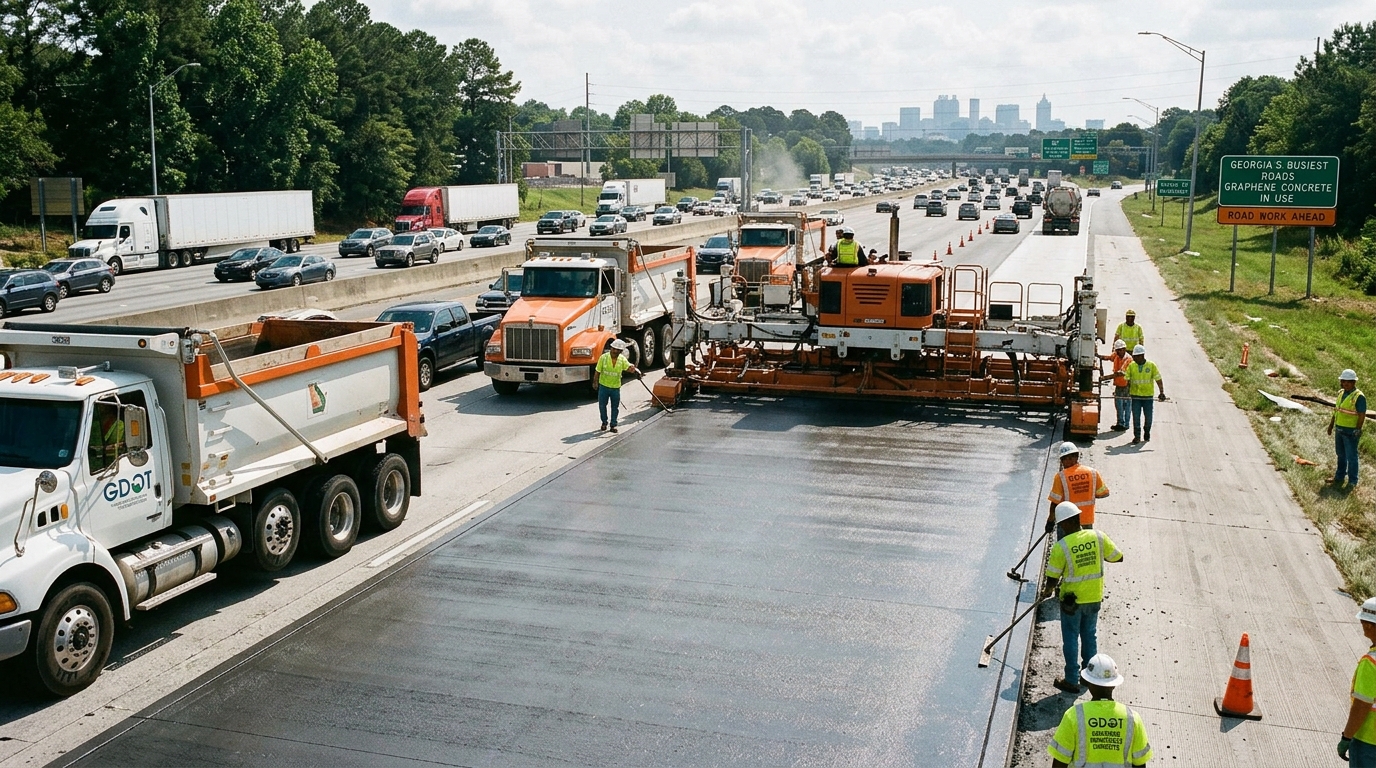
Graphene Concrete Is Coming to Georgia’s Busiest Roads
Graphene Concrete Is Coming to Georgia’s Busiest Roads — Here’s Why It Matters
Picture I-16 on a Tuesday morning. Maybe you’ve driven it. Miles of nothing, then Savannah, then the Port of Savannah — one of the busiest container ports in the entire country. And the trucks. So many trucks. Loaded, heavy, constant.
Now picture that same pavement six years later.
If we keep doing what we’ve been doing — conventional concrete, conventional timelines, conventional repair cycles — those roads are going to look exactly like what you’d expect. Cracked. Patched. Patched again. Slowing down commerce, creating hazards, costing everyone money.
But there’s a real alternative gaining ground right now, and if you care about Georgia infrastructure — or just about not sitting in construction-zone traffic on I-95 — it’s worth understanding what graphene-enhanced concrete for Georgia’s highway corridors actually is and why engineers are paying serious attention to it.
This isn’t a speculative piece about far-off technology. This is about what’s possible right now, on roads like I-16 and I-95, in Georgia’s real infrastructure environment.
What You’re Actually Dealing With on Georgia’s Port Roads
Before anything else, let’s be honest about the scale of the problem.
The Port of Savannah is massive. It handles more containers than almost any other port in the Southeast, and that cargo doesn’t move itself — it moves on trucks, on I-16, on I-95, through the Savannah metro, and out to distribution points across the country. The roads serving that port carry heavy freight at volumes that most highways simply aren’t designed to handle for extended periods.
Traditional concrete under that kind of continuous load stress develops microcracks. Water gets in. In Georgia’s climate — which swings between humid summer heat and periodic winter cold snaps — those cracks expand and contract with temperature changes. Combine that with the chemical effects of deicing treatments during the occasional ice event, and you’ve got pavement that degrades faster than the maintenance schedule can keep up with.
The result is what you’ve probably noticed: perpetual repair zones, uneven surfaces, and the not-so-subtle sound of a heavily loaded semi hitting a rough patch at highway speed.
Here’s what I mean by “scale”: when one corridor fails, it doesn’t just inconvenience commuters. It slows port logistics, increases shipping costs, damages cargo, creates accident risk — and the economic ripple runs further than most people realize. Georgia’s port infrastructure is a supply chain backbone. It deserves materials that can actually hold up.
What Graphene Concrete Is (And Why It’s Different)
Let’s get this out of the way simply, because “graphene” can sound like science fiction if you haven’t heard much about it.
Graphene is carbon, arranged in a single-atom-thick sheet of hexagonal lattice. It’s incredibly strong — we’re talking stronger than steel at a fraction of the weight — and it bonds well at the molecular level with cement particles. When graphene is introduced into a concrete mix, it doesn’t just sit alongside the cement. It fills the microscopic gaps between particles, creating a denser, less porous material.
For Georgia’s port corridors, this matters in a few specific ways that we’ll walk through. But the core idea is simple: graphene concrete for Georgia highway construction is the same familiar material — just fundamentally improved at the structural level.
And critically, it’s poured and finished using the same equipment and methods as conventional concrete. That’s not a small point. New materials that require entirely new infrastructure to deploy tend to stay in pilot programs forever. This one doesn’t have that problem.
Step 1: Understand What Makes Port-Corridor Roads Different
This is where a lot of generic “better concrete” conversations miss the mark for Georgia specifically.
Not all highways take the same kind of abuse. I-16 and I-95 near Savannah face a combination of stressors that most interstate segments don’t:
- Sustained heavy axle loads from port traffic, well beyond what standard pavement designs assume as typical distribution
- High annual average daily traffic with a disproportionate percentage of commercial vehicles
- Thermal cycling — Georgia summers get genuinely hot, which causes pavement expansion; occasional winter cold causes contraction. The constant movement stresses joints and existing cracks
- Humidity — coastal Georgia is wet. Water is consistently available to exploit any vulnerability in the pavement surface
When you’re choosing a material for this environment, you’re not just picking something that handles one of those stressors. You need something that handles all of them simultaneously, over a long service life. That’s the actual engineering challenge.
What this means practically: A standard concrete specification that works fine on a rural county highway in north Georgia might fail in five years on I-16 near the port interchange. The environment is just different. The material selection has to reflect that.
Step 2: Know What Properties Actually Matter Here
Once you understand the stressors, the material requirements get specific.
For Georgia’s port corridors, the key properties are:
Compressive strength under sustained load. Graphene-enhanced concrete shows 30-40% improvements over conventional mixes. Under continuous heavy truck traffic, that margin isn’t theoretical — it translates directly to fewer stress fractures and longer time before the surface needs attention.
Water penetration resistance. Graphene’s dense molecular structure reduces water absorption by up to 50%. In coastal Georgia’s humid environment, where water is almost always present, this is significant. Less moisture in the slab means less internal damage over time.
Thermal stability. The improved tensile strength of graphene concrete — how well it handles being stretched or pulled, rather than compressed — helps it manage the expansion-contraction cycle of hot summers and cool winters without cracking at the joints.
Fatigue resistance. This is the one that doesn’t get talked about enough. Concrete under repeated loading doesn’t just break all at once — it fatigues, gradually accumulating damage over millions of load cycles. Graphene’s effect on the cement matrix improves how the material distributes and absorbs those repeated stresses.
[IMAGE: Cross-section diagram showing graphene particles filling the microscopic gaps in a cement matrix, compared side-by-side with conventional concrete’s more porous structure]
Step 3: See How This Plays Out on a Real Corridor
Let’s make this concrete (again, no apologies for the pun).
Imagine a section of I-16 between Macon and Savannah — a stretch that sees consistent heavy port traffic. Under a conventional concrete resurfacing, you’d expect the pavement to hold up reasonably well for 10-12 years, then begin showing distress. Cracking, joint deterioration, rutting under the heaviest load paths.
At that point, you’re looking at a rehabilitation project — lane closures, traffic management, construction delays that ripple out through the logistics chain. The Port of Savannah doesn’t pause for road work. Those delays have real costs.
Now apply graphene-enhanced concrete to that same section. The expected service life extends to 25-30 years. Not because the engineers did anything dramatically different — the construction process is essentially the same — but because the material holds up better under the exact conditions it’s being asked to tolerate.
Over a 30-year horizon, you’re potentially looking at one resurfacing instead of two or three. That’s fewer disruptions, lower total cost, less risk of accident in construction zones, and roads that actually perform for the infrastructure they’re supposed to support.
[IMAGE: Timeline comparison graphic — conventional concrete maintenance schedule (repairs at years 5, 10, 15, 20) vs. graphene concrete schedule (minimal intervention through year 25+)]
Step 4: Understand the Construction Process (It’s Simpler Than You’d Think)
One of the most common misconceptions about graphene concrete is that it requires completely different construction methods. It doesn’t.
Here’s the actual process:
Mixing: Graphene is introduced into the concrete batch during mixing, typically in the form of a graphene-enhanced admixture. Standard batch plant equipment handles this without modification.
Placement: Poured and placed using conventional paving equipment. The workability of graphene concrete mixes is designed to be comparable to standard mixes — it has to be, or construction crews can’t use it efficiently.
Finishing and curing: Same techniques, same curing timelines. Contractors don’t need retraining or new equipment.
Quality control: This is actually where things get interesting. Because graphene concrete performs better, the QC emphasis shifts toward verifying mix consistency to make sure the graphene dispersion is uniform. That’s a process adjustment, not a new system.
For Georgia DOT contractors familiar with highway-grade concrete work, the learning curve is minimal. That’s part of why graphene concrete deployment on Georgia corridors is genuinely feasible in the near term — not a decade away, but on the timeline of projects currently being planned.
Troubleshooting: The Questions Worth Asking
Any time someone tells you a new material solves everything, push back a little. Here are the legitimate questions around graphene concrete and honest answers:
“Is it actually cost-effective?” The upfront cost per cubic yard is higher than conventional concrete — that’s just true. Graphene isn’t cheap to produce, though costs are falling as production scales. But the lifecycle math matters more than the sticker price. If you spend 20% more per square foot and the road lasts twice as long, the economics are favorable. For high-traffic corridors where the cost of disruption is also factored in, the case gets stronger.
“Has it been tested at scale?” Graphene concrete has been deployed in infrastructure projects in the UK, Europe, and increasingly in North America. The academic literature is solid. Real-world field data is still accumulating, which is honest to say — we don’t have 30-year real-world data because the material is newer than 30 years. But the material science is well-understood and the early performance data is consistent with the lab results.
“What about Georgia’s specific climate?” Georgia’s combination of heat and humidity is worth taking seriously. The good news is that graphene concrete’s moisture resistance is particularly well-suited to high-humidity environments. The concern would be if there were some unexpected interaction with the specific geology or aggregate sources used in Georgia mixes — that’s the kind of thing that regional pilot projects help answer.
Expert Tips: What to Actually Pay Attention To
A few things worth knowing if you’re following this topic or involved in infrastructure decisions:
Mix design matters enormously. Graphene concrete isn’t one product — it’s a range of mix designs with different graphene concentrations and admixture formulations. The performance benefits described here apply to well-designed mixes. Quality control in the batching process is where you protect that investment.
Pilot corridors create the data that makes wider adoption possible. If you’re in a position to advocate for where a graphene concrete trial might make sense in Georgia, high-traffic freight corridors near port infrastructure are exactly the right places to generate meaningful performance data. The results there would inform decisions across the state.
The integration with Savannah’s broader infrastructure plan matters. I-16 and I-95 don’t exist in isolation — they connect to local arterials, port access roads, intermodal facilities. A graphene concrete specification that works at the interstate level ideally gets coordinated with the materials decisions being made on connector infrastructure too. That’s a longer conversation, but it’s worth having.
[IMAGE: Aerial view illustration of the I-16/I-95 interchange near Savannah, with port container facilities visible, showing the convergence of freight traffic the pavement must handle]
Summary: What This Actually Means for Georgia
Let’s bring it back to what matters.
Georgia’s port corridors — I-16, I-95, and the infrastructure web around Savannah — are carrying the weight of significant economic activity. The roads that support that activity are under conditions that ordinary concrete wasn’t designed to handle long-term.
Graphene-enhanced concrete offers a real, deployable solution. Not a distant technology — a material that’s ready now, compatible with existing construction methods, and backed by growing real-world evidence. The improvements in compressive strength, water resistance, thermal stability, and fatigue resistance are exactly the properties that matter on these specific roads.
The next steps are genuinely practical:
- Stay informed about Georgia DOT’s materials specifications and any pilot projects that incorporate graphene admixtures
- Advocate — if you’re connected to local business, logistics, or civic organizations, the case for better infrastructure materials is worth making to the people who influence procurement decisions
- Follow the data — as pilot projects generate real-world performance information, that data will either confirm or refine the projections
If you want to go deeper on what graphene concrete means for Georgia’s highway infrastructure, that’s a conversation worth having. The technology is ready. The question now is how quickly Georgia’s infrastructure planning catches up to what’s possible.
Curious about graphene concrete applications beyond Georgia’s port corridors? Explore the full picture of graphene technology in highway construction — the applications go further than you might expect.
Title: Graphene Concrete Is Coming to Georgia’s Busiest Roads Slug: graphene-concrete-georgia-port-corridors-i-16-i-95-savannah-infrastructure Tags: graphene concrete, Georgia infrastructure, I-16 highway, I-95 corridor, Savannah port roads, highway construction Georgia, concrete technology, port logistics infrastructure Meta Description: Georgia’s I-16 and I-95 corridors are under relentless strain from port traffic. Here’s how graphene concrete could change everything for Savannah’s infrastructure.
Graphene Concrete Is Coming to Georgia’s Busiest Roads — Here’s Why It Matters
Picture I-16 on a Tuesday morning. Maybe you’ve driven it. Miles of nothing, then Savannah, then the Port of Savannah — one of the busiest container ports in the entire country. And the trucks. So many trucks. Loaded, heavy, constant.
Now picture that same pavement six years later.
If we keep doing what we’ve been doing — conventional concrete, conventional timelines, conventional repair cycles — those roads are going to look exactly like what you’d expect. Cracked. Patched. Patched again. Slowing down commerce, creating hazards, costing everyone money.
But there’s a real alternative gaining ground right now, and if you care about Georgia infrastructure — or just about not sitting in construction-zone traffic on I-95 — it’s worth understanding what graphene-enhanced concrete for Georgia’s highway corridors actually is and why engineers are paying serious attention to it.
This isn’t a speculative piece about far-off technology. This is about what’s possible right now, on roads like I-16 and I-95, in Georgia’s real infrastructure environment.
What You’re Actually Dealing With on Georgia’s Port Roads
Before anything else, let’s be honest about the scale of the problem.
The Port of Savannah is massive. It handles more containers than almost any other port in the Southeast, and that cargo doesn’t move itself — it moves on trucks, on I-16, on I-95, through the Savannah metro, and out to distribution points across the country. The roads serving that port carry heavy freight at volumes that most highways simply aren’t designed to handle for extended periods.
Traditional concrete under that kind of continuous load stress develops microcracks. Water gets in. In Georgia’s climate — which swings between humid summer heat and periodic winter cold snaps — those cracks expand and contract with temperature changes. Combine that with the chemical effects of deicing treatments during the occasional ice event, and you’ve got pavement that degrades faster than the maintenance schedule can keep up with.
The result is what you’ve probably noticed: perpetual repair zones, uneven surfaces, and the not-so-subtle sound of a heavily loaded semi hitting a rough patch at highway speed.
Here’s what I mean by “scale”: when one corridor fails, it doesn’t just inconvenience commuters. It slows port logistics, increases shipping costs, damages cargo, creates accident risk — and the economic ripple runs further than most people realize. Georgia’s port infrastructure is a supply chain backbone. It deserves materials that can actually hold up.
What Graphene Concrete Is (And Why It’s Different)
Let’s get this out of the way simply, because “graphene” can sound like science fiction if you haven’t heard much about it.
Graphene is carbon, arranged in a single-atom-thick sheet of hexagonal lattice. It’s incredibly strong — we’re talking stronger than steel at a fraction of the weight — and it bonds well at the molecular level with cement particles. When graphene is introduced into a concrete mix, it doesn’t just sit alongside the cement. It fills the microscopic gaps between particles, creating a denser, less porous material.
For Georgia’s port corridors, this matters in a few specific ways that we’ll walk through. But the core idea is simple: graphene concrete for Georgia highway construction is the same familiar material — just fundamentally improved at the structural level.
And critically, it’s poured and finished using the same equipment and methods as conventional concrete. That’s not a small point. New materials that require entirely new infrastructure to deploy tend to stay in pilot programs forever. This one doesn’t have that problem.
Step 1: Understand What Makes Port-Corridor Roads Different
This is where a lot of generic “better concrete” conversations miss the mark for Georgia specifically.
Not all highways take the same kind of abuse. I-16 and I-95 near Savannah face a combination of stressors that most interstate segments don’t:
- Sustained heavy axle loads from port traffic, well beyond what standard pavement designs assume as typical distribution
- High annual average daily traffic with a disproportionate percentage of commercial vehicles
- Thermal cycling — Georgia summers get genuinely hot, which causes pavement expansion; occasional winter cold causes contraction. The constant movement stresses joints and existing cracks
- Humidity — coastal Georgia is wet. Water is consistently available to exploit any vulnerability in the pavement surface
When you’re choosing a material for this environment, you’re not just picking something that handles one of those stressors. You need something that handles all of them simultaneously, over a long service life. That’s the actual engineering challenge.
What this means practically: A standard concrete specification that works fine on a rural county highway in north Georgia might fail in five years on I-16 near the port interchange. The environment is just different. The material selection has to reflect that.
Step 2: Know What Properties Actually Matter Here
Once you understand the stressors, the material requirements get specific.
For Georgia’s port corridors, the key properties are:
Compressive strength under sustained load. Graphene-enhanced concrete shows 30-40% improvements over conventional mixes. Under continuous heavy truck traffic, that margin isn’t theoretical — it translates directly to fewer stress fractures and longer time before the surface needs attention.
Water penetration resistance. Graphene’s dense molecular structure reduces water absorption by up to 50%. In coastal Georgia’s humid environment, where water is almost always present, this is significant. Less moisture in the slab means less internal damage over time.
Thermal stability. The improved tensile strength of graphene concrete — how well it handles being stretched or pulled, rather than compressed — helps it manage the expansion-contraction cycle of hot summers and cool winters without cracking at the joints.
Fatigue resistance. This is the one that doesn’t get talked about enough. Concrete under repeated loading doesn’t just break all at once — it fatigues, gradually accumulating damage over millions of load cycles. Graphene’s effect on the cement matrix improves how the material distributes and absorbs those repeated stresses.
[IMAGE: Cross-section diagram showing graphene particles filling the microscopic gaps in a cement matrix, compared side-by-side with conventional concrete’s more porous structure]
Step 3: See How This Plays Out on a Real Corridor
Let’s make this concrete (again, no apologies for the pun).
Imagine a section of I-16 between Macon and Savannah — a stretch that sees consistent heavy port traffic. Under a conventional concrete resurfacing, you’d expect the pavement to hold up reasonably well for 10-12 years, then begin showing distress. Cracking, joint deterioration, rutting under the heaviest load paths.
At that point, you’re looking at a rehabilitation project — lane closures, traffic management, construction delays that ripple out through the logistics chain. The Port of Savannah doesn’t pause for road work. Those delays have real costs.
Now apply graphene-enhanced concrete to that same section. The expected service life extends to 25-30 years. Not because the engineers did anything dramatically different — the construction process is essentially the same — but because the material holds up better under the exact conditions it’s being asked to tolerate.
Over a 30-year horizon, you’re potentially looking at one resurfacing instead of two or three. That’s fewer disruptions, lower total cost, less risk of accident in construction zones, and roads that actually perform for the infrastructure they’re supposed to support.
[IMAGE: Timeline comparison graphic — conventional concrete maintenance schedule (repairs at years 5, 10, 15, 20) vs. graphene concrete schedule (minimal intervention through year 25+)]
Step 4: Understand the Construction Process (It’s Simpler Than You’d Think)
One of the most common misconceptions about graphene concrete is that it requires completely different construction methods. It doesn’t.
Here’s the actual process:
Mixing: Graphene is introduced into the concrete batch during mixing, typically in the form of a graphene-enhanced admixture. Standard batch plant equipment handles this without modification.
Placement: Poured and placed using conventional paving equipment. The workability of graphene concrete mixes is designed to be comparable to standard mixes — it has to be, or construction crews can’t use it efficiently.
Finishing and curing: Same techniques, same curing timelines. Contractors don’t need retraining or new equipment.
Quality control: This is actually where things get interesting. Because graphene concrete performs better, the QC emphasis shifts toward verifying mix consistency to make sure the graphene dispersion is uniform. That’s a process adjustment, not a new system.
For Georgia DOT contractors familiar with highway-grade concrete work, the learning curve is minimal. That’s part of why graphene concrete deployment on Georgia corridors is genuinely feasible in the near term — not a decade away, but on the timeline of projects currently being planned.
Troubleshooting: The Questions Worth Asking
Any time someone tells you a new material solves everything, push back a little. Here are the legitimate questions around graphene concrete and honest answers:
“Is it actually cost-effective?” The upfront cost per cubic yard is higher than conventional concrete — that’s just true. Graphene isn’t cheap to produce, though costs are falling as production scales. But the lifecycle math matters more than the sticker price. If you spend 20% more per square foot and the road lasts twice as long, the economics are favorable. For high-traffic corridors where the cost of disruption is also factored in, the case gets stronger.
“Has it been tested at scale?” Graphene concrete has been deployed in infrastructure projects in the UK, Europe, and increasingly in North America. The academic literature is solid. Real-world field data is still accumulating, which is honest to say — we don’t have 30-year real-world data because the material is newer than 30 years. But the material science is well-understood and the early performance data is consistent with the lab results.
“What about Georgia’s specific climate?” Georgia’s combination of heat and humidity is worth taking seriously. The good news is that graphene concrete’s moisture resistance is particularly well-suited to high-humidity environments. The concern would be if there were some unexpected interaction with the specific geology or aggregate sources used in Georgia mixes — that’s the kind of thing that regional pilot projects help answer.
Expert Tips: What to Actually Pay Attention To
A few things worth knowing if you’re following this topic or involved in infrastructure decisions:
Mix design matters enormously. Graphene concrete isn’t one product — it’s a range of mix designs with different graphene concentrations and admixture formulations. The performance benefits described here apply to well-designed mixes. Quality control in the batching process is where you protect that investment.
Pilot corridors create the data that makes wider adoption possible. If you’re in a position to advocate for where a graphene concrete trial might make sense in Georgia, high-traffic freight corridors near port infrastructure are exactly the right places to generate meaningful performance data. The results there would inform decisions across the state.
The integration with Savannah’s broader infrastructure plan matters. I-16 and I-95 don’t exist in isolation — they connect to local arterials, port access roads, intermodal facilities. A graphene concrete specification that works at the interstate level ideally gets coordinated with the materials decisions being made on connector infrastructure too. That’s a longer conversation, but it’s worth having.
[IMAGE: Aerial view illustration of the I-16/I-95 interchange near Savannah, with port container facilities visible, showing the convergence of freight traffic the pavement must handle]
Summary: What This Actually Means for Georgia
Let’s bring it back to what matters.
Georgia’s port corridors — I-16, I-95, and the infrastructure web around Savannah — are carrying the weight of significant economic activity. The roads that support that activity are under conditions that ordinary concrete wasn’t designed to handle long-term.
Graphene-enhanced concrete offers a real, deployable solution. Not a distant technology — a material that’s ready now, compatible with existing construction methods, and backed by growing real-world evidence. The improvements in compressive strength, water resistance, thermal stability, and fatigue resistance are exactly the properties that matter on these specific roads.
The next steps are genuinely practical:
- Stay informed about Georgia DOT’s materials specifications and any pilot projects that incorporate graphene admixtures
- Advocate — if you’re connected to local business, logistics, or civic organizations, the case for better infrastructure materials is worth making to the people who influence procurement decisions
- Follow the data — as pilot projects generate real-world performance information, that data will either confirm or refine the projections
If you want to go deeper on what graphene concrete means for Georgia’s highway infrastructure, that’s a conversation worth having. The technology is ready. The question now is how quickly Georgia’s infrastructure planning catches up to what’s possible.
Curious about graphene concrete applications beyond Georgia’s port corridors? Explore the full picture of graphene technology in highway construction — the applications go further than you might expect.