

Graphene Concrete Is Quietly Changing SC’s Industrial Backbone
Graphene Concrete Is Quietly Changing SC’s Industrial Backbone
Here’s something most people don’t think about when they see a Boeing 787 roll out of North Charleston or watch a BMW X5 get loaded onto a car carrier at the Port of Charleston: before any of that can happen, someone had to pour a lot of concrete.
Roads. Floors. Loading docks. Structural pads. Drainage channels. The kind of infrastructure that holds billions of dollars of manufacturing activity together — and takes an absolute beating in the process.
And here’s where it gets interesting. A new kind of concrete is making its way into South Carolina’s most demanding industrial settings, and it’s not some distant future thing. It’s happening now, in the manufacturing and port corridors that define the state’s economy.
Graphene concrete. If you haven’t heard about it yet, stick with me for a few minutes. Because whether you’re a homeowner who lives near one of these corridors, a contractor who works near these facilities, or just someone who’s curious where infrastructure is headed — this matters more than you might think.
So What Even Is Graphene Concrete?
Okay, quick version: graphene is a material made from a single layer of carbon atoms arranged in a hexagonal lattice. It’s absurdly strong — stronger than steel by weight — and it conducts electricity and heat surprisingly well. Scientists have known about it for a while, but only recently has it become practical to mix into concrete at scale.
When you add graphene to a concrete mix, something interesting happens. The graphene nanoplatelets essentially reinforce the concrete at the molecular level, filling in microscopic gaps that would normally be weak points. The result? Concrete that’s significantly stronger, more resistant to cracking, and longer-lasting — using less material to get there.
Think of it like the difference between a regular sponge and one with a reinforced inner grid. Same material, completely different durability.
For a deep dive into how graphene concrete performs specifically in South Carolina’s road and highway context, this breakdown on graphene concrete for SC roadways and highway construction is worth your time.
Why South Carolina’s Industrial Corridors Are the Perfect Test Case
South Carolina has three major anchors that put extreme demands on local infrastructure:
BMW’s Spartanburg plant is the largest BMW manufacturing facility in the world by volume. Over a million vehicles have rolled off that line. The facility and its supply chain put constant stress on roads, loading zones, and structural foundations across the Upstate.
Boeing’s North Charleston complex assembles wide-body commercial jets — the 787 Dreamliner, among others. Aerospace manufacturing creates unusual infrastructure challenges: you need floors that can handle massive tooling loads, maintain precise levelness, and resist chemical exposure from fluids and cleaning agents.
The Port of Charleston is one of the busiest container ports on the East Coast and keeps growing. The sheer weight cycling through those docks — cranes, container stacks, heavy trucks running the same routes hundreds of times a day — destroys conventional concrete faster than almost any other environment.
Each of these places is, in its own way, a punishment test for any material you put in the ground. And that’s exactly why graphene concrete is getting serious attention here.
7 Ways Graphene Concrete Is Showing Up in SC’s Industrial Landscape
1. Heavy-Load Flooring in Manufacturing Facilities
Manufacturing floors are brutal environments. Forklifts, cranes, pallet jacks, heavy tooling — they cycle over the same surface thousands of times. Traditional concrete floors develop micro-cracks, then those cracks spread, then you’re shutting down a section of your facility for repairs.
Graphene-enhanced concrete floors hold up dramatically better under repeated point loading. Early adopters in the aerospace supply chain have reported measurably longer times between resurfacing cycles. That’s not a small thing when downtime in a precision manufacturing environment costs thousands per hour.
Quick tip: Floor flatness matters as much as strength in aerospace. Graphene concrete’s reduced shrinkage during curing also helps maintain the tight tolerances these facilities require.
2. Port Dock Surfaces and Container Yards
Here’s something most people don’t appreciate about port infrastructure: those container yard surfaces are essentially being compressed and scraped constantly by rubber-tired gantry cranes and heavy trucks. Every pass puts stress into the concrete. Conventional surfaces need patching within a few years.
Graphene concrete’s improved compressive and tensile strength makes it a genuinely compelling upgrade for these surfaces. Less maintenance, longer service life — and at the Port of Charleston, where capacity is already stretched, less maintenance downtime has direct economic value.
3. Road and Access Infrastructure Near BMW Spartanburg
The roads feeding a plant like BMW Spartanburg aren’t ordinary roads. They carry just-in-time components, finished vehicles on car carriers, and thousands of employees every shift. The wear patterns are intense and predictable — same routes, same weights, same stress points, over and over.
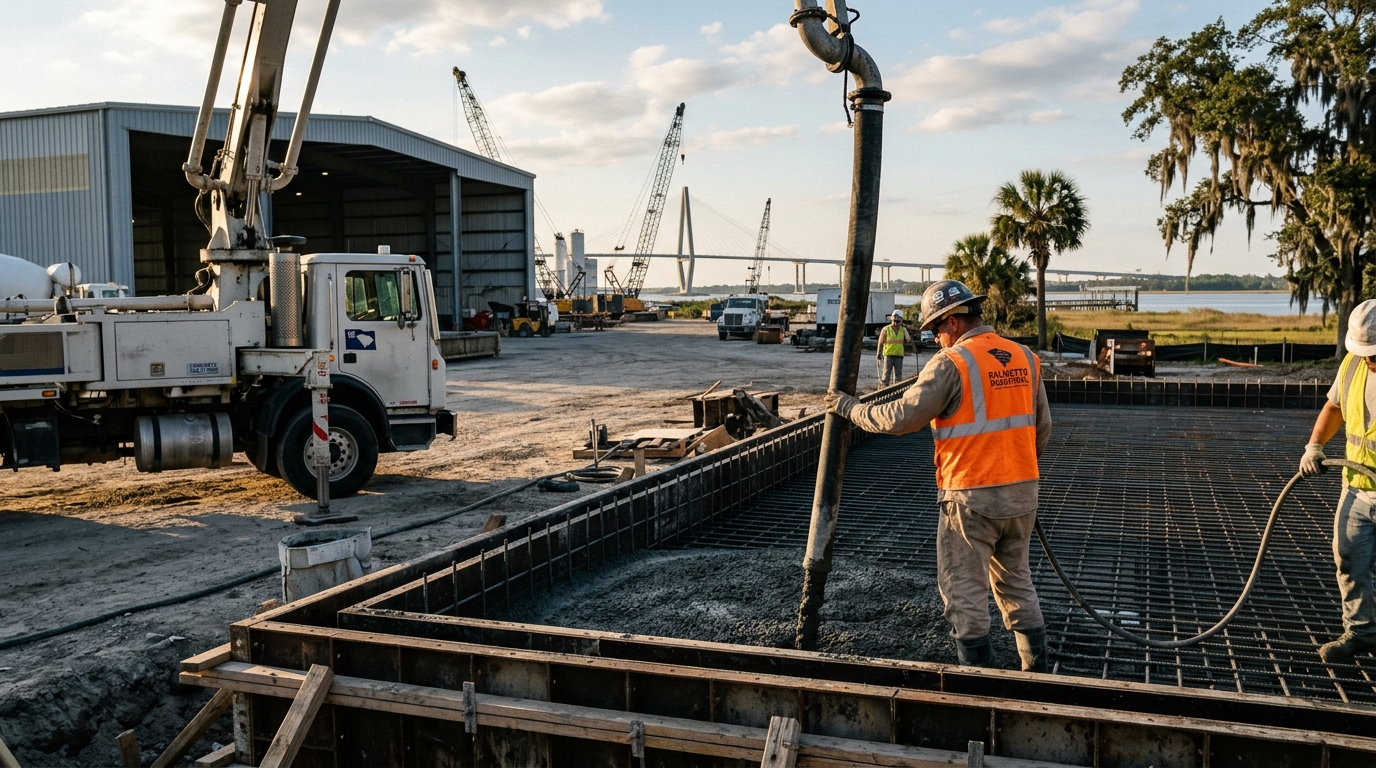
Graphene concrete’s impact on highway and road construction in South Carolina is significant precisely because these high-cycle corridors are where conventional concrete fails fastest. A longer-lasting road surface in these areas means fewer lane closures, less disruption to supply chains, and lower long-term costs for everyone.
4. Drainage and Stormwater Infrastructure
South Carolina gets hit hard by weather — summer downpours, coastal storms, the occasional hurricane swinging through. Industrial facilities generate a lot of impervious surface, and managing stormwater runoff is a constant engineering challenge.
Graphene-reinforced concrete performs better in wet environments. It’s less permeable, which means water infiltration into structural elements is reduced. For drainage channels and retention infrastructure near Boeing or the port, that’s a significant durability advantage.
5. Bridge and Overpass Structures on Corridor Routes
The I-26 corridor connecting Charleston to Spartanburg and Greenville is an economic lifeline for South Carolina’s manufacturing economy. The bridges and overpasses on that route take enormous loads from commercial traffic.
Infrastructure engineers are increasingly interested in graphene concrete for bridge deck applications specifically because of its crack resistance. Bridge deck cracking lets water and road salts into the rebar, which eventually causes spalling and structural degradation. Graphene concrete’s tighter microstructure slows that process substantially.
6. Foundation Work for Facility Expansions
Both Boeing and BMW have expanded repeatedly, and more growth is likely. New building foundations in these facilities need to meet stringent specifications — they’re not just holding up walls, they’re holding up production lines worth hundreds of millions of dollars.
Graphene concrete’s higher strength-to-volume ratio means engineers can potentially achieve required load capacities with thinner pours — which saves material, reduces construction time, and lowers the environmental footprint of new construction.
Honestly, that last part is underappreciated. Using less concrete to achieve the same or better performance is a genuine sustainability win, not just a talking point.
7. Maintenance Reduction in High-Cycle Zones
This one’s maybe the most practical. Every time a section of industrial infrastructure needs repair — a dock surface, a roadway, a floor — it causes disruption. Equipment gets rerouted. Schedules slip. Costs add up.
Graphene concrete’s extended service life compounds over time. A surface that lasts 40% longer isn’t just 40% cheaper to maintain — it also means 40% fewer disruption events. For facilities running around the clock like Boeing’s assembly lines or Charleston’s port operations, that’s meaningful.
A Quick Comparison
| Application | Conventional Concrete | Graphene Concrete |
|---|---|---|
| Manufacturing floors | 7-10 year resurfacing cycle | 12-18+ years |
| Port dock surfaces | Frequent patching needed | Reduced maintenance |
| Road/corridor surfaces | Cracks under high-cycle loads | Improved cycle resistance |
| Bridge decks | Vulnerable to water/salt infiltration | Tighter microstructure |
| Foundation pours | Standard volume required | Potential thickness reduction |
These aren’t guaranteed numbers — a lot depends on mix design, application, climate, and how the surface is used. But the directional improvement is consistent across research and early deployment.
Key Takeaways
- Graphene concrete adds carbon-based nanomaterials to standard concrete mixes, producing a significantly stronger and more durable result
- South Carolina’s BMW, Boeing, and Charleston Port facilities represent some of the most demanding concrete environments in the southeast — exactly where these improvements matter most
- Key applications include heavy-load floors, port surfaces, road infrastructure, drainage systems, bridge decks, and new foundations
- Longer service life translates directly to lower maintenance costs and less operational disruption in high-value industrial settings
- Reduced material usage per pour also has meaningful environmental benefits — less concrete for equivalent performance
- SC’s broader road and highway infrastructure is also seeing graphene concrete enter the conversation, which connects directly to the health of these manufacturing corridors
What This Means If You’re Paying Attention
Look, most homeowners aren’t going to be specifying concrete mixes anytime soon. But there’s a reason this matters beyond just the industrial users.
South Carolina’s manufacturing corridor — BMW, Boeing, the Port of Charleston — is a significant driver of the state’s economy. Jobs. Tax base. Supply chain businesses. When that infrastructure holds up better, when roads near these facilities stay smoother, when the port keeps running efficiently… that ripples out.
It’s also worth knowing this stuff is available. If you’re a contractor or a small business owner in the Upstate or the Lowcountry, and you’re working on a project near one of these corridors — or on anything that takes heavy use — graphene concrete is worth asking your supplier about. It’s not exotic anymore. It’s becoming a real option.
And if you’re curious how it fits into the broader infrastructure picture in South Carolina, the graphene concrete roadways resource at The Graphene Solution is a solid place to start.
The materials that hold our industrial economy together are changing. Quietly, practically, and — if early results are any indication — for the better.