


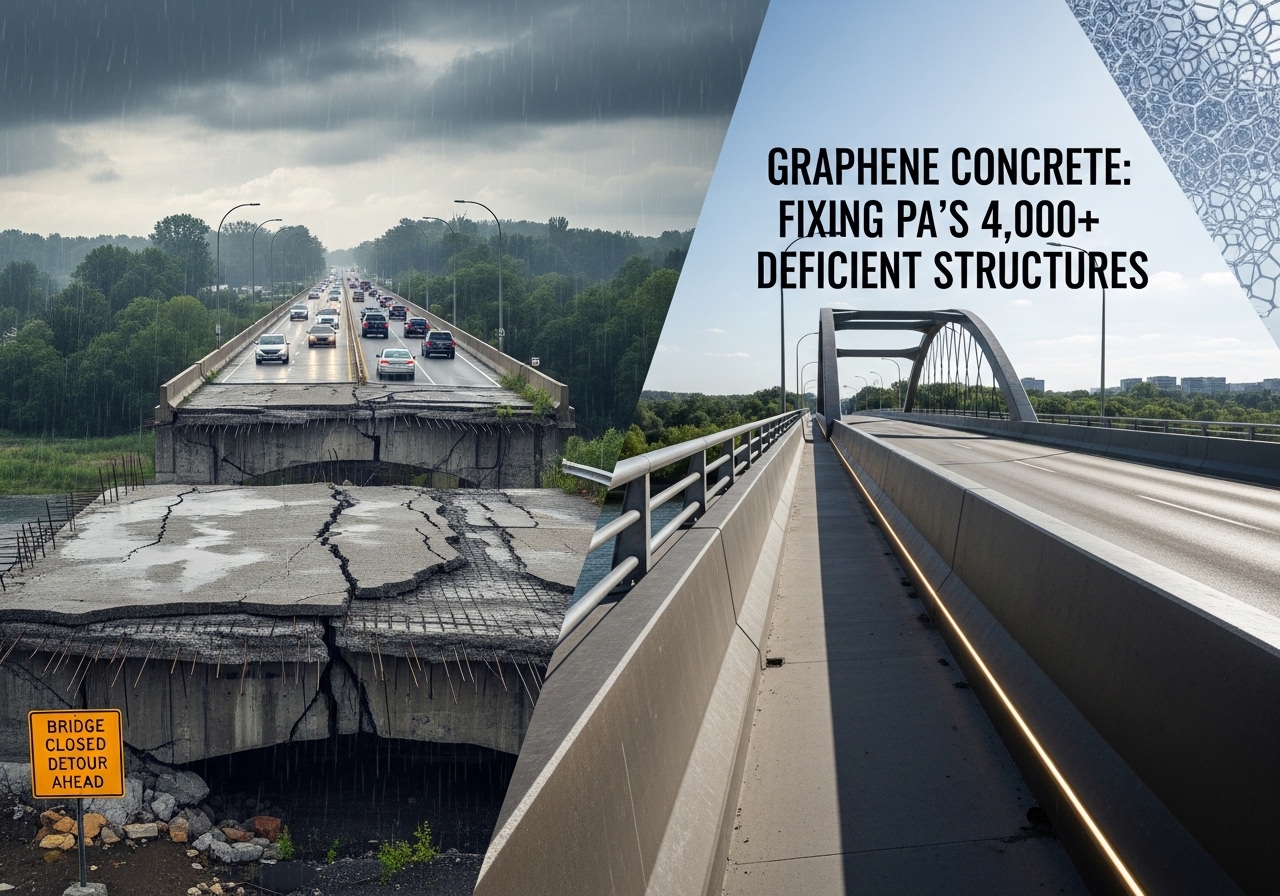
Pennsylvania’s Bridge Crisis — How Graphene Concrete Can Fix 4,000+ Deficient Structures
ennsylvania has a bridge problem — and it is bigger than most people realize. With thousands of structurally deficient bridges scattered across the state, from rural townships to dense urban corridors, the commonwealth faces one of the most pressing infrastructure challenges in the entire United States. Every day, millions of drivers cross bridges that engineers have flagged as deficient, aging, and in urgent need of repair or replacement. The question is no longer whether Pennsylvania needs to act — it is how it acts, and with what materials.
Traditional concrete has served the construction industry for over a century, but it is precisely that century of use that has exposed its limitations. Cracking under freeze-thaw cycles, corroding steel reinforcements, water infiltration, and accelerating deterioration have all shortened the usable lifespan of bridges across the state. Pennsylvania’s climate — with harsh winters, heavy road salt application, and dramatic seasonal temperature swings — makes things considerably worse. What Pennsylvania’s bridges need is not just repair. They need a material revolution. That revolution is already here, and it is called graphene concrete.
The Scale of Pennsylvania’s Bridge Problem
To understand why this matters, the numbers need to be confronted directly. Pennsylvania consistently ranks among the top states in the nation for structurally deficient bridges. According to ongoing federal infrastructure assessments, more than 4,000 bridges across the state have been classified as structurally deficient — meaning they have one or more key structural elements rated in poor condition. This does not mean they are about to collapse, but it does mean they require significant attention, monitoring, and eventual rehabilitation or full replacement.
The state’s bridge inventory is also among the oldest in the country. A large percentage of Pennsylvania’s bridges were built before 1970, using materials and engineering standards that were not designed for today’s traffic loads, environmental stressors, or longevity expectations. Decades of deferred maintenance have compounded the problem, creating a repair backlog that grows more complex and resource-intensive each year.
Beyond the engineering concern is an economic one. Deficient bridges disrupt freight movement, increase transportation costs for businesses, limit emergency response routes, and reduce quality of life for residents in affected communities. Pennsylvania is a critical corridor for interstate commerce along the Northeast, making functional bridge infrastructure not just a local issue but a national one.
Why Traditional Concrete Is Failing Pennsylvania’s Bridges
Standard Portland cement concrete has always had a fundamental vulnerability: porosity. Concrete is not naturally impermeable. Over time, water, chlorides from road salts, and environmental gases penetrate its surface, reaching the reinforcing steel beneath. Once that steel begins to corrode, it expands, creating internal pressure that cracks the concrete from the inside out. In Pennsylvania’s climate, this process is dramatically accelerated.
Freeze-thaw cycles are particularly destructive. Water that seeps into micro-cracks in a bridge deck will expand when it freezes, widening those cracks. When the ice thaws, more water enters. This cycle repeats hundreds of times over a winter season, slowly breaking apart even well-constructed concrete elements. Add decades of heavy traffic loading, overweight vehicles, and inadequate drainage, and it becomes clear why so many bridges have reached the end of their serviceable lives simultaneously.
Repairs made with standard concrete face the same vulnerabilities. Patching a deteriorated bridge deck with traditional materials often delays the inevitable rather than solving the underlying problem. Rehabilitation efforts may need to be repeated every few years, creating a cycle of spending that consumes budget without achieving lasting results.
What Is Graphene Concrete and Why Does It Change Everything?
Graphene is a single layer of carbon atoms arranged in a two-dimensional honeycomb lattice. It is the thinnest material ever discovered, yet it is stronger than steel, highly flexible, and an exceptional conductor of heat and electricity. When graphene is incorporated into cement mixtures at the nanoscale level, it transforms ordinary concrete into a fundamentally superior structural material.
The mechanism is straightforward but profound. Graphene nanoparticles fill the microscopic voids and capillary pores within the cement matrix. This densification dramatically reduces water absorption and chloride penetration — the two primary culprits behind bridge deterioration in Pennsylvania. The result is concrete that is not only far more resistant to environmental attack, but also significantly stronger in both compression and tension.
Research institutions and construction innovators have demonstrated that graphene-enhanced concrete can achieve compressive strength improvements of 30% or more compared to standard mixes, while simultaneously delivering tensile strength gains that reduce the likelihood of cracking under load. For bridge applications — where bending forces, dynamic traffic loads, and lateral stresses are constant — this dual improvement in strength is not incremental. It is transformative.
If you want to understand how this technology applies specifically to Pennsylvania’s construction landscape, the detailed resource on graphene construction and concrete materials in Pennsylvania provides an excellent overview of current capabilities, applications, and the state-specific infrastructure challenges that graphene concrete is positioned to address.
Graphene Concrete and Bridge Infrastructure: A Perfect Fit
Bridge construction and rehabilitation represent one of the highest-value applications for graphene concrete technology. The demands placed on bridge materials are extreme — constant dynamic loading, exposure to weather and chemicals, the need for decades of service life without major intervention, and zero tolerance for structural failure. These are exactly the conditions where graphene concrete’s advantages shine most clearly.
The dedicated resource on graphene concrete for bridge and overpass infrastructure explains in detail how graphene-enhanced mixes are engineered specifically for these demanding applications. Bridge decks reinforced with graphene concrete demonstrate dramatically reduced cracking, better load distribution, and superior bonding between the concrete matrix and reinforcing steel. This means longer intervals between inspections, less frequent rehabilitation, and structures that maintain structural integrity well beyond the lifespan expectations of conventional concrete bridges.
For Pennsylvania, where rehabilitating over 4,000 deficient bridges represents a generational infrastructure challenge, the ability to build or repair once and expect dramatically extended service life is not just a technical advantage — it is a financial and logistical necessity.
Addressing the Freeze-Thaw Problem with Graphene
Pennsylvania’s winters are among the most punishing on bridge infrastructure in the eastern United States. Heavy road salt application — while necessary for public safety — introduces aggressive chloride ions that attack steel reinforcement and accelerate concrete degradation. The combination of salt, water, and freeze-thaw cycling is the primary enemy of long-lasting bridge infrastructure in the commonwealth.
Graphene concrete addresses this threat directly at the material level. By dramatically reducing the porosity of the cement matrix, graphene-enhanced mixes create a physical barrier against water and chloride ingress. Salt-laden water that would penetrate standard concrete within months is effectively blocked from reaching the reinforcing steel. Without that pathway, the corrosion process that destroys so many Pennsylvania bridges is stopped before it starts.
Field applications and laboratory testing have shown that graphene concrete exhibits water absorption rates that are a fraction of those recorded for conventional mixes. For a state that applies millions of tons of road salt annually, and where freeze-thaw cycles can occur hundreds of times in a single winter, this resistance is not a luxury — it is a prerequisite for durable bridge construction.
Beyond Bridges: Pennsylvania’s Broader Infrastructure Application
While bridges represent the most urgent application of graphene concrete technology in Pennsylvania, the material’s benefits extend to the full spectrum of infrastructure that supports the state’s economy and daily life.
Pennsylvania’s highway and road network faces many of the same challenges as its bridges — aging materials, freeze-thaw damage, heavy freight loads, and an accelerating backlog of needed repairs. The graphene concrete roadway and highway construction page details how graphene-enhanced mixes are being applied to road surfaces and substructures to deliver pavement that lasts longer, requires less maintenance, and performs better under demanding conditions. For a state with tens of thousands of lane miles to maintain, the long-term benefits of reduced repair frequency are enormous.
Similarly, Pennsylvania’s network of dams, water infrastructure, and marine structures can benefit from graphene concrete’s superior impermeability and durability. The detailed resource on graphene concrete for dam and reservoir construction demonstrates how the same material properties that make graphene concrete ideal for bridges — reduced porosity, higher strength, superior resistance to water and chemical attack — translate directly into longer-lasting, safer water infrastructure.
The Environmental Argument for Graphene Concrete in Pennsylvania
Infrastructure sustainability is increasingly central to how states plan and fund public works. Pennsylvania has made commitments to reduce emissions and build a more sustainable economy, and the materials used in construction play a significant role in achieving those goals.
Traditional concrete production is one of the world’s largest sources of industrial carbon emissions. The cement manufacturing process is energy-intensive and generates substantial CO₂. Graphene concrete offers a path toward reducing this environmental burden in two distinct ways.
First, because graphene significantly strengthens concrete, less cement is needed per unit volume to achieve target performance specifications. Reducing cement content in a mix directly reduces the carbon footprint of production. Second, because graphene concrete lasts longer and requires fewer repairs and replacements, the cumulative environmental impact of construction activity over a bridge’s lifetime is substantially reduced. Building once with a durable material beats building twice with a fragile one — for the budget and for the environment.
For Pennsylvania engineers, planners, and policymakers evaluating long-term infrastructure strategies, the environmental case for graphene concrete complements the structural and economic arguments to create a compelling overall rationale for adoption.
What Adoption Looks Like in Practice
One of the most important aspects of graphene concrete from a practical standpoint is that it does not require entirely new construction workflows or equipment. Graphene additives are incorporated into standard cement mixing processes at dosages carefully calibrated to the specific project requirements. Existing concrete plants, mixing trucks, and placement equipment can be used without modification, meaning the transition to graphene-enhanced mixes does not require major capital investment or extensive retraining.
This matters enormously in a state like Pennsylvania, where thousands of construction contractors, engineers, and infrastructure workers are already operating within established workflows. The ability to integrate a transformative material improvement without disrupting existing processes means that graphene concrete can be scaled quickly across Pennsylvania’s bridge rehabilitation program as adoption increases.
For contractors and project managers looking to understand more about how graphene concrete is currently being applied in real-world infrastructure projects, the recent projects section offers insight into completed applications and demonstrated outcomes. Seeing graphene concrete perform in real conditions — not just in laboratory tests — is an important part of building confidence in the technology at the project level.
The Path Forward for Pennsylvania
The bridge crisis in Pennsylvania did not develop overnight, and it will not be solved overnight. But the availability of graphene concrete as a proven, scalable, and superior construction material means that the path forward is clearer than it has ever been. Every deficient bridge that is rehabilitated or replaced using graphene-enhanced concrete is a structure that will not require the same intervention again for decades — potentially within the working lifetime of the engineers who build it today.
Pennsylvania has the opportunity to transform its infrastructure deficit into an infrastructure model. By embracing advanced materials that match the scale of the challenge, the commonwealth can address its most urgent structural needs while building a bridge network that will serve future generations reliably and safely.
The technology is ready. The need is undeniable. The question now is how quickly Pennsylvania’s engineers, contractors, and decision-makers are prepared to move from awareness to action — and how soon graphene concrete will become the standard rather than the exception in Pennsylvania’s bridge and infrastructure projects.
For those ready to explore the specifics of graphene concrete applications across Pennsylvania’s construction sector, a comprehensive starting point is available at the graphene concrete and construction materials Pennsylvania page, where the full scope of available solutions, services, and applications is outlined in detail.
Pennsylvania’s bridges have waited long enough. The materials to fix them — and to fix them properly, lastingly, and sustainably — are here.